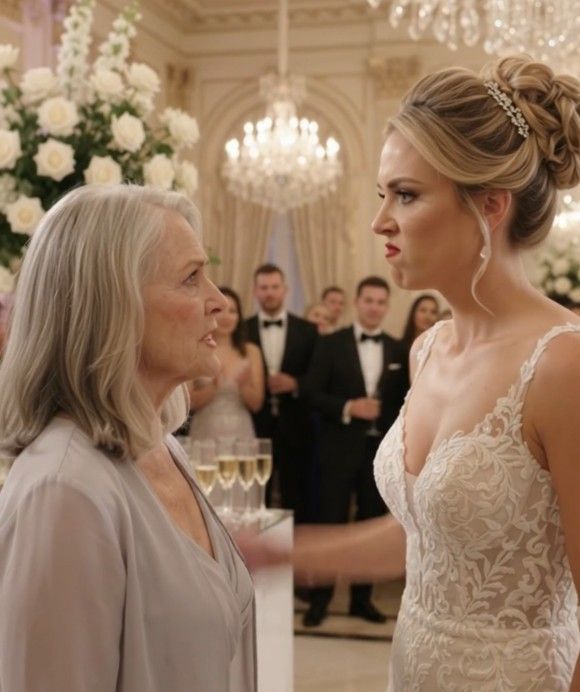
“I’ve given enough, Tiffany. My answer is no.”
Before I could move, her hand struck my cheek. A nearby guest dropped a champagne glass, and the sharp crash echoed through the sudden silence. The musicians stopped playing, and every face turned toward us.
I looked at my son, desperately hoping he would finally defend me. He merely whispered Tiffany’s name without taking a single step forward. He didn’t demand an apology or even ask whether I was hurt.
Then Tiffany pointed toward the exit.
“You need to leave. You’re destroying the atmosphere.”
I collected my purse and walked into the restroom, where I locked the door and stared at the bright red handprint across my face. My hands trembled as I reached for my phone, but my mind had never been clearer.
The ballroom, catering, bar, musicians, transportation, honeymoon suite, and farewell brunch were all contracted under my name. I called the venue manager and gave him one instruction.
“Activate the cancellation clause. Stop every remaining service charged to my account.”
“Mrs. Bennett, are you absolutely certain?”
I thought about my husband’s land, my empty savings, and the son who had watched his bride humiliate me.
“Yes. I’m certain.”
Less than ten minutes later, the bartenders stopped serving drinks, the musicians began packing their instruments, and the transportation arrangements were canceled. Confusion spread through the ballroom as guests looked around, wondering what was happening.
Then the venue manager gathered the contracts and walked straight toward Tiffany. She saw the folder in his hands, and her confident smile vanished as he stopped directly in front of her.
He opened the first page, leaned closer, and began explaining what had just happened.
The manager’s finger rested beside my signature on the contract. Tiffany tried to speak over him, but he kept his voice steady. “The services being provided under Mrs. Bennett’s account have been terminated according to the provisions she signed. We have stopped additional charges. Anything already supplied and any applicable cancellation fees will be accounted for in writing.”
For one stunned second, nobody moved. Then Tiffany reached for the folder as though she could tear away the page and make the evening resume. The manager drew it back politely. “This is a copy for the parties. The originals remain with our office.” Her father looked from the folder to the silent bar. He had insisted on the expensive champagne but now seemed determined to become invisible.
“You can’t cancel my wedding,” Tiffany snapped. “The ceremony is finished,” the manager answered. “I am speaking about the reception services Mrs. Bennett arranged and paid for. You may discuss separate arrangements with the providers, subject to their availability and terms.” His refusal to turn the matter into a personal fight seemed to make her even angrier.
My son, Daniel, finally came forward. In the restroom I had been staring at my reflection when I heard the ballroom erupt again. Now I stood in the open doorway with my purse in my hand and watched my son look at the person who had just struck me. He began with the words I had feared. “Mom, can’t we fix this?”
My cheek still burned. “You saw her hit me,” I said. He flinched but didn’t deny it. Tiffany pushed past him. “Your mother is ruining everything because she couldn’t stand to buy one bottle.” I looked past her at the chandeliers, at the tables dressed in flowers, at the guests turning their chairs so they could pretend they weren’t watching.
“One bottle was not the problem,” I said. “It’s what happened when I said no.” Daniel lowered his head. I wanted to shake him, to demand that he remember the years I had worked and loved and worried for him. Instead I stepped toward the manager. “Please send the accounting to my attorney and to me. I won’t authorize anything else tonight.”
Tiffany’s mother began pleading with the caterer to keep serving dinner. Her father asked the bandleader for a number. The bandleader explained that his arrangement was through the event company and he could not simply ignore the cancellation. Several guests had already eaten. Others had not. That inconvenience was real, and I felt its weight without accepting responsibility for the violence that had caused it.
I asked the manager to let guests collect their belongings calmly and to help anyone who needed information about transportation. I would not pay for another luxury convoy, but I did not want elderly relatives stranded at a remote estate. He assured me that venue staff could help guests contact local services and that no one would be forced to leave unsafely.
Near the coatroom, my cousin Helen caught my arm. “Margaret, are you hurt?” It was such a simple question that I almost cried. She looked closely at the handprint on my cheek. “You need a photograph of that,” she said. I took one, embarrassed by the act, then another under better light. I didn’t know what I would decide to do with it. I only knew I should not let the evidence vanish with the redness.
Outside, the night air smelled of wet roses and gravel. My oldest friend, Nora, brought me a shawl and sat with me on a stone bench. “You can be furious and still be heartbroken,” she said. A minute later Daniel came through the doors, scanning the driveway. For a hopeful instant I thought he might finally ask whether I was all right.
“Tiffany says you need to talk to the manager and restart the music,” he said. Hope left me so quickly I felt dizzy. “Daniel, what did you say when she slapped me?” He pressed his hands over his face. “I said her name.” “And what did you say to me?” He did not answer. “Nothing,” I told him. “You said nothing.”
He sat at the opposite end of the bench. “She’s been under pressure.” I turned toward him. “Pressure doesn’t make someone strike a person. It doesn’t excuse telling a guest to leave a wedding, and it certainly doesn’t excuse telling the woman who paid for it to leave.” He stared at the stones between his shoes. “I know,” he whispered, but I could hear that knowing hadn’t yet changed anything.
Tiffany emerged in her dress with its long train lifted above the gravel. “We’re not doing this outside,” she ordered. “We need a family meeting inside.” She was still assigning everyone their places. I stood slowly. “I am going home.” Her eyes narrowed. “You owe me an apology.” I looked at her hand, no longer raised. “I owe myself the right to walk away.”
Nora drove me home. At every stoplight I thought of the land I’d sold to pay for the celebration. My husband had loved that strip of meadow, the one where he taught Daniel to ride a bicycle and planted two apple trees. I had signed the sale papers telling myself I was investing in a happy marriage. Now I could not remember one moment when anyone had asked whether it made me sad to give the land up.
The next morning there were twenty-seven messages. A few guests wanted to know what had happened. Several asked whether I was safe. Tiffany demanded repayment for her ruined evening, though she couldn’t say what money she believed I’d taken. Daniel wrote only, “Please call.” I put the phone away long enough to make breakfast and drink coffee at my own table.
My attorney, Evelyn Price, met me that afternoon. She reviewed every receipt and cancellation term, careful not to promise that I could recover what I had already spent. The florist had delivered; the venue had hosted the ceremony; meals had been prepared. Those costs were real. Some unused portions might be credited, others were nonrefundable, and fees might still apply. The truth was painful, but it was better than another fantasy about how money could be made to fix my family.
