Jack’s hand did not move at first.
It stayed suspended halfway to the pocket of his blazer, fingers splayed, as if he could snatch the numbers I had just spoken out of the air and push them back into the phone.
The kitchen clock ticked once. Twice.
Amanda’s breath caught. I could see it in the tight lift of her shoulders under her sweater, the way she held herself completely still while staring at her father.
“Say it again,” Jack said, his voice suddenly hoarse.
I did. Slowly. The account name. The four digits. “Eight-four-one-nine.”
His throat worked. He didn’t look at me. He looked at Amanda, and for the first time since he walked in, the practiced charm was gone. His eyes darted to the broken card still lying on my echocardiogram, to the shattered glass in the hallway, to the phone in my hand.
“Marjorie, hang up,” he whispered.
I didn’t.
On the other end, the billing coordinator from St. Matthew’s was still speaking, cheerful and oblivious. “Mrs. Wilson? Are you there? The payment cleared this morning at 7:12 a.m. You are fully cleared for Tuesday. We just needed to confirm.”
“Who authorized it?” I asked, my eyes never leaving Jack.
A soft shuffle of papers on the line. “It was an electronic transfer from Wilson Family Holdings LLC. There was a note attached. It just says ‘For Marjorie. No more debt.'”
Amanda made a small sound. Jack flinched as if she’d struck him.
I thanked the woman and ended the call. The silence that came after was heavier than any argument we had ever had in that kitchen.
Amanda took a step toward her father. Her designer handbag slipped down her arm and thumped against her hip. She didn’t fix it.
“You told me you went bankrupt in 2008,” she said. Each word was precise, carefully placed. “You told me Mom kept the house because you let her. You told me you couldn’t help with tuition because you were rebuilding.”
Jack’s mouth opened. Closed. His silver watch caught the morning light coming through the window over the sink.
“I was rebuilding,” he said.
“With what?” Amanda’s voice cracked. “With what money, Dad? Because Mom just showed me twenty-four years of bank statements on my phone. Twenty-four years where every single deposit that you took credit for came from her.”
Jack finally looked at me. Really looked at me, and I saw the twenty-four years reflected back. The way I’d let him walk into birthdays with big wrapped boxes that I had already paid for. The way I’d let Amanda believe the Christmas trips to see him in his rented downtown loft were funded by his hustle, while I stayed home and transferred his rent the night before.
“Marjorie, you weren’t supposed to look at that account,” he said quietly.
“Why?” I asked. My hand was shaking around the phone, so I set it down. Carefully. “Because you told the court you had nothing? Because you told Amanda I was bitter and keeping you from her?”
He took a half step back until his shoulders hit the refrigerator. The expensive cologne suddenly smelled sour.
Amanda laughed once, sharp and without humor. “Oh my God. Wilson Family Holdings. That’s the name on the building where you have your office. The little glass one you showed me last year. You said you were leasing a desk there.”
“I am leasing,” Jack said quickly. Too quickly.
“No, you’re not,” Amanda said. She pulled out her phone with a jerk. Her fingers were trembling so badly she had to type with both hands. “I drove past it last month. There was a sign in the lobby. ‘Wilson Family Holdings — Private Equity.’ Dad, what is that?”
Jack closed his eyes.
That was the moment I understood he wasn’t going to answer until someone forced him. And Amanda, my girl who had snapped a card in half over a deductible, was suddenly the only person in the room willing to do the forcing.
She turned the phone screen toward him. “Is this you?”
On the screen was a business registry page. I could see it from where I stood. Registered Agent: Jack Wilson. Status: Active since 2009. Assets Under Management.
Jack’s breathing got shallow. “Amanda, put that away.”
“How much?” she demanded. Her voice rose, echoing off the kitchen tile. “How much is in there?”
“Enough,” he said.
“Enough to pay Mom’s surgery without blinking? Enough to buy me a car you pretended you couldn’t afford?”
He didn’t answer, and that was the answer.
I felt my knees go soft. I reached for the edge of the table to steady myself. The echocardiogram paper crinkled under my palm where the broken card still lay.
“Jack,” I said, and my voice was barely a sound. “The divorce papers said you had forty-seven thousand dollars in debt. The judge reduced your child support because of it. I worked double shifts at the clinic for three years to cover what you didn’t pay. Tell me that wasn’t a lie.”
His eyes opened. They were wet now, not with tears but with a sudden, naked panic.
“It wasn’t a lie at the time,” he said. “In 2002, I really did lose everything. The construction supply deal fell through. I was underwater.”
“And then?” Amanda pressed.
“And then in 2009, I got a settlement. From the lawsuit against Braddock Materials. They’d used my designs. My attorney didn’t think we’d win. We did. Seven hundred thousand. After fees, about four hundred and ten.”
The number hung in the air like smoke.
Four hundred and ten thousand dollars. While I had been choosing between Amanda’s dance lessons and fixing the furnace. While I had been telling Amanda that Dad was doing his best.
He kept talking, faster now, as if speed would make it less damning. “I put it into the Holdings account. I thought — I thought if I told you, you’d make me split it. The divorce was finalized. Legally it was mine. And I thought if I told Amanda, she’d expect—”
“You thought if you told me, Mom would make you be a father,” Amanda finished for him. Her face had gone completely white. “So instead you let her be both parents while you pretended to be the fun one with my money? Her money?”
“No,” Jack said, stepping forward, hands up. “Not her money. My settlement money. I never touched Marjorie’s transfers. I kept it separate.”
“You let me humiliate her yesterday,” Amanda whispered. “You let me stand in this kitchen and tell her to learn to live without my money. And you knew. You knew she paid for my apartment. My car. You knew she was four days from having her chest cut open and couldn’t afford the copay, and you had four hundred thousand dollars sitting in an account called Family Holdings.”
Jack looked at me then, truly pleading. “Marjorie, I paid the surgery. I took care of it. Doesn’t that count for something?”
That was the question that finally broke the stillness inside me.
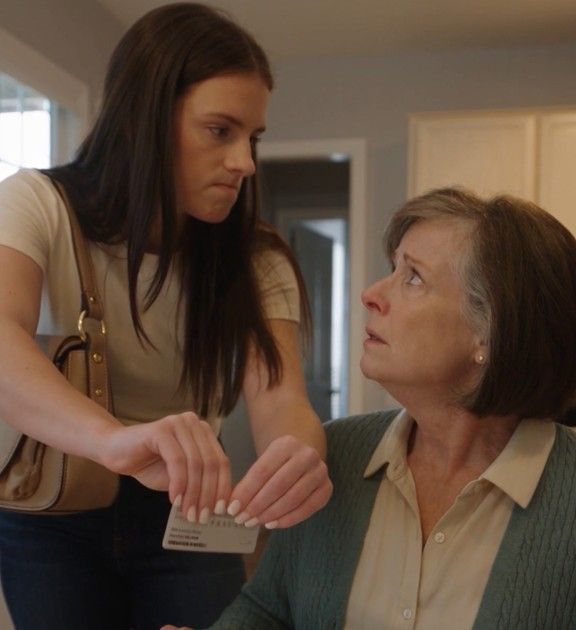
I picked up the two halves of the broken card from my echocardiogram. I held them out to him. The plastic was warm from my hand.
