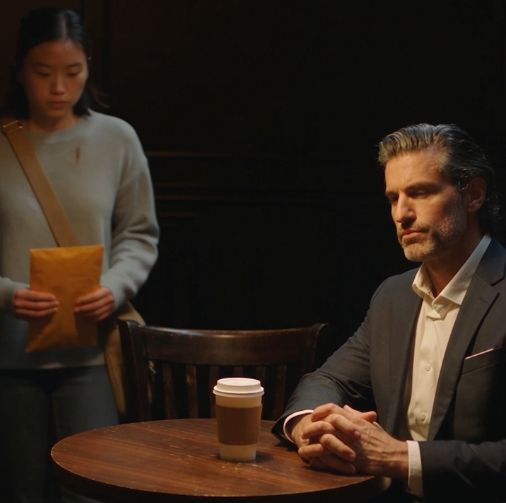
“You have nothing to be sorry for,” Nikolai said. He sat down heavily, as if his legs had given out. He ran a hand through his hair, and for the first time he looked his age, and tired. “He did this because I let him. I knew he was stealing. I kept hoping he would stop on his own so I wouldn’t have to destroy my mother’s brother.”
Lena’s eyes stung. She looked at the receipt again, at the apprenticeship letter, at the scrap of her own note.
“You kept the scratch,” she said suddenly. “You didn’t fix it? You said it was paid.”
“It is paid,” Nikolai said. “But I told Becker’s to leave the scratch. I haven’t decided what to do with it yet.”
“Why would you leave it?”
He gave a small, exhausted laugh that was almost a sigh.
“Because it brought you here,” he said. “And because my mother always said a flaw that is honestly acknowledged is more beautiful than a lie that looks perfect.”
Lena pressed her palms to her eyes. Her shoulders shook once, hard, and then she was crying, not pretty crying, but the awful, hiccuping, relieved sobbing of someone who had been holding her breath for twenty-four hours and for years before that. For rent and for her grandmother forgetting her name and for being afraid to want anything.
Nikolai didn’t move to touch her right away. He just pushed the box of napkins from the edge of the table toward her and waited.
“I’m here,” he said quietly. “Take your time.”
When her breathing slowed, she wiped her face and looked at him. Her eyes were red, her sweater sleeve damp.
“My grandmother,” she said, her voice hoarse. “You said you were looking for her. Is she — does she know? That you remember her?”
“I went to see her last week,” Nikolai said. “Before I called you. I didn’t tell you because I didn’t want you to think I was using her to get to you. I sat with her for an hour. She didn’t remember me at first. Then I showed her a photo of my mother, and she touched it and said, ‘Oh, the lady who loved yellow flowers.’ She remembered the flowers. She asked me if I was still that sad boy who sat by the window.”
Lena made a small sound, her hand over her mouth.
“She told me you were her pride,” Nikolai continued. “She said you restore things. That you can make broken things look whole again without lying about where they were broken. I told her you had left a note on a scratched car. She smiled and said, ‘Of course she did. I taught her that.'”
Lena’s tears spilled over again, but softer now.
“I thought I was going to have to tell her I failed,” Lena whispered. “That I couldn’t pay. That I messed up.”
“You didn’t fail,” Nikolai said. “You did exactly what she taught you to do. And because you did, a man who was stealing from his own family is finally going to be stopped. Do you understand? Your honesty did that. Not me.”
The barista, Arno himself, a man in his sixties with flour on his apron, came over with two fresh cups. He set a chamomile tea in front of Lena without being asked, and a glass of water in front of Nikolai. He didn’t say anything. He just rested a heavy hand briefly on Lena’s shoulder and squeezed, the way he did when she closed the shop and her feet hurt.
Lena wrapped her hands around the warm mug.
“What happens now?” she asked.
“Now,” Nikolai said, “you decide. The apprenticeship is real. The board approved it this morning before Anton knew. Dr. Mirza recommended you. You don’t have to accept it because you feel grateful or guilty. You can say no and walk out of here with the receipt and never see me again and you will still owe nothing. Or you can say yes and come to the lab tomorrow and see the collection. No payment plan. No debt.”
Lena looked down at the yellow envelope. She thought about her tiny kitchen, the list on the floor, the rice and noodles, the cheap brushes she had been ready to sell. She thought about her grandmother’s hands, spotted and thin, folding paper cranes while she hummed.
She slid the envelope, the receipt, and the apprenticeship letter into a neat stack.
“I want to see the collection,” she said, her voice steadier now. “But only if I start by restoring the scratch on your car. Properly. And you pay me the student rate. Ninety dollars. So we are even.”
Nikolai stared at her, then laughed, a real laugh this time that crinkled his eyes.
“Deal,” he said. “Ninety dollars. I’ll have Becker’s send you the invoice.”
She almost smiled. Then her face turned serious.
“And I want to bring my grandmother to the lab sometime. If she’s having a good day. She should see where I work.”
“She will have a key,” Nikolai said immediately. “If she wants.”
