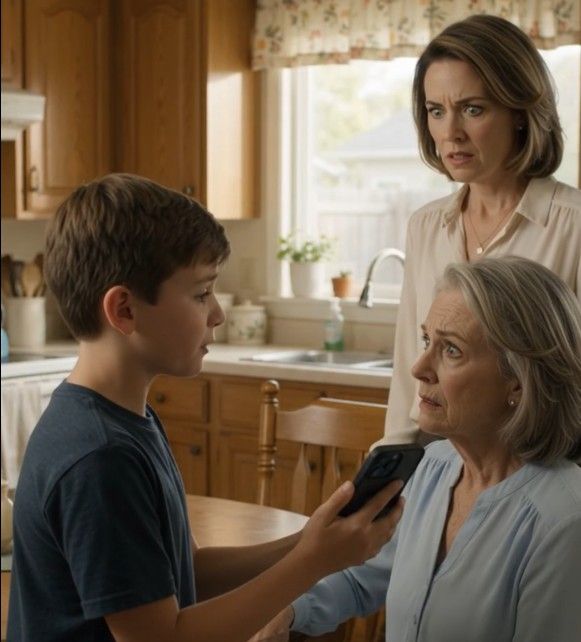
I felt my stomach turn. “So I was supposed to fall on cue,” I said. Paul insisted he hadn’t known about the wig rehearsal or the forged signature. But he admitted he’d helped choose camera angles and suggested that the step near the garden would make a good location for a tense scene. He had allowed Cara to tell potential partners that I was considering a move, although he knew I wasn’t. “You helped build a story you wanted to sell,” I said. “And it was easier to believe your wife than ask me what was true.”
He nodded, tears falling onto the folder. I remembered taking him to school on mornings when he was afraid of a difficult test, telling him that the right answer was still worth writing even if it was not the easy one. Now he was a father who had taught his own child to keep secrets for the camera. “I don’t know how to fix this,” he whispered. “Start by not making him responsible,” I said. “Then give the investigators everything. Don’t ask me to lie because you’re ashamed.”
Cara came to the house that afternoon, driving so fast that gravel scattered against the garden border. She had heard the partnership was canceled. She strode to my door carrying a printed statement and told me that if I signed it, we could call the matter a misunderstanding. The statement claimed that I had approved reenactments as part of a collaborative family series. I refused to let her inside. Sylvia stood beside me, not speaking. My wrist was in a splint, and for once I made no effort to hide it from Cara’s gaze.
“You’re destroying my career,” Cara said. “You humiliated me in front of a producer.” I asked whether the woman in the wig had been paid to pretend she was me. Cara scoffed. “Of course. Actors get paid.” “And did you pay her to imitate someone who’d agreed to be filmed?” I asked. Cara stared at me, realizing the question could not be answered without admitting the central deception. She tried another approach. “If you cared about your grandson’s future, you would stop.”
Sylvia took one step forward. “His future won’t be improved by teaching him that a forged signature is family loyalty,” she said. Cara turned toward her with a look of contempt. Paul, who had arrived separately to bring our son for his scheduled visit, heard the exchange from the driveway. “Cara,” he said, “don’t ask Mom to sign anything else.” She pointed at him. “You were part of this.” “I know,” he answered. “That’s why I’m telling the truth about my part.”
The argument ended when Cara left, but the damage did not. My grandson stood just inside Paul’s car, pale and silent. I asked whether he had heard. He nodded. I wanted to give him a simple explanation that would erase the fear in his eyes. Instead I told him that adults sometimes do harmful things when they are afraid to lose control, and that none of it was his job to repair. He looked at my splint and said, “I should have stopped filming sooner.” I shook my head. “You should never have been made to choose between obeying a parent and protecting your grandma.”
With support from a family counselor, we began helping him understand what had happened without requiring him to relive the footage. The production company refused to use any of the material. The attempted release and related agreements became part of an investigation into the false representations and proposed financial transactions. The performer who had played me provided a statement confirming she’d been told the scene was a dramatization for which permission had already been secured. She was horrified to learn that real footage and staging had been mixed without disclosure.
Cara’s version of the story changed repeatedly. First she claimed I had consented verbally. Then she said Paul had authorized the project on my behalf. When investigators compared message histories, payment records, and the dated signature with evidence of where I had actually been, the claims unraveled. The false release had been submitted to obtain commercial commitments. Cara ultimately faced and was convicted on fraud and forgery-related charges. The court ordered restitution and other penalties, and the contracts built on her false claims were terminated. No production company or sponsor owed her a career after what she’d done.
Paul faced consequences of his own. He had misled partners about my intentions and placed his child in the filming project without considering the harm. He cooperated with the investigation, accepted responsibility in the proceedings related to his role, and separated from Cara. Arrangements for their son were made through the proper family process, with attention to his safety and well-being rather than to what either parent wanted an audience to believe. I did not celebrate their separation. I simply stopped pretending that a family could remain healthy while everyone was ordered to support one person’s fiction.
The quiet that followed was not immediately peaceful. There were appointments, paperwork, and awkward visits during which Paul looked around my kitchen as if unsure where to place his hands. My grandson sometimes flinched when a telephone camera appeared at a birthday party. We learned to ask before taking photographs. We learned that “no” could be said without an explanation. I started putting my own phone away when he visited, so he could see that being together mattered more than recording it.
My wrist healed gradually. The first time I held a watering can again, I was startled by how heavy it felt. Sylvia stood beside me while I watered the rosemary. I said I was afraid the garden would always remind me of the fall. She handed me a packet of sunflower seeds and said we could give it some new memories. We planted them along the fence, bending slowly, making mistakes about how far apart the seeds should go. Nobody filmed us. At the end, we sat in the shade drinking lemonade and arguing cheerfully about whether the squirrels would dig them up.
Paul came over one Saturday to install the handrail I’d ordered before my birthday. He asked permission before opening the box. I watched from the patio chair while he measured the step. When he realized the instructions required another drill bit, he started to improvise. I stopped him. “Read the directions,” I said. He gave me a rueful smile and went to the hardware store. It was a small moment, but I saw him make a choice not to rush past something important simply because he wanted the task finished.
When the rail was secure, he held it and tested his weight against it. My grandson watched closely. “Grandma bought it because she wanted to be safer,” Paul told him. “That never meant she couldn’t take care of herself.” The boy touched the smooth metal. “Mom said it was a sign,” he whispered. Paul swallowed. “She was wrong. And I was wrong not to say so.” I felt no sudden cure for the wound between us. But I recognized the beginning of a father teaching his son the opposite of the lesson they’d been living.
Naomi visited once more after the investigation concluded. She brought no crew and no equipment, only a small pot of lavender for the garden. She apologized that her involvement had given the project an appearance of legitimacy before she understood what was happening. I thanked her for asking whether I needed medical help when other people wanted footage. She said she’d changed her company’s procedures so every participant would be contacted independently before work began. “You shouldn’t have had to prove you were the person who owned your own story,” she told me.
One afternoon my grandson arrived carrying an old memory card in a plastic case. He said he’d found it in the camera his grandfather had given him years earlier. I didn’t know what he wanted me to see. He asked if we could play one clip together on the computer. My first impulse was to refuse; screens had become objects of dread. Then he told me the footage had nothing to do with his mother or the documentary. “I made it before anyone told me I had to get views,” he said.
The video showed my garden two summers earlier. I was kneeling beside a tomato plant, trying to tie it to a stake while the boy’s voice asked why I always grew too many tomatoes. On the screen I laughed and said, “Because I like having enough to give away.” The camera swung wildly toward the sky, then back to my face. He asked why I didn’t sell them. I said the fun was watching people leave with something they hadn’t expected, not counting what they owed me. The clip ended with him laughing when a tomato rolled across the path.
I sat without speaking. So many people had tried to make my generosity evidence that I was foolish, my caution evidence that I was declining, and my fall evidence that my independence was over. In this tiny imperfect video, none of those arguments existed. There was simply a grandmother growing vegetables and a child asking questions. I turned to my grandson. “Why did you keep this?” I asked. He shrugged. “I liked how you answered me. You always sounded like you meant it.”
He had recorded other moments too: Sylvia and me dancing to an old song while we hung washing; Paul showing him how to toss a ball; the boy himself proudly reading a book aloud on my sofa. These were the family scenes Cara had claimed audiences wanted, except they had been made without pressure, and no one had been instructed to look vulnerable or heroic. My grandson asked whether the footage could stay private. “Of course,” I said. “It’s yours to choose what you share.” His shoulders relaxed as if a weight had finally fallen away.
On my seventy-first birthday, we held a small barbecue in the garden. There was no tripod. Sylvia brought a pie, Naomi sent a handwritten card, and Paul arrived early to check the chairs and help carry lemonade outside. My grandson was in charge of choosing a board game. The sunflowers along the fence had grown taller than either of us expected. From the patio, the new handrail caught a soft line of afternoon light.
After dinner my grandson asked whether he could take one photograph. He looked at me first and waited. I smiled. “Yes, one.” He took it with everyone standing together, then put the phone away. The photograph was imperfect. Someone blinked, the sun was too bright, and my hair was blowing across my cheek. It was the most beautiful family picture I’d seen in years because no one had pretended to be anyone else.
As the evening cooled, Paul cleared the plates while Sylvia and my grandson argued about the rules of the game. I sat near the garden step, my wrist strong again, listening to their voices carry through the open door. A year earlier, Cara had wanted the world to watch me fall. Now the people I loved were helping me live without watching me as though I might fail. I rested my hand on the rail I’d chosen for myself, looked toward the sunflowers, and thought of the little video where I’d said the pleasure of growing something was having enough to give away. The day felt like that: simple, freely offered, and entirely my own.
