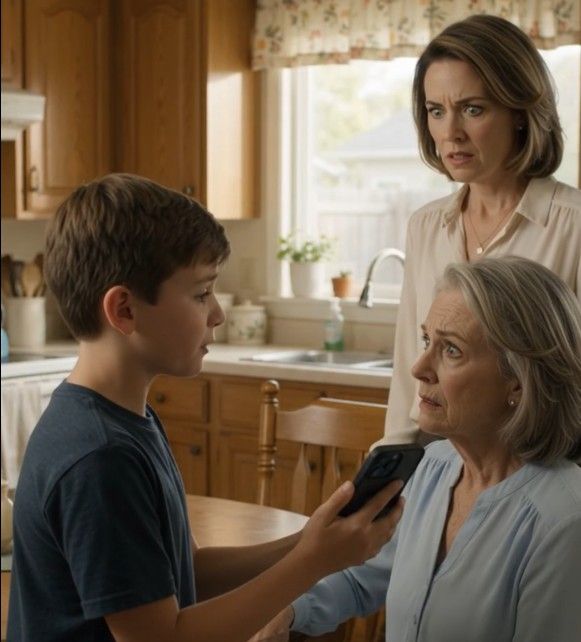
I told him that care required asking the person who needed it.
He sat down heavily.
For the first time, he seemed to understand how much of the project had been kept from me.
My grandson crept into the room and set his phone face down.
He apologized for filming.
Then he whispered, “Mom told me not to show you the first video.”
I asked what was in it.
He said Cara had recorded a pretend fall in my yard the day before, using a coat and wig to make another woman look like me.
The clip was already in a presentation she had sent to the producer.
Naomi’s face changed.
She took out her notebook and asked to see the files.
Cara lunged for the phone, but my grandson stepped behind me.
On the screen was a promotional title card: WHEN MOM CAN’T LIVE ALONE.
Beneath it was a release document indicating I had approved filming for a series.
The signature was dated two days earlier, when I had been out of town.
I put a finger on the date beside my supposed signature. Two days earlier, I had been sitting on a train three counties away, visiting an old friend. The ink on the screen was black and neat. Mine was usually blue, and I never wrote my first initial that way. Cara was still reaching toward my grandson’s phone. Naomi stepped between them, calm but firm. “Nobody touches that device,” she said. “We need to know what was sent under this release.” My grandson pressed his back against the kitchen cupboards.
“Give me my phone,” Cara ordered him. “I paid for it.” His face crumpled. He was young enough to think the threat of losing a phone could also mean losing his mother’s love. “It’s evidence,” I said, surprising myself with the steadiness of my voice. “And he isn’t responsible for what you’ve done.” Paul stood near the sink, his own telephone loose in his hand. I asked him to call for medical help and stop looking at his wife for permission. This time he did.
Naomi moved a chair nearer to me and helped support my injured wrist on a folded towel. Outside, a fly circled the fallen birthday cake. The bright frosting was scattered across the patio stones, and I could see the tripod Cara had set up beside the garden step. The scene was so absurdly ordinary that I almost laughed. I had imagined my seventieth birthday would be remembered for grilled vegetables and the smell of rosemary. Now I was sitting in my kitchen while strangers’ contracts tried to tell me what my life meant.
Naomi asked whether I had signed any filming release, even informally. I told her I’d agreed to a few family photographs. I had never consented to a series or to a dramatization of my health. She asked permission to photograph the screen displaying the forged document and the staged footage. I agreed, but only after she explained how she would preserve it for an investigation rather than circulate it. Cara shouted that Naomi was an employee who had no right to interfere with production. Naomi answered, “I’m not producing a lie about an injured woman.”
Paul returned to the kitchen after speaking to the clinic. “We can get her checked now,” he said. I stared at him. “You can say my name,” I replied. “You can say I need medical attention. I am not a problem in your production schedule.” He looked down, shame flickering across his face. Then Cara demanded the files again. She claimed the staged fall had been a rehearsal for a pitch, harmless because everyone in it was acting. My grandson whispered, “You told me it was supposed to look real.”
The words landed with a force no one had expected. Naomi opened her notebook. “Who was the person wearing the wig?” she asked. Cara looked toward the window. “A performer.” “Did you label that footage as a reenactment?” Naomi continued. No answer. “Did you tell the distributor you had a signed release from the real homeowner?” Cara’s lips tightened. “They knew this was documentary television. Everyone edits.” Naomi shut the notebook slowly. “Editing isn’t permission to invent consent.”
I asked my grandson to come to me. He approached as though crossing an invisible line. I told him I was hurt but not angry with him for being frightened. He began to cry. “Mom said if we got the show, you could have a really nice room somewhere,” he said. “She told me it was going to help you.” I took his free hand. “A room isn’t help if I didn’t ask to move there,” I said. “You can always tell me when something makes you uncomfortable.” He nodded, but he still glanced at Cara, waiting to see whether she would punish him for believing me.
At the clinic, the physician confirmed a small fracture in my wrist and bruising around my hip. I would need a splint, rest, and follow-up care. My son drove, while Naomi accompanied us at my invitation because I didn’t want to be alone with Cara. Cara stayed behind, furious that filming had stopped. In the waiting room Paul asked whether I was going to press charges. I looked at my swollen fingers. “I’m going to tell the truth about what happened,” I said. “What follows will depend on the evidence and the people whose job it is to investigate.”
Paul rubbed his face with both hands. “Cara said the project would cover the care you might need later. She said you were starting to have trouble outside.” I reminded him that I’d ordered the handrail after noticing the step was awkward in rain. Taking a safety precaution did not mean I had lost my judgment. “You could have helped me install it,” I said. “Instead you helped her turn the fact I wanted a rail into proof I needed to leave.” He began an apology. I asked him to finish it only when he could tell me exactly what he had known.
The next morning my friend Sylvia drove over with groceries and helped me change the codes on my home alarm. She had been my neighbor for twenty years and had no interest in Cara’s argument that everything could be spun into a compelling narrative. She collected the broken cake plate, swept the patio stones, and put the unopened handrail box in the garage where nobody would trip over it. When I apologized for needing help, she said, “You’ve taken me to appointments enough times. Today I get to be useful.” It was help offered without an audience, and I nearly cried from gratitude.
Naomi called to explain what she had discovered from the production files. The pitch deck described me as an unwilling elderly relative whose deterioration made supervised placement urgent. There were proposed scenes of confused shopping trips, medication mistakes, and a dramatic family intervention. None had happened. A potential sponsor had been shown the staged fall, and a draft contract listed my home as a filming location available for repeated shoots. The signature on the release was attached as if I had authorized it all.
Naomi’s company withdrew from the project immediately and preserved the communications. She urged me to consult an attorney, not to create a better public response video. I appreciated the distinction. The next day my lawyer reviewed the materials and advised me on possible fraud, identity misuse, and privacy claims. We notified the parties that the release was unauthorized, requested that the material not be published or distributed, and reported the suspected forgery to the appropriate authorities. My lawyer warned that stopping every copy of a file could be difficult. That possibility frightened me more than I’d expected.
For two nights I barely slept. I imagined strangers watching a woman in a wig fall in my garden and believing she was me. I imagined people deciding I could no longer make choices, not because they knew me, but because they had seen a convincing title card. My wrist throbbed inside the splint. I kept looking toward the low step visible through the back window. It had been an ordinary feature of my home until Cara learned how to make it appear sinister.
My grandson called from Paul’s phone. He asked whether I wanted him to delete everything he’d filmed. I told him not to change or delete the original files until the adults handling the investigation explained what should be kept. “You’re not in charge of solving this,” I said. “And you don’t have to watch those videos anymore.” He was quiet, then asked if he could still come over after my arm healed. “You can come over before it heals,” I told him. “I’ll need someone to open the lemonade bottles.” His laugh was shaky but real.
Paul arrived alone on Sunday with a folder he had not wanted to show me. He said Cara had been negotiating for months with a company selling assisted-living referrals. The documentary was supposed to generate leads by following a supposed journey from family care to supervised accommodation. A referral contract would pay fees for certain placements. Cara had promised the company she could document my transition and had used my birthday as the dramatic point at which the family realized I needed help.
