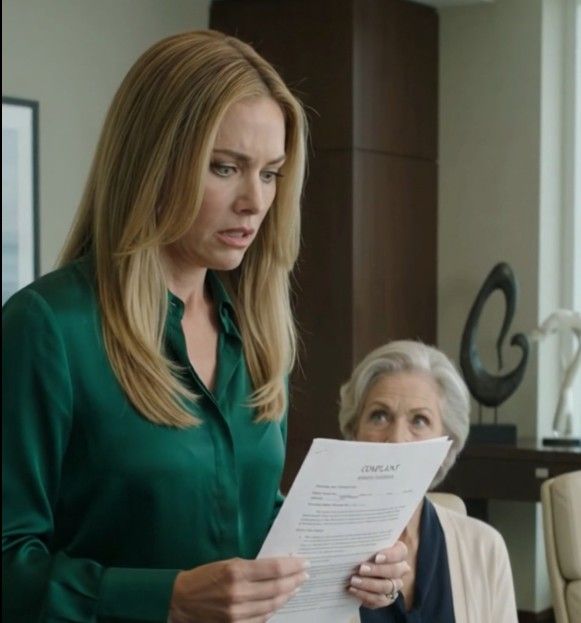
The staff records and reservation confirmation answered the factual claims. I directed the general manager to respond through the normal guest relations process, without any reference to my family tie. The complaint was closed after the review. I did not put it on my desk to read again.
Mark and I did not speak for nearly a month. I walked through my properties, attended meetings, and returned each night to the house where I lived alone. In the evenings I kept thinking of the bed-and-breakfast where it had all begun. I remembered the way Mark’s small shoes used to squeak across the kitchen tile and how he would insist on helping fold towels, each one a lopsided bundle.
I had once hung one of those towels on the wall because he had drawn a blue sun on it with a washable marker. For years I carried that image as proof we had survived everything together. Now I wondered whether surviving hard things together could also teach people to assume the survivor would always endure more.
One Sunday I drove to the first property, a modest inn I’d kept even after the company expanded. The porch still creaked near the third step. A guest was reading beneath the old oak, and the kitchen smelled of cinnamon. The current manager welcomed me with no ceremony and offered me coffee in the room that had once been my cramped office.
In a cabinet I found the little brass bell Mark used to ring when he wanted to help at the front desk. Its handle was worn smooth. Beside it lay a picture of us: me in an apron, Mark missing two front teeth, both of us grinning beneath a hand-painted sign. I had never looked wealthy. I had looked happy, exhausted, and proud.
I asked the manager if I could borrow the photograph. She placed it in an envelope and added a note about the bell. “We tell new employees the story of how you started,” she said. “They like knowing you know how hard this job is.”
That evening Mark called. His voice was unsteady. “Amber and I are living apart for a while,” he said. “I don’t know what happens next.”
I sat down with the envelope in my lap. “I’m sorry you’re hurting.”
“You don’t sound happy.”
“I’m not happy when you’re in pain. I can be relieved that someone is reconsidering how they live without enjoying the suffering that comes with it.”
He breathed out slowly. He told me he’d asked Amber to attend counseling and to apologize directly to the employees she had insulted. She had refused, saying that making apologies would make them look weak. When he told her that the video showed exactly what they had done, she accused him of choosing a stranger over his own wife.
“I realized I was asking you to lie for us,” he said. “And I’d been asking you to do that in smaller ways for years.”
“You have,” I answered. “If you want us to repair this, I need your actions to change, not just your explanation.”
He agreed. Over the following months he began seeing a counselor on his own and made a point of calling me without an agenda. We spoke about ordinary things: an old recipe, a leaking roof at his house, the books I was reading. At first the conversations were awkward. I resisted the urge to fill every silence with reassurance.
He eventually visited the inn with me. We walked through the little kitchen, and I showed him where he’d slept while I worked. He stood in the doorway and tried to picture me at thirty-four, newly widowed, balancing a pot of coffee and a frightened twelve-year-old son’s future.
“I always told people you worked hard,” he said. “I don’t think I understood what those words meant.”
“It’s all right not to know every detail,” I said. “It’s not all right to stop seeing the person.”
He nodded and asked if he could help prepare the dining room for the next morning. I handed him a stack of napkins. He folded them slowly, making sure the corners lined up, and neither of us made a joke about the reversal.
There was one more difficult conversation. Mark admitted he’d been drawn to Amber’s confidence because he’d spent much of his life feeling ashamed of our humble beginning. Luxury had seemed like proof that the frightened boy behind the laundry room was finally safe. When Amber demanded the penthouse, he had heard a demand for status and mistaken it for security.
“I laughed when she called you the maid because I didn’t want to be the one she laughed at,” he said. “I can’t believe I did that.”
I turned away to give myself time. The honesty mattered. The memory still hurt. “I don’t need you to be proud of my money,” I told him. “I need you never to treat work, or a person doing it, as shameful.”
He went back to the resort—not as my son asking for favors, but as a guest who had requested a meeting with the employees affected. The server agreed to speak with him in the presence of a supervisor. Mark apologized for laughing and for failing to intervene. The server said he appreciated the apology but did not owe Mark friendship or forgiveness. Mark accepted that without pressing. He also wrote to Sarah, acknowledging that her professionalism had been met with contempt.
Amber did not take those steps. As her separation from Mark became permanent, she continued telling relatives that she had been betrayed by people she should have been able to control. The exposure did not ruin her life, but it ended the unquestioned access she had expected to my business and my patience. Mark sought legal advice and eventually ended the marriage. I neither financed the separation nor tried to manage it. Amber’s lasting consequence was a loss of trust she refused to repair, not a punishment I staged for an audience.
I returned my attention to the people who had made Serenity Shores worthy of its name. I expanded the staff education fund we’d been discussing for months, creating a clear application process for professional training and family scholarships. It was not a publicity response to the video. It was an investment in people who had often been invisible to guests like Amber—and, for too long, to my own son.
At the first gathering for the fund, the young server received support to finish his hospitality management certification. Sarah helped present the award. When I rose to speak, I did not mention the lobby confrontation. I told the staff that a good hotel was built by people who noticed a guest’s needs while remembering their own worth. The applause was warm and brief, just as I hoped it would be.
Afterward Mark walked over carrying something wrapped in brown paper. He told me he had visited the first inn on his own and asked permission to copy an old photograph he had seen there. Inside the paper was a framed image of a woman in an apron beside a young boy with missing front teeth. Under it he had written a sentence in his careful handwriting.
She was never just the help. She was the reason I had a home.
I couldn’t speak. All my life I had feared that if Mark knew how much the company was worth, he’d see only the money. He had found a better way to measure it by remembering the person who made the beds when no one else was there to do it.
“I thought you might want it in the office,” he said.
“I want it where everyone can see,” I answered. We hung it near the entrance to the staff training room, where new employees passed every morning on their way to learn the work.
