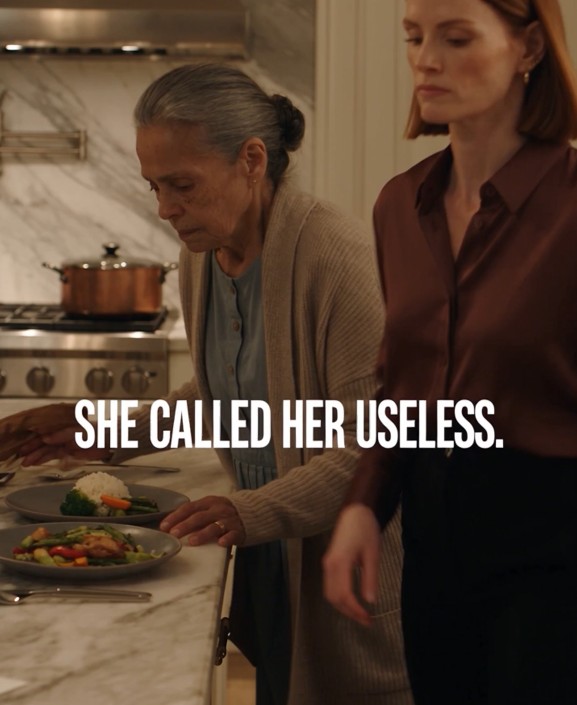
Elena looked at the stool tucked beneath the counter. Sarah had moved it there that afternoon because, she said, it spoiled the room.
Her son followed her gaze.
He set down his bag, pulled out the stool, and placed it beside his mother.
“Can you sit?”
Elena lowered herself carefully. Only when her weight was off her feet did she realize how badly her legs were trembling.
Sarah started toward her.
“Let me—”
“Give her the papers.”
The words were quiet enough that Sarah hesitated, as if she had expected anger she could argue against.
She placed the packet on the counter.
Elena covered it with her palm.
Her son crouched beside the stool, bringing his face level with hers.
“Do you need a doctor?”
“I need a minute.”
“All right.”
He waited. Sarah stood on the other side of the counter, watching a silence she could no longer control.
The refrigerator motor started. Somewhere beyond the kitchen, a clock chimed.
Then Sarah said, “You should read what she’s been hiding from us.”
Elena’s son did not turn.
“Mom?”
Elena could still put the pages away. She could call the whole evening a misunderstanding, endure Sarah’s sudden kindness, and leave when she could carry her own suitcase.
She knew how to make herself easy to live around.
The thought exhausted her more than the cooking had.
“Read them,” she said.
He took the packet only after she lifted her hand.
The first sheet was Sarah’s transplant discharge summary, something his mother had helped organize when Sarah came home. Beneath it lay Elena’s own surgical paperwork.
He turned a page.
Then another.
His eyes stopped moving.
“This says donor nephrectomy.”
Elena nodded.
He looked at Sarah, then back at his mother.
“You told me it was a cyst.”
“I told you I needed an operation.”
“You let me think—”
“Yes.”
The admission stayed between them, plain and difficult.
Sarah gripped the counter.
“No. The donor was anonymous.”
“I asked them to keep my name from you,” Elena said. “The team knew. I went through the evaluations. They made sure it was my decision.”
