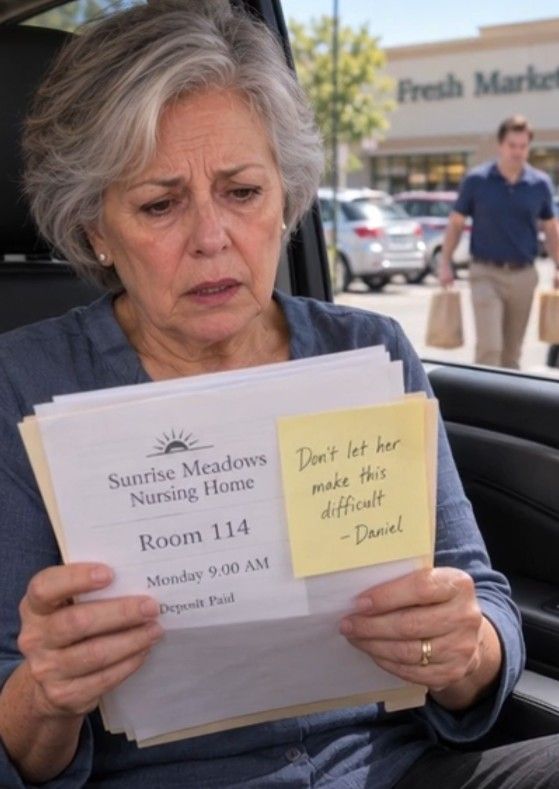
She waited until she could act on her own behalf.
At home, she tried to keep her attention on the steps she could take.
The impulse to call Daniel out immediately returned each time she noticed something missing.
She wanted to hear him admit that the papers were real, perhaps because some part of her still hoped he would supply an explanation that made them harmless.
But the receipt would be useful only if she followed it before allowing him to shape the conversation.
She considered what she would need if he challenged her account: her own documents, access to her money, and someone who would listen without automatically assuming her son knew best.
Asking a neighbor for help was uncomfortable.
She had not wanted family trouble to become something discussed beyond the house.
She kept the request specific and described what she had actually found.
The neighbor did not have to decide whether Daniel was a good son in every other part of his life.
Mrs. Hart needed assistance with a storage receipt and the return of belongings that were hers.
Making the problem concrete helped her speak without apologizing for bringing it up.
She could be upset and still give an accurate account.
The first useful response was not reassurance that everything would be fine.
It was a willingness to help her find out what had happened.
With help from a trusted neighbor and the storage manager, she followed the receipt to Unit 47.
Inside were boxes of her clothes, keepsakes, and household possessions.
Daniel had already moved pieces of her life out of her home.
The storage records and payments matched the timetable on the nursing-home papers.
There was no longer any room to mistake the arrangement for a suggestion he had not yet raised.
The manager’s records supplied dates that she could compare with the papers from the truck.
She read them slowly, paying attention to the sequence.
Monday no longer stood alone as an alarming date on an admission form; there had been preparations leading toward it.
She looked into the boxes without immediately trying to empty them all.
Clothing that should have been available to her had been folded away.
Keepsakes had been treated as items to clear from a room.
Daniel had not needed to understand an object’s meaning to remove it from her reach.
That realization hurt in a different way from the prospect of Sunrise Meadows.
A person could reduce the space she occupied without asking her to leave all at once.
The absences would gather quietly until a familiar home no longer contained enough of her life to feel like hers.
