But it became truer each time.
Before the nursery reopened, Adrien asked Marco to search Isabella’s project files—not her private correspondence, not her journals, only the plans connected to the room. Two days later, Marco brought him a thin blue folder recovered from an architect’s archive.
Inside were wiring diagrams for the hidden audio unit and a page of notes in Isabella’s hand. She had drawn three tiny stars beside the crib locations. Near the rug, she had written PRESS TO QUIET — FOR 3 A.M. MERCY.
Adrien laughed when he read it, then cried again.
One note explained that the system was never supposed to play continuously. A motion sensor would trigger only a short greeting when a parent entered at night. The pressure pad was a manual mute so anyone could silence it instantly without reaching behind a crib. The damaged transformer had defeated both intentions by leaving a faint electrical output even when the recording was not actively playing.
The electrician showed Adrien where the insulation had cracked. It was ordinary failure, not sabotage. Heat, age, and a poor connector had turned a loving design into something painful.
That mattered to Adrien. He had spent the first night looking for a person to blame because blame felt easier than accepting that harm could grow from neglect, grief, and one unnoticed defect.
He ordered inspections of every hidden convenience built into the estate. Then he did something harder. He asked the household staff what rules he had created after Isabella died that made their jobs worse.
The first meeting was painfully quiet. No one wanted to criticize the man who paid them.
Elena finally spoke.
“You make people afraid to bring you bad news.”
Adrien’s instinct was to argue.
He stopped himself.
“How?”
“You ask for explanations before you ask what happened. People start preparing a defense before they come to you.”
Marco looked at the floor.
Adrien noticed. “You agree?”
Marco cleared his throat. “Sometimes.”
“Most times?”
A pause. “Most times.”
That answer would once have offended him. Now it frightened him more than disobedience. A secure house where people hid problems from the owner was not secure at all.
He changed reporting procedures so any staff member could flag a safety concern without going through a supervisor. He asked Dr. Gable to review the children’s care notes for signs everyone had normalized because the reports looked neat. He also instructed the nursery team to record what the babies actually ate, slept, and reacted to rather than what the schedule said they were supposed to do.
The changes were mundane. That was precisely why they mattered.
Sophie became part of the new routine in a way no one planned. She was still four. She still forgot shoes, asked impossible questions, and once fed a cracker to a decorative fountain. But when she visited, adults listened when she said a sound was “too sharp” or a room “smelled funny.” Most of the time it meant nothing. Once it led them to a smoke detector with a failing battery before it began chirping in the night.
Adrien never called her gifted. He did not turn her into a mystery child. He simply treated her observations as observations.
Months passed.
The triplets learned to crawl. Theo developed a habit of pulling books from shelves. Miles laughed whenever anyone sneezed. Nora refused to sleep unless one sock was missing.
The nursery became exactly what Isabella asked for.
A mess.
There were blocks under the cribs, fingerprints on the windows, bottles on side tables, and one faint crayon mark Sophie added to the baseboard during a visit.
Adrien saw it and did not have it removed.
On the babies’ first birthday, the house was full but not formal. No chandeliers polished for strangers. No staff lined against walls. The East River sewing group came. Dr. Gable came. Marco came with a toy drum Adrien immediately regretted.
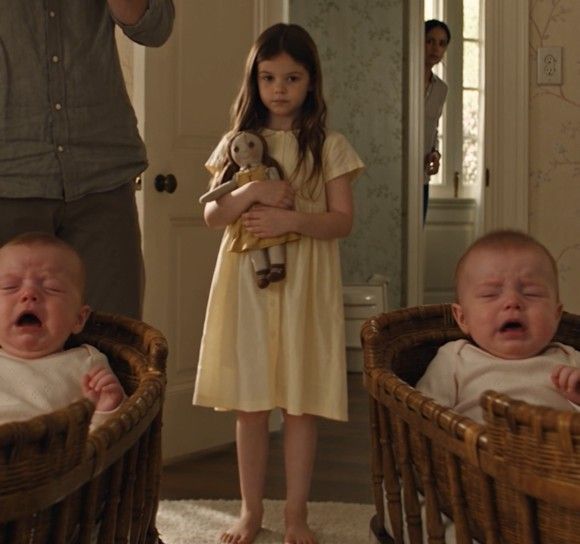
Elena brought Sophie, who wore a yellow dress two sizes larger than the one she had worn that night.
At dusk, Adrien carried the three children upstairs.
Sophie followed.
He placed the triplets in their cribs and let Sophie choose the recording.
She selected the four-note lullaby.
Isabella’s voice filled the room.
Sophie listened carefully.
Then she smiled.
“What?” Adrien asked.
She looked toward the repaired wall, where the hidden panel had once been.
“The lady isn’t sad anymore.”
Adrien looked at his children.
For months, he had believed the most frightening thing in the nursery was a voice he could not explain.
It turned out the danger was not Isabella’s voice at all.
It was the damage layered over it—the noise adults could barely hear, the grief nobody wanted to name, the secrets they mistook for protection.
He turned the volume down one notch and sat on the rug until all three babies fell asleep.
This time, nothing was hidden in the walls.
And nothing Isabella had loved needed to be hidden either.
For Adrien, that ordinary quiet became the safest sound in the house.
