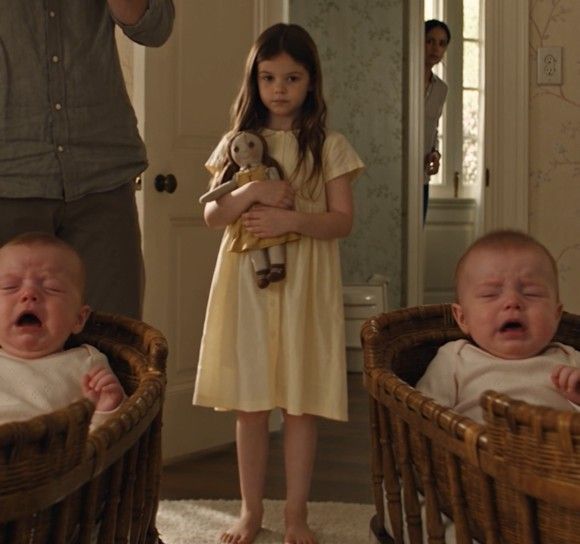
Adrien put one hand over his face.
Sophie stood near the rug.
“The bad noise is gone,” she said.
Everyone turned.
Adrien crouched.
“You heard a bad noise?”
She nodded.
“Why didn’t you say that?”
“I did.”
He frowned.
She pointed toward the wall. “I said the lady was singing.”
Adults, Adrien realized, were very good at deciding which part of a child’s sentence mattered.
“What did it sound like?”
Sophie hummed the same four notes, then made a face and added a thin, wavering squeal.
Elena covered her mouth.
Adrien looked at his daughter’s cribs, then back at Sophie.
“You were trying to make it stop when you stood on the rug.”
“I wanted to hear the song without the hurting part.”
That explained the impossible silence.
Sophie had not calmed the babies by magic.
She had stepped on the mute switch Isabella designed.
Later, after the triplets were asleep downstairs as a precaution, Adrien returned to the workroom.
The memory card sat on the table.
He had been avoiding it.
Elena waited near the door.
“You don’t have to listen tonight.”
He looked at her.
“Did you hear the recordings?”
“No.”
“Then stay.”
The electrician copied the files first so the original would remain untouched. There were twelve tracks.
Most were named by crib position or song.
One file was labeled FOR ADRIEN.
His hand froze above the keyboard.
Elena quietly moved toward the door.
“Stay,” he said again.
He pressed play.
Static came first.
Then Isabella laughed.
Adrien stopped breathing.
Not a memory of her laugh.
Her actual laugh.
Recorded less than nine months earlier.
“Okay,” her voice said through the speaker, “if this works, you are going to pretend you hate it for at least ten minutes, because that is your favorite way to survive being emotional.”
Elena gave a broken sound that was almost a laugh.
Adrien could not move.
Isabella continued.
She explained the hidden player, the pressure switch, and the songs. She said she wanted the babies to wake to a familiar voice on mornings when one parent was exhausted and the other was downstairs pretending coffee could replace sleep.
Then her tone changed.
“I know the surgery scares you,” she said. “It scares me too.”
Adrien’s throat tightened.
Isabella had been scheduled for a complicated delivery. They had known there were risks. Neither had spoken about them honestly.
“If something goes wrong,” she continued, “do not turn this room into a museum. Let them make a mess in it. Let them hate my songs if they want. Let them know I was a person, not a saint.”
Adrien bowed his head.
“And please,” Isabella said, softer now, “do not make grief into another kind of security system. You cannot protect them from loving people just because losing people hurts.”
The recording ended.
No one in the workroom spoke.
Adrien had built gates, cameras, staff protocols, and layers of permission around his children. He had called all of it protection.
Some of it was.
Some of it was fear with better architecture.
