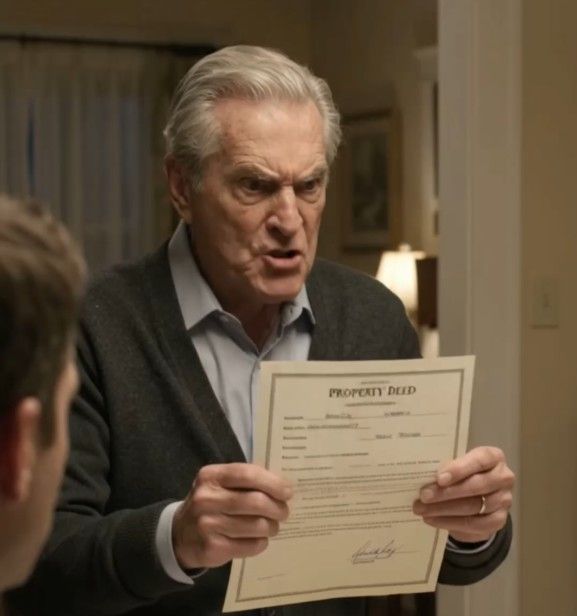
“Put it with the other important papers.”
He nodded.
Then he looked toward the hallway.
“Dad?”
“What?”
“Would you come with me?”
He led me to the blue room.
A family was staying there that week: a mother named Tessa and her two sons. Tessa had found work at the hospital but needed time to save for an apartment. Her younger son had drawn pictures on the wall with washable markers. The older one had repaired the loose handle on the dresser.
They stood beside the window when we entered.
Tessa held an envelope.
“I wanted to give you this,” she said.
Inside was a photograph.
It showed the children in front of the oak tree, holding a painted wooden sign.
THE OAK HOUSE.
Michael looked at me.
“We made it for the front gate,” Tessa said. “If that’s okay.”
I could not speak for a moment.
The house had been built for my wife and me. Then for our son. Then for children who had never known us.
The meaning had widened without taking anything away.
“It is more than okay,” I said.
That evening, Michael and I hung the sign beneath the porch light.
The children stood on the steps, arguing about whether it was straight.
“It is crooked,” my granddaughter said.
“It has character,” my grandson answered.
Michael adjusted it by half an inch.
“There,” he said.
The sign was still crooked.
We left it that way.
After dinner, everyone gathered around the table. The children colored while Tessa told us about her first day at the hospital. Evelyn joined us by video call from her room, complaining that the camera made her look tired.
“You look exactly as tired as you sound,” Michael told her.
