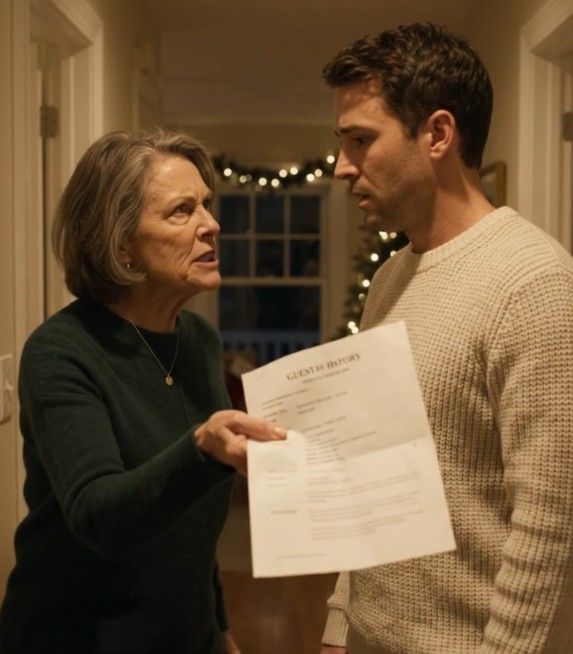
That meant they had been tracking my plans closely enough to know when I would be away.
In the hall I found the old family calendar.
Someone had copied my medical appointments and travel dates onto it in blue marker.
I had never told Vanessa about several of those appointments.
Then I noticed a familiar name on the printed guest history.
A man who had once worked with my late husband had stayed here three times.
I called him because I thought he might know how long the rentals had been operating.
He sounded upset.
“Eleanor, I thought you had decided to sell. Julian told me the rental income was going toward the closing costs.”
I looked at my son.
He suddenly seemed unable to stand still.
Before I could ask what closing costs he meant, my phone received a notification from the county’s public-records service.
Someone had filed an application to change the property’s mailing address.
I opened the notification twice, hoping the second reading would make it less real. The county office had received a request to send future property correspondence to an address I did not recognize. Below it was a reference number and a link to the application status. The request was still pending. Vanessa watched my face, then reached for the old family calendar as if tidying the hall might restore the ordinary Christmas she had just destroyed. I held up my phone. “Who filed this?” Julian looked toward her, and she said, “It’s a billing adjustment.” Outside, wind struck the windows hard enough to rattle the glass. It sounded like someone trying to get in.
I called the county clerk before the office closed for the holiday. A patient woman explained that the mailing-address request had not changed ownership and could be challenged with proof of identity. She could not tell me that my property was safe from every possible fraudulent filing, but she marked the request as disputed and gave me instructions for submitting an objection. I wrote them down on the back of an old Christmas envelope. Vanessa said I was overreacting. “No one can sell your house with an address change,” she told me. “Then why did someone try to hide the notices from me?” I asked. She looked away. Julian quietly put down the box of smart-lock manuals he had been holding.
My next call was to a local attorney, Rebecca Marsh, who had helped me update my estate documents after my husband Peter died. She told me not to rely on a phone argument with family members. Preserve the documents, she said, and notify the county, insurer, and rental platform in writing. She also recommended a title search and steps to detect new filings. When I mentioned the guests who had been relocated, she asked whether anyone had received accurate information about the icy access road. I admitted the welcome guide described the cottage as a year-round luxury retreat. Rebecca went quiet. “First we make sure no more guests arrive in a storm,” she said. “Then we find out what paperwork they’ve used.”
I turned back to Vanessa. “Give me the login to the rental account.” She said it belonged to her business. “Then close the listing while the platform investigates,” I said. She folded her arms. Julian offered to do it. Vanessa looked at him as though he had broken a private agreement. He called the platform in front of me and provided the booking reference numbers, acknowledging that the property owner had not authorized the rentals. The representative explained that accounts would be reviewed and guests contacted through official channels. I insisted that anyone already traveling receive accurate road and access warnings. There was no victory in this moment. I had to protect people who had paid my son and his wife to take risks I would never have chosen for them.
The family we had sent to a hotel was staying in a nearby town. Their father, Graham, called to thank me for helping them find a room when the weather worsened. His voice shook with embarrassment. “We thought we’d ruined your Christmas,” he said. I told him none of this was his doing. His little daughter had been excited about seeing the sea in winter, and he had promised her a holiday she would remember. I looked at Peter’s red sled leaning against the wall. “She can still see the ocean,” I said. “Just not by trusting that driveway tonight.” He laughed with exhausted relief and said he would take her to the public beach when the roads cleared.
After the call I asked Julian to sit at the kitchen table. The same table had held school projects, birthday cakes, and Peter’s repair plans. Vanessa remained near the window, her phone in her hand. “How long have you been collecting rent?” I asked. Julian repeated seven months. “And why did you tell Peter’s old colleague I was selling?” His jaw tightened. Vanessa answered before he could. “Because we were exploring options.” I asked what closing costs had been paid. Julian rubbed his palms on his trousers. “There was an agreement,” he said. “Not a completed sale.” I felt cold spread through me despite the kitchen stove ticking with heat.
He showed me an electronic contract describing a proposed transfer of the cottage to a limited company called North Beacon Properties. The buyer’s name meant nothing to me. Under seller authority was a document claiming Julian could act for me under a power of attorney. I had never granted him such power. Vanessa insisted they had been working on a family estate plan. But the signature page bore the same uneven imitation of my writing that appeared on the county request. My late husband’s name had been used in a paragraph about honoring his wishes. Peter’s wishes had never included strangers changing our locks, renting unsafe winter accommodation, or selling land without his wife knowing. I said so plainly.
Julian reached for the contract, then stopped when I placed my hand on it. I asked him whether he had seen the false power of attorney before today. He nodded. That was the second time he had chosen to tell me the truth only when there was no easy lie left. “You knew?” I whispered. “Vanessa said we could put the income back and show you how much the house had become worth.” I looked around at the wallpaper Peter had helped me hang, the dark beams he’d sanded by hand, the crooked shelf he insisted was level. “It was worth something before you priced it,” I said. Neither of them answered.
Rebecca arrived the following morning despite the holiday week, bringing a portable scanner and a calm assistant. We reviewed the rental ledger, the address-change request, and the proposed sale documents. The title search confirmed that I remained the record owner. The supposed buyer had not completed a transfer. Rebecca sent urgent notices disputing the claimed authority and sought protections against fraudulent filings. The county process would take time, but now any legitimate buyer, lender, or title professional reviewing the dispute would have a clear warning. I signed only papers that Rebecca explained line by line. I remembered how often I had signed school forms for Julian when he was little. There had never been anything harmless about another adult signing my name.
The buyer’s company turned out to be linked to Vanessa’s brother, who worked in short-term property investments. The plan was to secure an agreement at a price far below the property’s likely market value, improve the marketing, then arrange a new financing package based on projected rental income. Part of that package depended on letters claiming I had voluntarily left the property and authorized Julian to handle the transaction. A broker who had been shown the documents contacted Rebecca after receiving her notice. He preserved the communications and paused all work. The plan had not been merely to make the cottage pay bills. It was to remove me from the decision completely.
Peter’s former colleague, Owen Pike, came to the house on a clear afternoon after the wind dropped. He carried a box of photographs from their years working on coastal construction projects. His face fell when I showed him the false sale papers. “I paid Julian for three stays,” he said. “He told me the money would help you manage the closing costs.” He had also introduced a friend to the investment proposal, believing my approval had already been given. Owen was embarrassed, but he did not hide the emails or try to protect Julian from accountability. He copied everything for Rebecca. Then he sat beside the window and told me how much Peter had loved this cottage because I had chosen its first set of curtains before we owned a single piece of furniture.
Owen’s recollection undid me more than the legal documents. It had been years since anyone spoke of Peter as a man who admired my choices, rather than as a convenient name on a family memory. We made tea. Owen told me about a winter decades earlier when Peter helped pull a stranded neighbor’s groceries home on the red sled. “He said a house was only a house until someone inside noticed who needed help,” Owen recalled. I looked toward the sled in the hall. For a moment I could see Peter laughing as he dragged it over uneven snow. But I also remembered that he never invited people inside without asking me first. Generosity had been a partnership, not an excuse to ignore the person who lived there.
The investigator assigned to our report came two days later. She photographed the electronic lock, copied the fraudulent documents, and asked precise questions about the rental arrangements. I described what I had witnessed and what others had told me, keeping those things separate. Vanessa asserted that the family had a verbal understanding. She had no recording or message showing I had agreed to a sale or a winter rental business. When asked why my medical appointments had been copied onto the calendar, she said she needed to manage turnover. The investigator paused her pen. “Your turnover schedule was based on when the owner wouldn’t be home?” Vanessa looked toward Julian. He stared at the table.
That evening Julian asked to speak with me alone. I refused to hold the conversation in secret from the legal process, but we sat together while Rebecca’s assistant finished scanning upstairs. He told me the financial trouble had begun after their business lost a major contract. He was ashamed to ask me for help, so Vanessa suggested the cottage could help without my needing to know. “I thought we’d give it back once things improved,” he said. “A house isn’t a sweater,” I replied. “You can’t borrow its ownership while I’m not looking.” He covered his mouth with one hand. “I know.” I asked if he understood that the copied medical appointments frightened me more than the missing rental money. He nodded. “We watched when you’d be gone,” he whispered.
Christmas arrived without the celebration I had imagined. I made soup for myself, put a small candle beside Peter’s photograph, and watched snow collect along the porch rail. Julian and Vanessa had removed their belongings under an agreed supervision plan. The digital lock had been replaced. For several hours the cottage was almost too quiet. Then a car stopped at the foot of the driveway. I felt panic rise before I recognized Graham and his family walking along the cleared public path. They had come to return a scarf I had lent their daughter at the hotel lobby and to leave a card. I stepped onto the porch to meet them, staying clear of the ice. His daughter held up a shell she’d found on the beach. “It was still beautiful,” she announced. I believed her.
Over the winter the platform removed the unauthorized listing and processed claims under its policies. Some guests received reimbursements from payments it could recover; other disputes required further work. Vanessa’s brother withdrew from the proposed transaction after his connection to the paperwork came under scrutiny, but that did not end the investigation. The county rejected the disputed mailing-address change, and the title records continued to show me as the owner. Rebecca secured court orders restricting the use of my identity and access credentials while the matter proceeded. I learned enough about the legal process to protect myself, but I refused to let every evening become a review of what someone might try next. The house needed firewood, food, and laughter more than another hour of fear.
The evidence eventually showed that Vanessa had directed the false authorization, sent it to the broker, and arranged the unauthorized rentals. Julian had approved the use of my documents and accepted proceeds despite knowing I had not consented. Both faced formal consequences, including restitution and restrictions under court orders; Vanessa’s involvement in false property filings brought a separate criminal case. The rental company she controlled was dissolved, and the proposed sale collapsed permanently. I did not confuse Julian’s smaller role in organizing the scheme with innocence. He had helped make it possible. But I also refused to let anyone tell me I should stop loving my son to prove that I took what he had done seriously.
