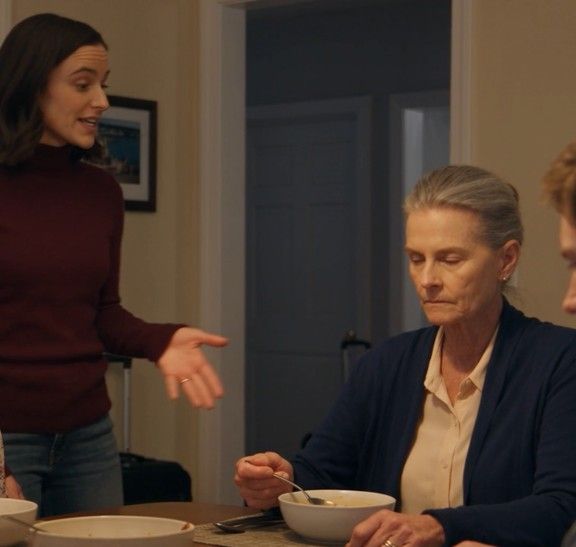
“I don’t want your house, Mom,” he cried into the wood. “I never wanted your house. I just wanted you to be proud of me.”
“Oh, my boy,” I whispered, standing and going to him, putting my arms around his shoulders the way I had when he was small and feverish, “I have always been proud of you. Even yesterday. Even when you looked at your shoes.”
We stayed like that a long time, the afternoon light moving across the kitchen, the sound of Bill and Linda quietly folding things in the other room, the house settling back into itself.
Sarah came back at dusk to pack her clothes. She didn’t speak to me. She spoke only to Lucas, in urgent, low whispers by the front door. She told him he was choosing his mother over his wife. She told him he would regret it. She told him she would file, she would take half of everything.
Lucas listened to her with the key still in his pocket. When she finished, he said, quietly but without hesitation, “Sarah, half of nothing is nothing. Mom owns this house. I own my mistakes. If you want to be my wife, we can find an apartment and start over and talk honestly for once in our lives. If you want this house, you can’t have it.”
She stared at him as if she didn’t recognize him. Then she picked up her suitcase and left. The moving truck had long since gone, but her small car pulled away with a squeal that faded down the street.
Thirty days passed. Ruth came and went. The upstairs suite grew quiet. Lucas moved his few things into the attic room with its slanted ceiling and single window that looked out over the flower bed his father had built. He sanded the windowsill himself. He painted the walls white. In the evenings he came down and we ate at the table together, just the two of us, and we talked about Thomas, and about money, and about how easy it is to be quiet when you should be loud.
Bill and Linda sent a handwritten note a week after they left, apologizing again, and a small potted hydrangea that Linda had obviously chosen herself. I put it by the front steps where the movers had scuffed the grass.
Sarah filed for separation. She did not get the house. She did not get any claim to it. Ruth’s paperwork held like a wall. She got what was marital and nothing more, and for the first time in years Lucas’s paycheck was his own to budget.
The most beautiful twist came on a Sunday, a month and a day after the notice expired.
I was in the garden, kneeling by the flower bed, pulling the weeds that had grown while strangers trampled it. The sun was warm on my back. Lucas was on a ladder, fixing the gutter Thomas had always meant to fix.
A car pulled into the driveway. Not Sarah’s. An older sedan. Linda got out, alone, holding a covered dish.
She stood at the edge of the grass, uncertain, as if afraid to step onto property she now deeply respected.
“Mrs. Whitaker?” she called softly. “I hope I’m not intruding. I just— I made too much lasagna. Bill is at our nephew’s, and I remembered you liked it without the extra onion.”
I stood, brushing soil from my knees. Lucas came down the ladder, wiping his hands.
Linda held the dish out with both hands. Her eyes were clear, no longer puffy, and she smiled with genuine shyness.
“I also wanted to say thank you,” she said. “For letting us stay the week. For not calling the police like you could have. Sarah— Sarah is in counseling. She told us she was sorry. She hasn’t called you because she’s ashamed. But Bill and I— we don’t want to lose you. If you’ll let us, we’d like to be the kind of extended family that asks before they come over.”
I took the dish. It was warm.
“There’s onion in here, isn’t there?” I said, peeking under the foil, trying not to smile.
Linda laughed, a real laugh this time, surprised and delighted.
“A little,” she admitted. “I forgot.”
“Then you’ll have to come in and help me pick it out,” I said.
We walked together toward the front door, the three of us, not as invaders and invaded, but as people who had learned, painfully and late, where the boundaries of a home really are.
That night, the house was full again, but differently. Linda’s lasagna was on the table, with the onions mostly picked out. The blue rug lay flat and straight. Thomas’s recliner was empty, but not forgotten — Lucas had draped his father’s old throw over its arm. The porcelain figurines were back on their shelf, exactly where they belonged, catching the lamplight.
And upstairs, the attic room glowed warm through its small window, a single light left on for a son who finally knew how to come home.
I sat at the head of my table, in my own chair, in my own house, surrounded by the quiet, steady breathing of people who had finally learned to ask, and I felt, for the first time in a long time, completely at peace.
Outside, the wind moved gently through the flower bed, and the house held us all safely inside.
