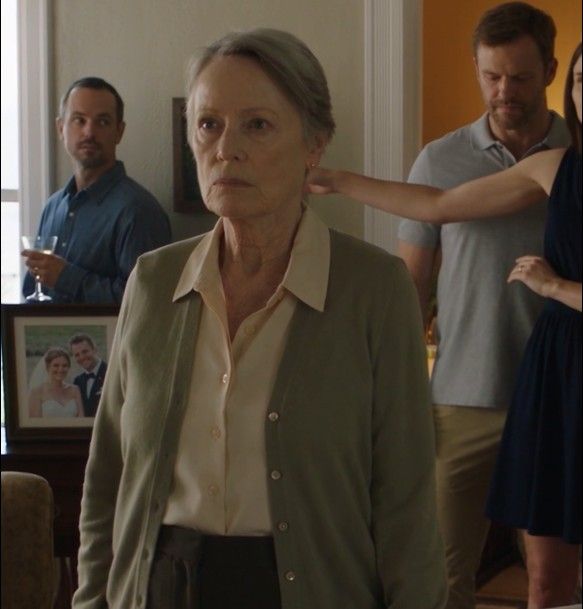
“No, dear,” I said, bringing it back to my ear. “Thank you. You’ve done enough. I’ll call you tomorrow.”
“Call me any time,” she said, and hung up.
Robert was still standing near the sliding doors, his hands in his pockets like he used to do as a teenager when he was in trouble. Sand had been tracked across the rug. One of Henry’s coasters was on the floor. I bent slowly— my knees ache in the damp— and picked it up.
June watched us both, then squeezed my shoulder. “I’ll be next door if you need me, Carol. Take your time.” She slipped out, pulling the front door softly closed behind her, leaving Robert and me alone in the house that suddenly felt too large and too quiet.
He didn’t move. He stared at Henry’s chair, empty again, the cushion still dented.
“I sat in that chair once after Dad died,” he said, his voice barely above a whisper. “You were asleep upstairs. I sat there and cried for an hour because I didn’t know how to be the man of the family at twenty-six. I never told you.”
I set the coaster back on the side table, precisely where Henry always kept it.
“I know,” I said. “I heard you. I stood at the top of the stairs and listened because I didn’t know how to tell you that you didn’t have to be him. You just had to be my son.”
His head dropped. A sound escaped him that he tried to swallow, but couldn’t. He crossed the room in three strides and then stopped a foot away from me, as if unsure he was allowed to come closer. His hands lifted, hovered, fell.
“Mom, I’m so sorry,” he said, and the words broke on the way out. “For the listing. For not stopping her. For calling it an asset when you and Dad gave up everything for it. For letting her say there’s no room for you and just standing there like a coward.”
I looked at his face, this man who was still somehow seven years old and soaked from the rain, and I felt the last of the anger I had carried since Christmas drain out of me, leaving only the raw, tender place underneath.
I reached out first. I put my hand on his cheek. His skin was warm and damp, and he leaned into my palm like he used to when he had a fever.
“I missed you,” I whispered.
That was all it took. Robert made a rough, quiet sob and bent his forehead to mine. We stood there in the middle of the messy living room, two people holding each other up, breathing in the familiar smell of salt and old wood.
After a long time, he pulled back just enough to look at me. His eyes were red, but clearer.
“The trust,” he said, wiping his face with the back of his hand. “You said we could still— that my kids could still live here?”
“If you want to,” I said. “The way Henry and I lived here. Not as an investment. As a home. You can stay here whenever you want. You can bring your children here. You can learn again what peace smells like. But you can’t sell it. You can’t carve it up. Megan can’t either, unless she understands that.”
He nodded, slow and serious. “She won’t like that.”
“I know.”
“She might not forgive me for asking her to accept it.”
I held his hands. They were shaking slightly. “Then you’ll have a very hard choice to make, my love. And whatever you choose, I’ll respect it. But this house will never again be the thing that decides whether you love me.”
He closed his eyes at that, and nodded. Another silence settled, but this one was different. It was the silence after a storm, when the rain has stopped and you can hear the house settling.
I led him to the kitchen. We moved together without needing to discuss it, picking up cups, wringing out towels, righting the chairs. Working side by side the way we did when he was small and I would let him dry the dishes even though he left them wetter than before. The sun was beginning to lower toward the water, turning the kitchen gold.
On the counter, half-covered by a wet beach towel, I saw an envelope. Cream-colored, familiar handwriting.
My breath caught.
“What’s that?” Robert asked.
I slid the towel away. The envelope said, in Henry’s careful, slightly slanted script: For Robert — when he’s ready. It had been taped to the inside of our bedroom closet for years. I had almost forgotten it. Henry had written it during his last spring, when the doctors had told us the treatments weren’t working, and he spent long afternoons at the kitchen table writing letters none of us were meant to open right away.
“Where did that come from?” I said, more to myself. The guests must have knocked it loose. Perhaps Megan had been looking through the closets when she was staging the house for photos.
Robert picked it up with both hands, as if it might tear. He looked at me, asking permission. I nodded.
He opened it carefully. Inside was a single sheet of lined paper, folded twice, and a small, faded Polaroid. The photo was of Robert at age nine, asleep on Henry’s chest on this very sofa, both of them sunburned after a day on the beach.
Robert unfolded the letter. His lips moved as he read, then stopped. He made a small, wounded sound and pressed the paper flat on the counter so I could see.
It read:
Robert—
If you’re reading this, I’m gone and your mom is doing her best, which has always been better than anyone else’s. I want you to know something I never said well out loud.
This house was never about the house. Your mom and I bought it because we wanted one place in the world where no one ever had to earn their welcome. No performance. No proving. Just come in, kick off your shoes, you’re home.
If anyone ever makes you feel you have to choose between the people you love and the place you love, choose the people. But don’t give away the place that taught you what love feels like.
Take care of your mom. Let her spoil you a little, even when you think you’re too old.
Love, Dad
P.S. Don’t let June tell you I can’t cook. I taught her to make that clam chowder.
Robert laughed, a wet, broken laugh, and then he was crying again, his shoulders shaking, his hand flat over the letter as if he could keep it from blowing away.
I put my arm around his waist, and he leaned into me. The Polaroid lay beside us, that small boy and his father, both breathing deeply in sleep, safe.
“Henry knew,” I whispered. My own eyes were full now, and I didn’t wipe them. “He knew I would need to hear it too.”
We stood there until the light turned from gold to amber. June’s granddaughter had left the plate of cookies. Robert picked one up, broke it in half, and handed me the larger piece without thinking. It was oatmeal raisin. Henry’s favorite.
Later, after we had swept the sand from the flowerbeds as best we could and put Henry’s chair back exactly where it belonged, Robert helped me fold the last of the strangers’ towels and left them in a neat pile by the door for whoever would come to claim them. He didn’t ask to stay the night. He asked if he could come back tomorrow, alone, to fix the sprinkler head one of the children had snapped off near the roses.
“You don’t have to earn it back in one day,” I told him, standing in the doorway where I had been frozen just hours before.
“I know,” he said. “I want to.”
He hugged me again before he left. Longer this time. No hesitation.
After his car pulled away, I was alone. The house was quiet, but not empty. It smelled faintly of salt, and coffee, and the faint lemon polish Henry always used on the banister. I sat down in Henry’s chair. The cushion was warm from the afternoon sun. I picked up the Polaroid and held it to my chest, and through the open window I could hear the tide coming in, steady and sure, as if it had been waiting for me to listen.
And for the first time since Henry died, the house smelled like peace again.
