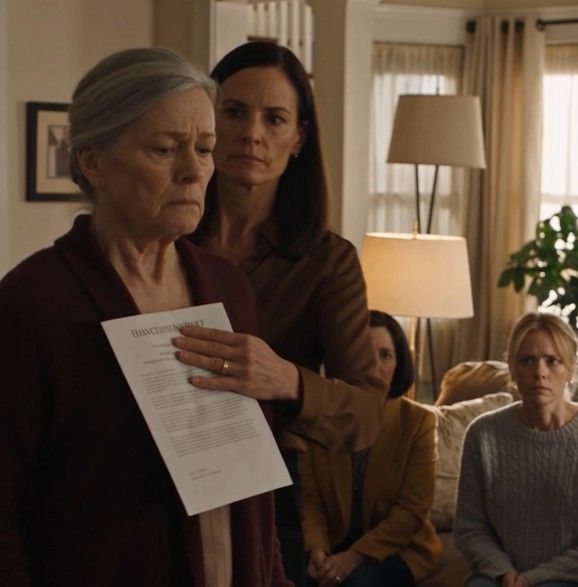
I remembered her only as the woman who had looked at the wedding photograph.
Her letter asked whether I would permit a visit. She said there was something she wanted to explain, but she would understand if I preferred never to see anyone from that evening again.
I let the letter sit for three days.
Then I invited her for tea.
Nora arrived carrying no flowers, no wine, nothing that would make the visit feel like a celebration. She stood on the step until I asked her inside.
“I should have spoken that night,” she said.
I led her to the sitting room.
She sat on the edge of the same sofa.
“Melissa knew a colleague of mine. She’d invited a few of us over. I work for the bank, though not in lending.”
My hand tightened around the teapot.
“She said you were Brian’s aunt. That you’d come to stay after his mother died.”
I looked at the photograph.
“But that was you,” Nora said. “And when you called him your son, I knew something was wrong.”
“You heard?”
“Enough. Not everything.”
She swallowed.
“The next morning, I reported what I’d seen through our internal fraud channel. I didn’t know there was an application until investigators contacted me later.”
I set the pot down.
For months, I had remembered that room as a collection of people who watched me disappear.
One of them had gone home and refused to let it happen.
“There’s something else,” Nora said.
She took a photograph from an envelope. In it, a young woman stood beside a little girl wearing an enormous knitted hat.
“My mother cleaned houses when I was small. She worked for you for a few months after my father left.”
I recognized the woman before I recognized the child.
“Janine.”
Nora nodded.
“You let me sit in your kitchen when school was closed. Your husband taught me to shuffle cards.”
I remembered small fingers dropping half a deck, my husband solemnly insisting the floor was simply another part of the game.
“Your mother found office work.”
“She did. You wrote her reference.”
Nora looked toward the fireplace again.
“I remembered that photograph. That was why I kept looking at it. I was trying to place you before Melissa sent you upstairs.”
I touched the corner of the picture she had brought.
I had thought my life had narrowed to what two people were willing to leave me. Yet something I had done years before, without considering it especially generous, had survived outside this house and found its way back.
“Is your mother well?”
“She’d very much like to see you.”
“Then we should set another place.”
Nora pressed her lips together and nodded.
By the following autumn, Brian had completed his community service and kept his job. He made no request to return. When we met, he arrived when invited and left when agreed. Slowly, those ordinary acts became something I could trust.
I invited him to Sunday dinner with Ruth.
He stood in the doorway holding a pie.
“Where would you like me?”
It was such a simple question.
I pointed to a chair at the kitchen table.
“Here.”
He sat.
Ruth complained that he had bought the wrong kind of pie, then cut herself the largest piece. Brian laughed, uncertainly at first. I brought out my husband’s chipped glass and filled it with the last marigolds from the garden.
After dinner, Brian washed the dishes while Ruth dried. I stood nearby, not because I needed permission or because I feared what might happen if I left, but because I liked their company.
When they had gone, I turned off the porch light and checked the lock.
The house settled around me with its familiar wooden sighs.
In the sitting room, my blue sleeve brushed the restored centerpiece. I straightened one crooked stem, then left another exactly as it was.
There were crumbs on the table, clean glasses in the cupboard, and a chair waiting wherever I chose to sit.
I sat downstairs until the last light faded, with no one left to ask.
