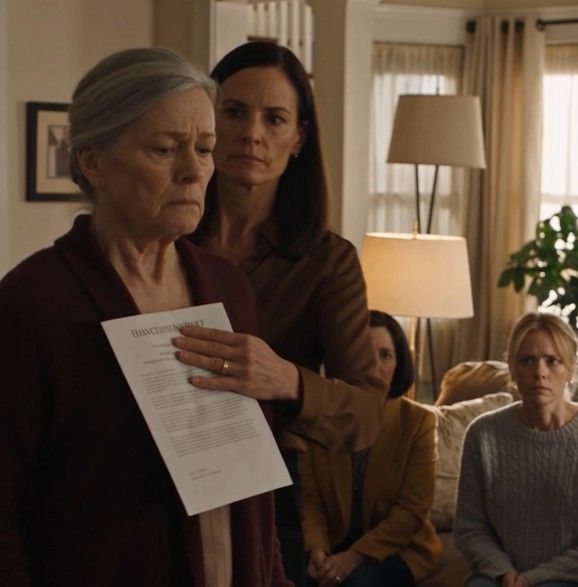
“You’ll be lonely.”
Ruth’s chair scraped against the floor, but I touched her wrist.
“Perhaps sometimes,” I said.
Melissa waited.
I gave her nothing else.
Brian left his key on the hall table. He had a room arranged near a warehouse where he had recently started work. Melissa was going elsewhere. Their separation was not dramatic in front of me; whatever remained between them had become another thing they carried out in boxes.
“I’ll give Helen my address,” he said.
“All right.”
He looked toward the kitchen.
“Dad’s glass is behind the flour tin. I moved it so nobody would break it.”
After he left, I found it there.
I sat on the kitchen floor holding that ridiculous chipped glass, angry that he could protect something so small while helping someone take everything around it.
Ruth lowered herself beside me with a groan.
“Neither of us is getting up gracefully,” she said.
I laughed once, painfully, and then leaned against her shoulder.
The investigation took months.
There were requests for records, interviews, and days when an unfamiliar envelope made my stomach tighten. Helen checked the property records and helped me secure my accounts. Nothing had transferred. The house remained mine, without the fraudulent loan against it.
The false death certificate had come from a file Melissa edited. Messages showed her instructing Brian to use a separate email address and keep the bank’s correspondence away from me. His replies showed agreement, not confusion.
When Melissa claimed she had believed I had authorized everything, investigators had the messages in which she complained that I would never consent.
Her own words closed that door.
Both were charged. Both eventually pleaded guilty to their roles in the fraud.
Melissa received a prison sentence. Brian’s sentence included probation, community service, and restitution. His early admission and cooperation mattered, but they did not erase his conviction. Neither of them could turn what they had done back into a misunderstanding.
Their divorce followed.
I attended the sentencing with Ruth. Melissa did not look at me. Brian did, briefly, before lowering his head.
I had expected satisfaction.
What I felt was exhaustion, and then an unfamiliar space where dread had been.
Outside, Ruth asked whether I wanted to go home.
“Not quite yet.”
We ate soup in a small café. Halfway through lunch, I realized I was hungry.
Brian began sending payments through Helen. I accepted them. The amount was small, but I no longer confused refusing repayment with loving my child.
For a long time, I did not see him.
Then, one afternoon, I agreed to meet him on my porch.
He sat at the far end of the bench.
“I kept thinking about the night of the party,” he said. “You called my name.”
“Yes.”
“I heard you.”
“I know you did.”
He rubbed his thumb along a seam in his trousers.
“I wanted you to stop asking so I wouldn’t have to choose.”
“You did choose.”
His face crumpled, but he did not argue.
We listened to a lawn mower starting down the street.
Finally, I told him something I had not managed to say in Helen’s office.
“I missed your father in my own house. Then I started missing myself.”
Brian cried quietly, without reaching for me.
I stayed beside him.
It was not forgiveness. It was the first conversation in which he had not asked me to make his pain smaller.
CHAPTER 5 – A Place at the Table
I washed the blue blouse twice before I could wear it.
The first time, I hung it at the back of the wardrobe. The second time, I left it over a chair where morning sunlight touched the sleeve.
Eventually, I put it on to buy groceries.
Nothing happened.
No one knew what the fabric had carried. A cashier complimented the color, and I said thank you without needing to explain.
I began inviting people over again.
Ruth came on Tuesdays. An old friend from the library brought a cake and stayed until we had eaten indecently large slices. I moved the cream sofa back toward the fireplace because I liked to see the photograph when I sat down.
The autumn centerpiece turned up in a cupboard in the garage, crushed beneath a shopping bag.
Most of it could be repaired.
Ruth helped me straighten the wire stems at the kitchen table. We kept the pieces that were mine and threw away the ones that had broken.
Nearly a year after the bank called, Helen forwarded a letter from a woman named Nora Ellis.
She had been at Melissa’s gathering.
