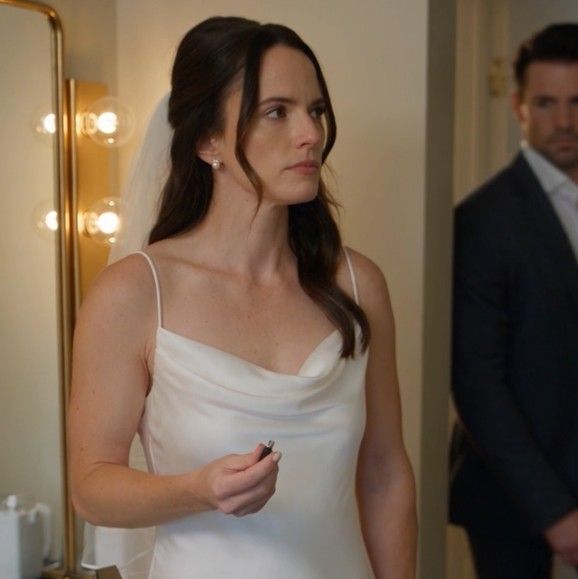
“Do you think he ever loved either of us? Even a little?”
I thought about it. Really thought about it.
“I think he loved the idea of us. The access. The convenience. But no. I don’t think he ever saw us as people.”
“Then I’m glad he’s gone.”
“Me too.”
We walked to the car in silence.
Maya was waiting at my apartment when we got home. She had set up her laptop on the kitchen table and was already typing.
“What are you doing?” I asked.
“Applying for a grant. There’s a foundation that funds forensic accounting programs for wrongful conviction cases. I want to build a practice that helps people like you — people who were buried under fabricated evidence and had no one fighting for them.”
I sat down across from her.
“You already fought for me.”
“And now I want to fight for everyone else.” She looked up from the screen. “You should join me.”
“What?”
“Your operations experience. Your knowledge of corporate systems and financial workflows. You understand how companies are structured from the inside. That’s exactly what we’d need.”
I stared at her.
“You’re serious.”
“I’ve never been more serious about anything in my life.”
I looked at Vanessa.
Vanessa looked at me.
“Tell me more,” I said.
The foundation launched eight months later. We called it the Bellamy Trust — a deliberate reclamation of the name Adrian had tried to use as camouflage. My mother donated the first major contribution, publicly, with a statement that acknowledged what she had done and why she was committed to making sure it didn’t happen to anyone else.
My father quietly resigned from the board of Bellamy Events and used his exit settlement to fund a legal defense fund for employees who had been wrongfully terminated. He never asked for recognition. He never asked for forgiveness. He just did the work, day after day, in small rooms with no cameras, building something that might, over time, balance the scales.
He and I speak every Sunday now. Short calls at first. Tentative. Careful. Then longer. Then easier. We are not what we were. We may never be what we were. But we are becoming something new, and it is honest, and it is ours.
Vanessa enrolled in law school. She told me she wanted to specialize in corporate fraud prosecution, and when I asked her why, she said, “Because I almost married a man who would have destroyed our entire family, and I want to make sure the next Vanessa has someone in the courtroom who understands what it feels like.”
My mother started painting again. She had abandoned it years ago, when the social calendar and the board dinners and Adrian’s constant orbit consumed every hour. Now her easel stands in the breakfast nook where the good china used to be displayed, and the walls of her home are slowly filling with bold, vivid canvases that look nothing like the delicate watercolors she used to produce. She told me the old paintings were about control. These new ones are about letting go.
And me.
I wake up in the mornings now and the first thing I feel is not dread.
That single shift — from dread to its absence — is the most profound change of my life. Not joy, not triumph, not vindication. Just the quiet, radical absence of fear.
I work with Maya every day. We share an office in a converted warehouse downtown with exposed brick and too many plants and a coffee machine that only works if you hit it twice on the left side. We have twelve clients now. Twelve people who were silenced, framed, discarded, and who found their way to us because someone handed them a black box and told them to decide for themselves.
I still keep one of those boxes in my desk drawer. Empty. Just in case I need to remember what it felt like to hold all the truth in my hands and know that the only thing between me and justice was the courage to open the lid.
On Friday evenings, the four of us gather at my mother’s house for dinner. My father grills despite everyone’s suggestions that he stop. Vanessa brings dessert from whatever new recipe she is testing. Maya brings her stories — wild, sprawling tales about her childhood that make us laugh until the candles burn down. My mother paints while we eat, standing at her easel in the corner, occasionally turning to add a comment or steal a bite from someone’s plate.
Last Friday, as the sun was setting through the kitchen windows and casting everything in that warm amber glow that makes even ordinary things look sacred, my mother set down her brush and looked at the four of us around the table and said, “This is what I should have been protecting all along.”
Nobody spoke for a moment.
Then Vanessa said, “You are now.”
And my mother smiled — a real smile, unguarded, the kind she hadn’t worn since I was a child — and picked up her brush again.
I drove home that night with the windows down and the radio off, just the sound of the engine and the air and the distant rhythm of the city winding toward sleep. I thought about the man who had tried to take everything from me and how, in doing so, he had shown me exactly what I had.
Not the company. Not the money. Not the name.
This. The table. The laughter. The people who stayed.
I pulled into my apartment building’s small parking lot and sat in the car for a minute, listening to the engine tick as it cooled. A moth circled the streetlight above me, patient and persistent, drawn to the light not because it understood it but because it couldn’t help itself.
I thought about Adrian in his cell, in his government-issued uniform, stripped of every name he had ever stolen.
I thought about the passport in his pocket that said Daniel Reeves.
I thought about the email in which he wrote that the Bellamys were perfect — old money, old guilt, old loyalty — and how right he had been about all of it, and how wrong he had been about what that meant.
He thought old loyalty was a weakness to exploit.
He didn’t understand that old loyalty, tested and broken and rebuilt on truth, is the strongest thing there is.
I went upstairs. I unlocked my door. I set my keys on the hook by the entrance — the same hook where, months ago, I had hung the black box before Maya delivered it to Vanessa.
The apartment was quiet.
I stood in the doorway for a moment, breathing in the familiar smell of old books and coffee and the cedar candle Maya had given me, and I felt something settle in my chest — not happiness, exactly, but the ground beneath happiness. The still, solid surface that joy needs in order to stand.
I was home.
Not because of the walls or the address or the locks.
Because I had stopped running from the story of what happened to me and started living in the truth of who I became because of it.
