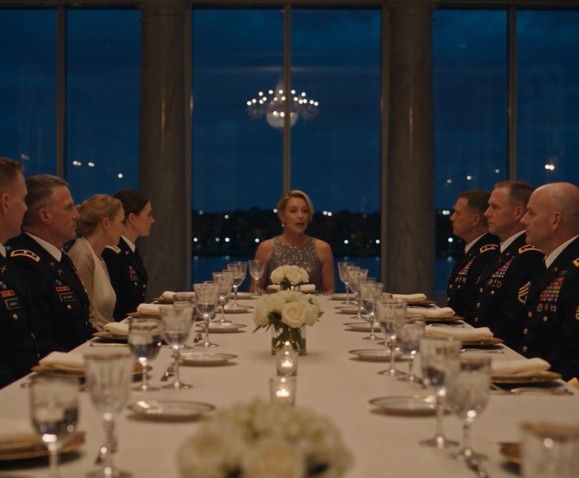
My mother told a ballroom full of decorated officers that I should have been the one who was gone instead of my brother. Minutes later, she mocked my military service, demanded I reveal my “cute little call sign,” and waited for twenty-four officers to laugh with her. Then I said two characters and three numbers: “R-007.” My name is Major Nora Whitaker, United States Army aviation, and that evening I sat near the end of a charity-gala table overlooking the Potomac, partly hidden behind a marble column as though my own family had misplaced me on purpose. The ballroom was polished stone, white linen, crystal, quiet music, and carefully positioned cameras. A small American flag stood beside the foundation banner near the entrance. My mother, Meredith Whitaker, knew how to make cruelty look respectable beneath chandeliers. She had seated my sister Celeste at her right hand in a cream silk dress while I wore the Army dress uniform I had pressed myself in a hotel bathroom before arriving. Every ribbon was aligned. Every crease was sharp. I had signed the security log downstairs at 6:12. The photographer had glanced at my badge, then looked past me as if searching for the daughter who mattered. Celeste’s only greeting had been, “You’re late.” I was six minutes early. At 7:18, Meredith tapped one red fingernail against her glass three times. Conversation faded. “This foundation exists,” she told the cameras, “because sacrifice has to mean something.” Officers around the table listened politely. Colonel Connor Hale, seated near the opposite end, did something different. He watched me. He had been doing it since the salad course, becoming more attentive each time someone said the name Whitaker. Meredith continued. “My son, Owen, gave everything for this country. He understood duty. He understood honor. Some people in this family never did.” Then she looked directly at me. “She should have been the one gone instead of my son.” What stayed with me was not the sentence. Meredith had said cruel things before. It was the silence afterward. Twenty-four officers sat motionless. A fork remained suspended over a plate. One man studied his napkin. Nobody challenged her. I kept my hands flat in my lap. An instructor once taught me that when a cockpit begins screaming, you do not become another alarm. Meredith took a slow sip of wine. “Go ahead, princess,” she said. “Tell these gentlemen your cute little call sign from that helicopter unit. Did they use it over the radio while you were crying and asking to come home?” The first laugh came from one colonel. Then another. Soon most of the table had joined in. Celeste smiled into her glass, relieved that the attention remained on me. My pulse did something unexpected. It slowed. I could have stood and told Meredith everything she did not know. I could have explained what her foundation truly represented to me, what Owen had known, and why there were parts of my service history my family had never been allowed to see. I said none of it. Restraint was not weakness. Sometimes it was simply control. Meredith wanted tears, anger, or retreat. I gave her none. I lifted my eyes and met hers. “My call sign,” I said, “was R-007.” The laughter stopped instantly. At the far end of the table, Colonel Connor Hale’s glass slipped from his hand and shattered across the marble. Red wine spread beneath his chair as he stood so quickly it struck the wall behind him. His face had gone completely pale. “Say that again,” he said, his voice breaking slightly. For the first time all evening, my mother stopped smiling, because Connor Hale clearly knew exactly what R-007 meant—and nobody else at that table did. 👇
Connor Hale did not sit back down.
He stood beside the shattered glass, one hand braced against the table as though the call sign had reached across years and struck him physically.
“Say it again,” he said.
I held his gaze.
“R-007.”
The ballroom seemed to contract around the two of us.
My mother looked from Connor to me. “What is wrong with him?”
Connor did not answer her. His eyes had gone somewhere else entirely—somewhere with rotor wash, smoke, and darkness.
Then he straightened.
“Major Whitaker,” he said, and his voice was steady again, “were you the aircraft commander on Red Flight Seven during Operation Lantern?”
Every muscle in my body tightened.
The name had not been spoken in front of my family before.
“Yes.”
Connor closed his eyes for half a second.
When he opened them, there was no confusion left.
“I was Chalk Two.”
My mother frowned. Celeste stopped smiling.
I knew exactly who he was now.
Twelve years earlier, before the gray at his temples and the colonel’s eagles, Connor Hale had been a young captain leading a ground element trapped in a mountain valley after a coordinated attack cut off their planned extraction route. Owen had been with him.
My brother.
The son whose portrait hung behind my mother’s foundation podium.
The son she had just told a ballroom full of officers I should have died instead of.
Connor looked toward Meredith.
“Ma’am,” he said quietly, “your daughter came back for us.”
The room went completely still.
My mother stared at him.
“What?”
Connor moved around the table, stepping over the broken glass. “Red Flight Seven was the call sign of the aircraft that made the final approach after two earlier extraction attempts were turned back.”
My hands stayed flat in my lap.
“Connor,” I said.
He stopped.
There were still limits.
Even now.
He understood immediately.
“I will only discuss what has been released,” he said.
Then he looked back at my mother.
“What is public now is this: Major Whitaker’s crew entered a landing zone under conditions that had already forced other aircraft away. They evacuated wounded personnel and returned for a second lift when fuel and damage made that decision exceptionally difficult.”
My mother’s lips parted.
Connor’s voice became softer.
“Your son was on the second lift.”
Celeste turned toward me so fast her chair moved.
“You were with Owen?”
I had imagined being asked that question for years.
I had never imagined it here.
“Yes.”
Meredith shook her head. “No. Owen died overseas. Nora was somewhere else. We were told—”
“You were told what you were permitted to be told,” I said.
Her face went white.
For twelve years, she had built grief into architecture. A foundation. Annual dinners. Press releases. A scholarship bearing Owen’s name. She had turned his death into a public story about sacrifice while privately making me responsible for the emptiness he left behind.
