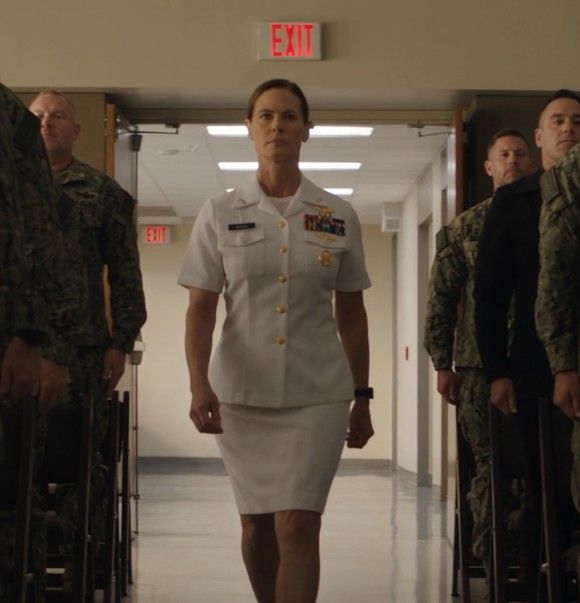
Fourteen minutes before I entered the command hall in Coronado, my father texted me five words: “Nobody cares about your Navy career.” Then I walked through the doors, nearly three hundred battle-tested SEALs rose at once, and someone called, “Admiral on deck!” My father sat frozen in the last row. My name is Rear Admiral Claire Mercer, and as the doors closed behind me, the measured sound of my boots seemed impossibly loud. I spotted Dad immediately. Frank Mercer had spent my childhood entering every room as though it belonged to him. Now he sat between my younger brother Evan and an empty chair, his phone still clutched in his hand. I knew what was on the screen because the same message remained unanswered on mine. The commander ordered everyone seated. Almost three hundred men moved at once. Dad leaned toward Evan. “They’re required to do that,” he whispered. “It’s protocol.” He was right. That was the frustrating part. I was a flag officer. Of course they stood. Dad had spent thirty-one years finding explanations that made every achievement smaller. When I received my commission, he called it “government college in uniforms.” When I became a commander, he asked whether that was “actually a big deal.” When Mom framed a photograph from my first promotion, he placed one of Evan’s construction awards above it. Evan had never treated me like a rival. Dad did that for both of us. Mom was different. She rarely understood the acronyms, but she understood showing up. She attended every ceremony she could, usually wearing the same tiny gold anchor pin on her blue jacket. After she died eighteen months earlier, I found that pin inside an envelope with my name written across it. Dad skipped the ceremony when I made rear admiral. He did not call afterward. So when I invited him to my change-of-command ceremony, I expected silence. Three days before it, he called. “Is this another one of those events where everybody salutes you?” “It’s a change of command.” “So that’s a yes.” I nearly ended the call. Instead, I told him Mom would have wanted him there. After a long pause, he asked where to park. That morning, I sent the visitor instructions and one sentence: I’m glad you’re coming. His reply arrived fourteen minutes before the ceremony. Nobody cares about your Navy career. I locked my phone and handed it to my aide. Then I walked inside. At the podium, Captain Luis Reyes thanked the families, staff, and operators gathered from commands throughout Naval Special Warfare. Dad kept looking around. These were not young recruits impressed by polished shoulder boards. Some had gray in their beards. Others moved carefully because of old injuries. A man near the aisle had a prosthetic below his left knee. When Reyes said my name, that man touched two fingers to his chest and gave me a single nod. Dad noticed. He looked away first. The ceremony should have moved directly into the transfer of command. Instead, Reyes closed his prepared remarks. “Before we continue, Command Master Chief Davis has asked for two minutes.” That was not on Dad’s program. It was not on mine either. Davis approached carrying stapled pages inside a clear protective sleeve. I recognized the marking across the top. He looked at me. “Admiral, you’ll have to forgive me for changing the order.” Then he faced the room. “There are parts of Admiral Mercer’s career that her family was never authorized to hear about. Some of those things should stay that way. But one record was partially approved for release this week.” My throat tightened. Davis looked toward the back. “Mr. Mercer?” Dad slowly stood. “Your daughter has spent most of her adult life respecting restrictions that prevented her from defending herself whenever people misunderstood what she actually did.” Dad answered, “I never asked her to defend anything.” Davis nodded. “No, sir. I imagine that may be part of the problem.” Then he explained the report concerned an operation from twelve years earlier and that several people in the room had been there. The man with the prosthetic lowered his eyes. Another SEAL clasped his hands tightly between his knees. For the first time, Dad stopped looking at the stars on my uniform and started looking at the men. Davis handed the report to Captain Reyes. Reyes found a marked paragraph and looked directly at my father. “Mr. Mercer, you told your daughter this morning that nobody cares about her Navy career.” Dad’s face changed. Reyes lowered his eyes to the page. “I think you need to hear why this entire room became silent when she walked through those doors.” He turned one page and began to read. “At 0217 hours—” 👇
Captain Reyes stopped after the time stamp.
The room held so still that I could hear the faint hum of the ventilation system above the command hall.
“At 0217 hours,” he read, “the primary extraction route was lost following coordinated hostile fire and a vehicle strike. Communications with the forward element were intermittent. Rear Admiral Mercer, then serving as the joint maritime operations lead, assumed control of the recovery plan after the first support aircraft was forced to divert.”
Dad’s eyes moved from Reyes to me.
I did not look away.
Reyes continued.
The language in the report was dry because official records usually are. It described shifting routes, damaged equipment, a worsening weather window, and a team whose position could not be held indefinitely. It described my decision to redirect two assets that had been reserved for a different contingency. It described a second approach after the first one failed.
It did not describe the voices in my headset.
It did not describe the man near the aisle, twelve years younger, trying to stay conscious while someone tightened a tourniquet above his knee.
It did not describe the moment a chief told me there was no safe option left and I answered, “Then give me the least bad one.”
Dad looked at the man with the prosthetic.
The man met his eyes.
Reyes read the last approved paragraph.
“Her decisions resulted in the recovery of all surviving personnel from the isolated element and prevented additional casualties during the withdrawal.”
He lowered the report.
No one applauded.
That was right.
Some things are not applause moments.
Command Master Chief Davis stepped forward.
“The rest remains restricted,” he said. “But every operator in this room who was connected to that night knows what those sentences leave out.”
Dad swallowed.
The man with the prosthetic stood.
“My name is Aaron Cole,” he said. “I was one of the people on that element.”
Dad’s grip tightened around the back of the chair in front of him.
Cole touched the edge of his prosthetic.
“I lost part of my leg later because the damage was too severe. But I got home alive. So did the men beside me.”
He looked at me.
“Admiral Mercer never asked us to thank her. Most of us were not even allowed to explain the operation to our families for years.”
Then he looked back at Dad.
“But you should know something. When your daughter walked through those doors today, I did not stand because a regulation told me to respect stars. I stood because I remembered her voice on the worst night of my life.”
Dad sat down.
Not slowly.
His legs seemed to make the decision for him.
Evan remained standing beside him for another second before sitting too.
My brother looked at me as if he were seeing the outline of a person he had known only in fragments.
I had expected anger from Dad. Maybe disbelief. Maybe another attempt to minimize what he had heard.
Instead, he looked down at his phone.
The message was still there.
Nobody cares about your Navy career.
His thumb moved over the screen, then stopped.
Captain Reyes returned the report to Davis.
“Mr. Mercer,” he said, “you were invited today because family is part of command. Not decoration. Not background. We asked Admiral Mercer if there was anyone she wanted present. She gave us your name.”
Dad looked up sharply.
I felt exposed in a way no classified briefing had ever made me feel.
He turned toward me.
“Why?”
I answered honestly.
“Because Mom would have wanted you here.”
The tiny gold anchor pin was inside my left pocket.
