I went to every appointment Dr. Patel scheduled. I bled, then I didn’t. I fed Noah at all hours. I let my sister Maya come from Oregon, even though we hadn’t spoken in a year, and I let her sleep on Priya’s couch and then on my couch when I finally moved back into the house. She didn’t ask questions. She just washed bottles, folded laundry, and held Noah while I sat on the bathroom floor and cried for the marriage I thought I had.
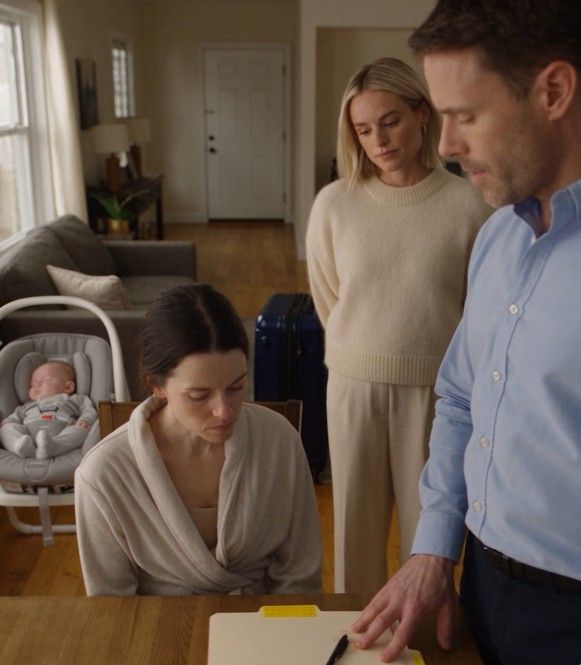
One night, maybe six weeks after the curb, Maya found me in the kitchen at midnight, staring at the folder Ethan had slid across the table. I had kept it, yellow tabs and all.
“Why did you keep it?” she asked softly.
I traced the edge of the acknowledgment I had signed. “Because I want to remember that I read it. That I didn’t panic. That I knew what I was signing.”
She came and hugged me from behind, her chin on my shoulder. “You were so brave.”
“I wasn’t brave,” I said. “I was bleeding and terrified. But I had copied the bank statements two weeks before. I think some part of me knew. I think I was waiting for him to prove who he was.”
We stood like that until Noah cried, and then we both went to him.
The healing was not linear. There were days I couldn’t get out of bed. Days I was angry at myself for not seeing it sooner, for walking away from my career for him, for polishing those floors while pregnant like that would make him love me. Priya made me say it out loud in her office: “You did not cause this. His fraud is not your failure.”
Karen called me in late April. “He wants to plea,” she said. “He’ll get thirty months federal, minus time served. He wants to write you a letter.”
I said no to the letter. I said yes to the plea. I didn’t want Noah to have to visit a courtroom.
The day Ethan was sentenced, I didn’t go. Priya went and texted me one line: It’s done. I was in the backyard with Noah on a blanket, watching him learn to roll. The light was soft. The air smelled like cut grass. I put my phone down and picked up my son and held him against my chest until his warm weight made my arms ache.
That should have been the end.
But there was one more thing. One beautiful twist I didn’t expect.
In May, Mr. Albright’s paralegal called. “Your grandmother’s trust attorney asked us to review the file when we pulled the deed,” she said. “There’s an envelope in the safe. It’s been there since the trust was funded. Your grandmother left instructions – to be opened only if you ever needed to enforce the trust. Or if you became a mother.”
I went to the office with Noah in his carrier. Mr. Albright was old now, his hands spotted, but he remembered me. He remembered her.
He slid a cream envelope across the desk. My name in my grandmother’s handwriting – Lena, love.
Inside was a letter, two pages, and a second document.
My dearest Lena,
If you are reading this, it means you needed the house I helped you buy. I hope you never needed it. I hope you are reading this on a happy day with a baby on your hip. But if you are reading it because someone tried to take what is yours, know this: I put that house in trust not because I didn’t trust you, but because I knew this world would try to make you feel you had to earn your safety by being small and useful to a man. You never did. That house was always yours. The money was always yours. You polished those floors for yourself and your child, not for anyone else.
The second page is a deed. Your grandfather and I bought the small cottage on Maple – the one with the blue shutters you loved as a girl – before you were born. We never sold it. We rented it quietly all these years. It is also in your trust, free and clear. If you ever want to leave Chestnut Lane and its memories, you have somewhere else to go. Or you can sell it and have your freedom twice over.
You were always the careful one, the one who kept receipts. I am so proud of you.
All my love,
Gram
The second document was a deed. 6 Maple Street. The cottage where I had spent every summer until I was twelve, shelling peas on the porch while Gram braided my hair. I had thought it was sold after she died.
I sat in that law office and sobbed – not the sharp, frightened tears from the curb, but deep, shaking, relief-filled sobs that made Noah startle and then quiet, patting my face with his small hand.
Mr. Albright handed me a tissue and waited.
“She knew,” I whispered. “She knew he might -”
“She knew you might need to remember you were never trapped,” he said gently.
I walked out of that office into the bright May sun with Noah asleep against my chest and two deeds in my diaper bag.
I didn’t sell either house.
I kept Chestnut Lane. I had the locks changed, the hardwood re-buffed, the nursery painted a soft, buttery yellow that had nothing to do with Ethan or Sloane. I turned Ethan’s old home office – the room where he had printed those fake Northstar invoices – into a home office for myself. Priya offered me a contract position, ten hours a week at first, remote, forensic review for the U.S. Attorney’s fraud cases. “You have an eye,” she said. “And you have a story that will make juries listen.”
I took it. I worked while Noah napped, with the front door open to the spring air.
Ethan wrote once more from the federal correctional facility, a short letter I allowed Rosa to screen. He apologized. Not well, but he tried. He said he understood now that he had claimed things that were never his – the house, the company, my labor – and that prison was teaching him what ownership actually meant. I didn’t write back. But I did tell Rosa that Noah could have a supervised visit on his first birthday, if Ethan’s counselor approved. For Noah, not for him.
On a Saturday in June, Priya and Maya and Rosa and Dr. Patel and Mr. Albright’s paralegal – all the women who had held me up without ever making me feel small – came for a barbecue in the backyard. We didn’t call it a housewarming or a divorce party. We just called it dinner.
Noah crawled for the first time that day, from my lap toward Maya’s outstretched hands, across the blanket on the grass. Everyone cheered. Priya cried and pretended she had something in her eye.
After dinner, after the sun had set and the string lights I had hung myself swayed in the warm air, after everyone had gone home and Maya had taken Noah upstairs to bathe him, I stood alone in the kitchen.
The house was quiet. The hardwood glowed. The fruit bowl sat in the center of the island, full.
I placed my hand flat on the counter – the counter I had chosen, paid for, installed – and felt its cool steadiness.
For the first time since I was still bleeding on the bathroom floor, I didn’t feel like a guest in my own life.
I turned off the kitchen light, left the porch light on for anyone who needed to find their way home, and walked upstairs to where my son was laughing in the bath, to where my sister was singing off-key, to where my life – my house, my work, my child, my future – was waiting, completely and finally mine.
