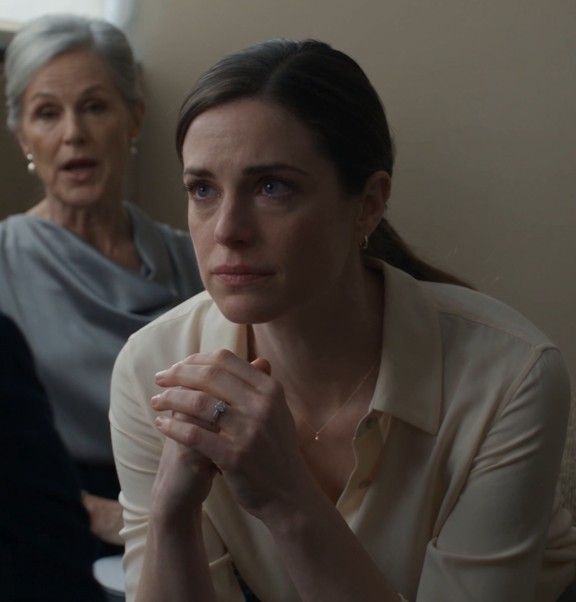
The little girl’s voice was soft and clear and it cut straight through the crystal and the string quartet and the held breath of two hundred guests.
She could not have been more than three years old, dark curls pulled back with a pale blue ribbon, her hand still locked tight in Amelia’s. Her eyes, wide and impossibly familiar, never left Ethan’s face.
Ethan’s hand spasmed. The champagne flute tilted, liquid shivering to the rim, and then slipped. It didn’t shatter so much as it cracked against the white linen, champagne bleeding across the tablecloth in a slow, widening stain while no one moved to stop it.
Amelia felt all three children press closer to her legs. Her oldest, a boy with Ethan’s exact furrow between his brows, kept his chin down. The middle girl clutched Amelia’s dress with both fists. The youngest just waited, her question still hanging in the air, innocent and absolute.
Margaret Caldwell recovered first. Her smile sharpened by a fraction, the practiced smile she used for shareholders and senators.
“Well,” she said lightly, her voice carrying too perfectly in the silence. “What a charming interruption. Amelia, darling, how lovely that you could join us. And you’ve brought… friends.”
A ripple of nervous laughter tried to start and died instantly.
Ethan hadn’t heard her. He was staring at the three children as if the room had fallen away. His chest rose once, hard, and then he couldn’t seem to get air again. His eyes moved from the boy to the girls, to their ages, to Amelia’s face, and the calculation hit him like a physical blow. Four years. Three heartbeats.
Olivia Harrington stood slowly from her place beside him. Her white dress caught the chandelier light. She didn’t look at Margaret. She didn’t look at the guests. She looked at Ethan, and then she looked at the little girl who had just asked the only question that mattered.
Ethan finally set the broken stem down. His fingers were shaking so badly he had to use both hands.
He stepped away from the head table.
“Amelia,” he said. His voice broke on the second syllable. He swallowed. “Amelia.”
Margaret’s hand shot out and closed around his wrist. Her nails were perfect. Her grip was iron.
“Ethan, dear, you are making a scene,” she whispered, still smiling for the tables. “These children are not ours to claim. Sit down. Olivia is waiting.”
Ethan looked down at his mother’s hand, and for the first time in his life, he pulled away.
He walked the ten steps between the head table and the doorway. Every eye followed him. The quartet had stopped entirely. A waiter stood frozen against the wall with a tray held mid-air.
He knelt. The polished floor was hard against his knee. He was now eye level with the three children, and up close the resemblance was undeniable, terrifying in its precision. The boy had his jawline. The middle girl had his sister’s eyes, the sister who had died as a child. The youngest had the exact small gap between her front teeth that Ethan had had until he was seven.
“Hi,” he whispered. He couldn’t get any louder. “Hi.”
The oldest boy stared at him, unsmiling, protective. “We told you not to make Mommy cry,” he said quietly, not as an accusation but as a fact he had carried for a long time.
Amelia’s breath caught. She put a hand on her son’s shoulder to steady him and herself.
“I know,” Ethan said to the boy, his eyes filling before he could stop them. “I know you did.”
Margaret laughed, a single, brittle sound.
“Enough of this theater,” she announced, rising now, her chair scraping loud against the marble. “Amelia Carter left this family four years ago of her own accord. She made her choices. To return now, at my son’s wedding, with children of uncertain parentage and attempt to -”
“They’re mine,” Ethan said without looking at her.
The room sucked in a breath.
Margaret’s composure cracked for half a second. “You cannot possibly know that.”
“I know,” he said, still kneeling, still looking at the children. His voice steadied as he said it again, louder. “They’re mine.”
Olivia took a step forward. Her hands were clasped so tightly her knuckles had gone white, but when she spoke, her voice was calm and kind.
“Margaret,” she said. “Stop.”
Margaret turned on her, incredulous. “Olivia?”
Olivia didn’t flinch. “I asked you earlier if you really wanted this marriage,” she said to Ethan, but she was speaking to the whole room. “You said ‘of course.’ I knew you were lying. I knew it for months.” She glanced at Amelia, and there was no jealousy in her face, only a deep, tired relief. “I didn’t know how you were lying until last week.”
Amelia’s head snapped up. “What?”
Olivia reached for the small, pearl clutch on her chair and withdrew a folded envelope, worn at the edges. She held it out, not to Ethan, but to Amelia.
“This was delivered to my apartment,” Olivia said. “No return address. Inside were copies of medical records. And a letter.”
Margaret went utterly still.
Amelia took the envelope with cold fingers. The children pressed against her, watching. She unfolded the papers with one hand. The top sheet was a lab report from the clinic where she and Ethan had gone four years earlier, the evaluation Margaret had insisted on. The name at the top was hers. The result line, stamped clearly, read: WITHIN NORMAL LIMITS. NO IMPAIRMENT DETECTED. PROGNOSIS: EXCELLENT FOR CONCEPTION.
The second sheet was Ethan’s. Same stamp. Same words. EXCELLENT FOR CONCEPTION.
Amelia’s hands began to shake violently. She looked up at Margaret, her eyes suddenly wet and furious.
“You told us it was uncertain,” she whispered. “You told us both – you sat in that office and told us the doctor said it might not be possible.”
Margaret lifted her chin, but color had drained from her neck. “I protected my son from a life of disappointment. The doctor explained -”
“The doctor didn’t explain anything,” Olivia cut in, her voice now shaking too. “Because you paid him. Dr. Michael Grant. He retired last year. He confessed in the letter. You paid him fifteen thousand dollars to tell two twenty-four-year-olds that their future was ‘uncertain.’ You told Amelia she was a risk. You told Ethan he would be tying himself to a childless marriage.” She looked at the three children. “You told them a lie so complete they never questioned it.”
A murmur tore through the ballroom, low and horrified. Ethan’s father, Robert Caldwell, who had said nothing for an hour, slowly pushed his chair back and stood. His face was gray.
“You told me the tests were inconclusive,” he said to his wife, his voice barely audible. “You told me Amelia had left because she didn’t want the pressure.”
“I did what was necessary for this family,” Margaret snapped, her perfect mask finally shattering. Her voice rose, sharp and desperate. “Do you think resorts run on kindness? Do you think legacies survive on love? I built this family! I protected our name from a schoolteacher’s daughter who would have dragged us down with her empty -”
“Empty?” Ethan was on his feet now. He wasn’t kneeling anymore. He was standing between Margaret and Amelia, and his whole body was trembling with a rage he had never allowed himself to feel. “You looked me in the eye and let me believe I couldn’t give her children. You let me watch her walk out with one suitcase in the rain and you told me to let her go because it was for the best. You let me believe for four years that I had lost her because I wasn’t enough of a man to stand up to you.”
He turned. Amelia was crying now, silent tears running down her face while she tried not to make a sound for the children’s sake. The oldest boy had wrapped his arms around her waist.
“I came after you,” Ethan said to her, and the words broke on a sob he didn’t try to hide. “That night. I drove to your apartment an hour after you left. Your neighbor said you’d gone to your parents in Augusta. I called. I called for three days. Margaret said you told her not to give me your number. That you said if I ever really loved you I would have spoken at that dinner.”
Amelia shook her head, her mouth opening, no sound coming out.
“I never said that,” she whispered. “I never – I waited by the phone for two weeks. I thought – I thought your silence at that dinner was your answer.”
Robert stepped around the table, his hand gripping the back of a chair for support. “Margaret intercepted the calls,” he said hoarsely, looking at his son with shame etched deep in his face. “She always handled the house line. She told me you’d changed your mind, Ethan. That you’d decided to focus on the business.”
