I bought Miguel lunch. He tried to refuse. I insisted.
We talked about ordinary things—his children, my garden, the absurd price of tomatoes. It was the first conversation connected to that day that did not make me feel like evidence.
Two years after the fall, Daniel and I sat across from each other in a therapist’s office.
It was not reconciliation.
It was a beginning with rules.
He had completed restitution obligations, taken a regular job, and spent months in counseling before I agreed to see him. I did not give him a key to my house. I did not share financial details. I did not promise holidays.
He did not ask.
“I miss you,” he said.
“I miss who I thought you were.”
He lowered his eyes.
“That makes sense.”
For once, he did not argue with my version of reality.
That was the first thing he did that felt like love.
We built from there slowly.
Some relationships heal into what they were. Ours did not. It became smaller, more careful, and more honest. I learned that peace did not require restoring access to someone who had abused it.
On my seventieth birthday, I walked the same shopping-center route alone.
My knee no longer needed a brace.
At the edge of the parking lot, I stopped beside the drainage ditch. Wild yellow flowers had grown along the slope. I took out my phone—the replacement I had bought after the original became evidence—and photographed them.
Then I sent the picture to Ruth.
No caption.
She replied with a heart.
I put the phone back in my pocket and kept walking.
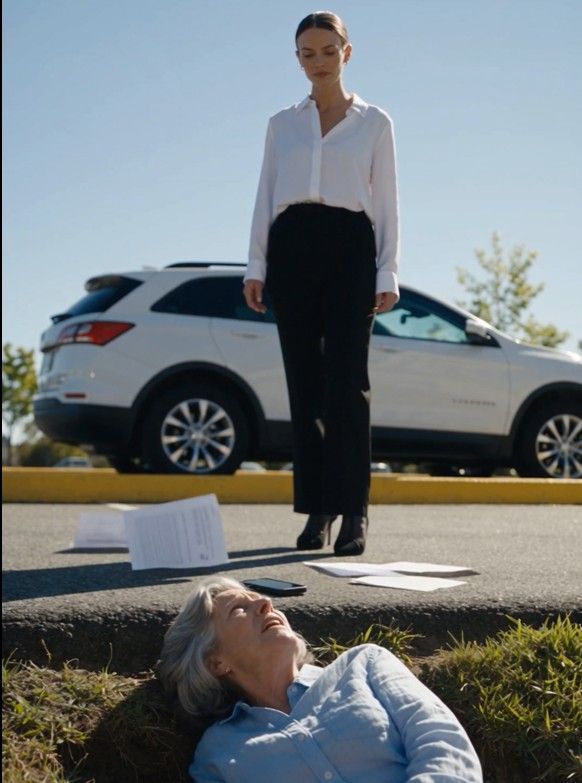
The ditch had once been the place where Vanessa told me I would never prove what happened.
In the end, the proof had not come from shouting louder than her or convincing my son to believe me.
It came from paper trails, a camera, and a delivery driver who heard someone calling for help and decided not to keep walking.
Most of all, it came from the fact that I never surrendered my own memory just because people I loved found it convenient to question it.
