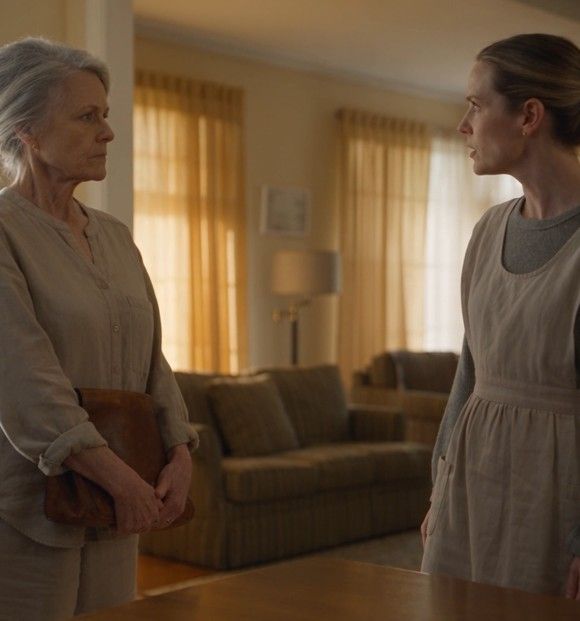
Eleanor did not rush the weeks that followed. For years, Michelle had made urgency work in her favor: answer now, agree now, clean this now, prove you are useful now. Eleanor began doing the opposite. Every decision about the house was written down. Every conversation involving money or care happened with another person present. Samuel Price reviewed the deed, the household expenses, and the documents Michelle had gathered while describing Eleanor as confused. Rebecca kept a notebook, not because Eleanor needed someone to speak for her, but because Eleanor had learned how easily a private conversation could later be retold as something else.
David struggled with that new clarity. His first instinct was still to explain Michelle’s behavior rather than name it. She had been stressed. The house had been crowded. Valerie’s birthday had become chaotic. Each excuse sounded smaller once he heard it aloud. Eleanor did not argue. She asked him one question: when had he last seen his mother sleep in the bedroom she had shared with Ernest? David could not answer. He stared at the floor, and in that silence the history of the house became harder to reduce to one ugly birthday scene.
The bedroom mattered because it was where the pattern had become physical. Eleanor had surrendered it gradually, first for convenience, then for peace, then because Michelle behaved as though reversing the arrangement would be selfish. Samuel made clear that ownership was not ambiguous. Eleanor did not need permission to reclaim any room in her own property. Yet when she finally opened the master-bedroom door, she did not feel triumphant. She saw the place where Ernest’s dresser had stood, the window they used to crack open during summer storms, and a pale rectangle on the wall where one of their photographs had been removed. She sat on the edge of the bed and cried for what she had allowed herself to forget.
Rebecca found her there and did not offer a speech. She opened the curtains. Dust moved through the afternoon light. Eleanor laughed weakly and said Ernest would have complained that nobody had cleaned the window tracks properly. The joke loosened something in her chest. Together they began sorting what belonged to whom. Michelle’s things were packed carefully, not thrown into the yard, not damaged, not used as props in a public revenge. Eleanor wanted a boundary, not a spectacle.
Michelle reacted badly to the loss of control. She called relatives before Eleanor could, describing the situation as a sudden episode of confusion. This time the story met documents. Samuel had copies of the deed. The assessor had notes from the interrupted meeting. Rebecca had dates. David, finally forced to choose between protecting appearances and telling the truth, admitted that his mother had been pushed out of her bedroom and routinely treated as unpaid household help. Several relatives who had remained silent at Valerie’s party apologized. Eleanor accepted some apologies and declined others. She had stopped believing that every relationship had to be preserved simply because it was old.
Valerie became the person Eleanor worried about most. The girl had seen adults turn her birthday into a lesson about power, silence, and humiliation. Eleanor refused to make her responsible for repairing it. When Valerie asked whether Grandma was angry with her, Eleanor knelt so they were eye to eye and told her no. The adults had made adult choices. Valerie’s only job was to be a child. They baked together a week later in Rebecca’s kitchen, where flour ended up on the floor and nobody treated the mess as evidence of anyone’s worth.
David began therapy on his own. Eleanor did not request updates. She told him that if he wanted a relationship with her, she would judge it by what happened between them, not by promises about work he was doing elsewhere. He started with small things. He called before visiting. He did not arrive with laundry. He asked whether she wanted help rather than assuming she existed to provide it. The first few conversations were stiff. Then one afternoon he brought a box from storage containing Ernest’s old hand tools and asked where she wanted them. Eleanor realized he had not opened the box. For once, he had left the choice entirely hers.
Michelle moved out after the legal deadline Samuel arranged. There was no dramatic final confrontation. That was almost disappointing to people who had heard pieces of the story and expected Eleanor to deliver a speech on the front lawn. Eleanor wanted something more durable than a satisfying scene. She wanted the locks changed, the bills in the correct names, her medical information protected, and the false narrative about her capacity corrected in writing. Those things happened. Michelle’s authority over the house ended not with shouting but with signatures, receipts, and keys that no longer worked.
The opal necklace remained with Eleanor. Mr. Sterling’s offer had started the phone call Michelle interrupted, but Eleanor discovered she was not ready to sell it. The money could have been useful; the necklace was not sacred simply because it had belonged to her mother. Still, after everything else, she wanted one decision that did not have to be made under pressure. She placed the necklace in a small box and told Mr. Sterling she would contact him if she changed her mind. He answered that good antiques had survived longer waits than that.
That line made her smile. So had she.
Eleanor used the house differently once it was hers in practice as well as on paper. She moved back into the master bedroom but changed the curtains. Ernest had loved the old dark ones; she wanted morning light. She turned the laundry-room corner where she had once slept into shelves for gardening supplies. The transformation was not expensive. It was enough that the room no longer contained a bed. Every time she passed it, she saw proof that usefulness was not the rent she owed for belonging.
Rebecca helped her reconnect with two friends Michelle had gradually discouraged her from seeing. The first lunch was awkward because Eleanor felt embarrassed explaining how isolated she had become. Her friends did not ask why she had allowed it. They asked when they could see her again. That difference mattered. Soon her calendar contained ordinary things: coffee, a museum afternoon, Valerie’s school concert, a dentist appointment she did not have to justify to anyone. Freedom arrived looking less like escape than like possession of her own Tuesday.
David’s relationship with Valerie changed too. He had watched his daughter absorb the consequences of adult silence, and he became more careful about what she saw him tolerate. When Valerie interrupted him one evening to say she thought a joke about Eleanor was mean, David did not hush her. He agreed. Later he told Eleanor about it without presenting himself as heroic. He looked ashamed that his child had learned the lesson faster than he had.
Eleanor did not restore the family to what it had been. She built something narrower and healthier. David visited by invitation. Valerie had a key for emergencies and knew it was not permission for anyone else to enter. Michelle’s contact with Eleanor was limited and practical. Rebecca remained the person who could walk into the kitchen, make tea without asking, and still somehow make Eleanor feel more like the owner of the room rather than less.
The first gathering in the reclaimed house was deliberately small. No thirty guests. No performance. Eleanor invited Rebecca, David, Valerie, and two old friends. She cooked because she wanted to, then stopped halfway through clearing the table and sat down while the others finished. Nobody praised her for allowing them to help. Nobody needed to. The absence of entitlement was its own kind of quiet.
Later, Eleanor found herself alone for a moment beneath Ernest’s sign. The brown leather purse rested on a chair nearby, no longer carrying proof that she belonged in her own home. She touched the worn handle and understood the final gift Ernest had left her without knowing it: not the deed, not the purse, but the memory of being loved without being made smaller.
One practical change surprised Eleanor more than the legal ones. She began using the front door without listening first for who might be in the living room. During the years of Michelle’s control, entering her own house had become an act of assessment: Was someone irritated? Was there a task waiting? Would she be accused of forgetting something? Once that vigilance faded, Eleanor noticed how exhausting it had been. She could come home carrying groceries, set her purse on the hall table, and take ten minutes to sit by the window before doing anything else. No one measured the pause.
She also asked Samuel to prepare a simple estate plan that made her intentions unmistakable. The experience was different from discovering the old deed. This time Eleanor was not proving ownership after someone challenged it; she was deciding, calmly and in advance, how her property should be handled. Valerie would be protected without being placed in the middle of adult conflict. David would understand the conditions clearly. No one would be able to use uncertainty as leverage. Eleanor signed only after reading every page herself.
When she finished, Samuel asked whether she wanted Rebecca to witness the final copy. Eleanor smiled and said yes. Rebecca had been present when a faded folder reopened Eleanor’s eyes, and it felt right that she should also be present for paperwork created from confidence rather than fear. They went for coffee afterward. The documents stayed in Eleanor’s bag while they talked about a spring trip, new curtains, and whether Valerie was old enough to learn Eleanor’s pie crust recipe. The ordinary conversation felt like evidence of its own.
David entered the hallway and stopped at a respectful distance. “Need anything, Mom?”
Eleanor looked toward the warm dining room, then back at him. “No,” she said, smiling. “I have my place.”
Eleanor also stopped explaining every boundary. A closed door could simply be closed. A declined request could remain declined. She discovered how much energy she had spent preparing defenses for ordinary choices. The first time David accepted no without asking why, she noticed the absence of pressure more strongly than she would once have noticed an apology.
