One rainy afternoon, nearly six months after the sentencing, we opened the black leather folder again.
Not for evidence.
For Arthur.
The criminal case was over, and my attorney had returned the personal materials no longer needed. Tucked behind the final divider was a thin envelope I had somehow never noticed because it had been pressed flat against the backing.
SARAH, Arthur had written across the front.
Her hands began to shake.
Inside was a single page dated four days before his death.
He had written that he was sorry he had not told her about Mark immediately. He had wanted proof before asking her to choose between her husband and her father. He wrote that Mark had claimed she knew about the transfers, but that he did not believe it for one second.
Then came the line that broke her open.
You have always had a generous heart. If someone used that generosity against you, the shame belongs to them, not you.
Sarah pressed the paper to her chest and cried against my shoulder the way she had when she was a little girl.
I cried too.
That letter became the beautiful truth hidden inside the ugliest folder I had ever owned.
The house was never sold.
For a long time, I thought keeping it meant refusing to move forward. Then I realized the opposite. Mark had looked at my home and seen collateral. Sarah had once looked at it and seen a problem to solve. Arthur had filled it with books, old coats, arguments, dinners, ordinary mornings, and thirty-five years of living.
I began changing it carefully.
I boxed some of Arthur’s clothes and donated them. I kept his wool coat. I moved his reading glasses from the side table into the desk drawer instead of leaving them exactly where he had last set them. I repainted the guest room Sarah had slept in after leaving Mark.
The following spring, she helped me plant two dogwood trees near the back fence.
One Sunday evening, almost a year after that terrible dinner, Sarah arrived carrying roast beef and a loaf of bread.
“No financial advice tonight,” she said as she set the dishes down.
“Excellent rule.”
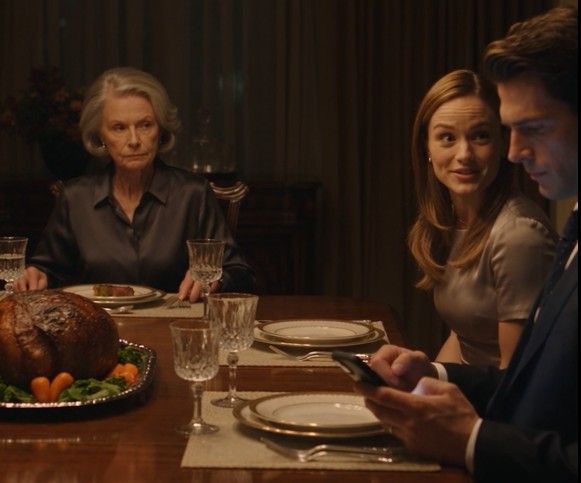
We ate at the same table where the wineglass had shattered.
The black leather folder was no longer there.
Arthur’s letter to Sarah had been framed in simple wood and placed on the bookshelf behind us, not as evidence, not as a warning, but as proof of something Mark had never understood: trust could be wounded without being erased.
After dinner, Sarah carried our plates to the sink. I opened the back door, and the evening air moved through the kitchen. The dogwoods were beginning to bloom.
She came to stand beside me.
For a while, neither of us spoke.
Then Sarah slipped her hand into mine, and together we watched the first white petals move in the spring wind where nothing had been growing before.
By summer, Sarah had begun rebuilding parts of herself that had nothing to do with court dates or Mark. She enrolled in a weekend ceramics class because Arthur had once teased her that she could make a spreadsheet out of anything except clay. The first bowl she brought me leaned badly to one side. I put it in the center of the dining table and filled it with lemons.
“That is objectively terrible,” she said.
“It is structurally adventurous.”
She laughed so suddenly that both of us went quiet afterward. We had not heard that sound in the house for a long time.
The restitution process took months, and not every dollar came back. Some of the money had been spent beyond recovery. At first I found myself measuring the loss as Arthur might have, adding figures and imagining what the missing amount could have become. Then my attorney reminded me that Arthur’s estate was still secure, the house was mine, and I had more than enough to live without fear. The number stopped feeling like the center of the story.
Sarah eventually finalized her divorce. She kept very little from the marriage. She wanted her books, a few photographs from before Mark’s lies had swallowed everything, and the old blue bicycle she had bought with her first paycheck. When she rode it to my house one Saturday morning, hair coming loose from beneath her helmet, I saw the girl Arthur had trusted inside the woman who had survived him.
We created one new tradition that autumn. On the anniversary of Arthur’s death, instead of visiting the cemetery separately, we cooked his favorite dinner together and each told one story about him that had nothing to do with Mark, money, illness, or the investigation. Sarah remembered the time he ruined Thanksgiving gravy and secretly ordered replacement from a restaurant. I remembered him dancing barefoot in the kitchen during a power outage because the radio had gone silent and he insisted we could still hear the song.
Those were the memories I wanted back.
Before Sarah left that night, she paused beside Arthur’s wool coat, still hanging on the old brass hook near the mudroom.
“You’re keeping that forever, aren’t you?”
“Probably.”
She touched one sleeve and smiled.
“Good.”
I turned off the kitchen lights. The framed letter caught the last amber glow from the lamp in the hall. Outside, the dogwood leaves had gone red along the edges.
Sarah kissed my cheek, stepped onto the porch, then turned back just long enough to say, “See you Sunday, Mom.”
The door closed softly behind her.
I stood there with Arthur’s coat at my shoulder and the quiet house around me, no longer guarding it from anyone, no longer afraid of what another knock might bring. Then I touched the worn wool once, switched off the final light, and went upstairs knowing that the home Mark had tried to turn into collateral had become what Arthur and I had meant it to be all along: a place our daughter could still come back to.
