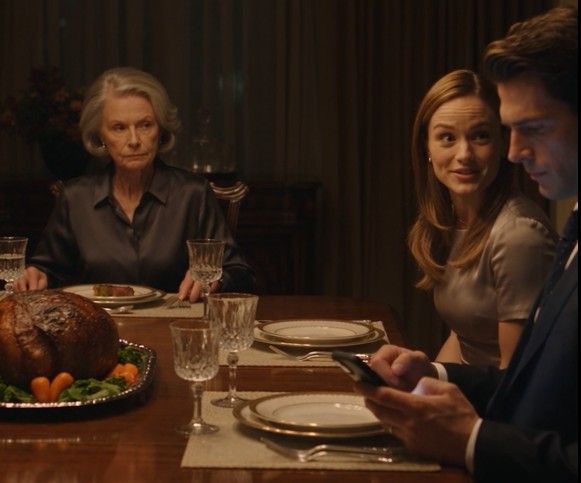
“No.”
His jaw tightened. “Don’t do this because your mother is emotional.”
“I’m not doing anything because of Mom.” She wiped her face. “I’m doing it because Dad wrote that you used his money, and you stood in this house tonight and lied before anyone even accused you of a crime.”
“Sarah—”
“Go.”
He looked at me then. The fear was gone for a moment, replaced by a hatred so direct it almost felt clean.
“You’ve destroyed your own daughter’s marriage.”
I shook my head.
“No, Mark. Whatever happens next, you built it yourself.”
He walked out.
Sarah stayed.
For three nights she slept in her childhood bedroom. She barely ate. She moved through the house like a person recovering from anesthesia, waking into a reality that hurt more each time it sharpened. I did not push her to talk. I made tea. I left clean towels outside her door. I answered when she asked questions and stayed silent when she did not.
On the fourth morning, she came into the kitchen carrying her wedding ring in her palm.
“I keep thinking about all the little things,” she said.
I poured coffee and waited.
“The year Dad died, Mark kept saying his company was under pressure. He told me not to ask questions because he was protecting employees. He said Dad had invested because he believed in him.”
She stared at the ring.
“I wanted that to be true.”
“Wanting to believe your husband is not the same as helping him steal.”
“He used our home network.”
“Yes.”
“What if he used my computer?”
“Then the forensic review will show that too.”
Her eyes filled.
“What if I signed something without understanding it?”
“Then you tell the truth about what you remember.”
Sarah nodded slowly. That became the beginning of her difficult choice. She could protect the marriage she had spent twelve years defending, or she could cooperate fully and accept that every answer might cost her the life she thought she had.
Two days later, she met Detective Ortiz with her own attorney.
She handed over her laptop.
She gave consent for investigators to review archived cloud backups.
And she told them about a night six days before Arthur died, when Mark had returned home after midnight furious and shaken. He had said Arthur was threatening to ruin the company over a misunderstanding. Sarah remembered Mark opening a bottle of whiskey in the kitchen and saying, “Your father is going to regret humiliating me.” At the time, she had dismissed it as anger.
Now she did not.
The financial case moved first.
Bank records showed that the $600,000 had not been invested in Meridian Strategic Holdings in any conventional sense. The transfers had covered payroll shortfalls, personal debt, a luxury vehicle lease, and a private bridge loan Mark had failed to disclose to Sarah. More troubling, investigators found attempted transfers totaling another $240,000 that had been rejected after Arthur changed his online credentials.
The device records matched what I had already found.
So did the signatures.
Mark’s attorney began calling the transfers “informal family financing.”
Then the independent document examiner retained by the state concluded that Arthur’s signatures on two authorization forms were simulated from older specimens.
The phrase sounded almost gentle.
The act was not.
Three weeks after Sunday dinner, Mark was charged with financial exploitation, forgery, computer-related fraud, and attempted theft. Bail conditions prohibited him from contacting me about the investigation or accessing any account connected to Arthur’s estate.
Sarah filed for separation the same afternoon.
But the question of Arthur’s death remained.
That was the question that woke me at three in the morning.
The preserved blood sample had been drawn after Arthur complained of unusual dizziness and nausea. His physician had ordered routine tests. The original panel had not included a broad toxicology screen. After his sudden death the following day, no one thought to connect the sample to what had happened. Arthur had heart disease. His death had been certified as a cardiac event.
My attorney had only requested further review after finding the note about Mark and seeing the timing.
The first laboratory had identified a sedating prescription compound that had never been ordered for Arthur.
The state laboratory confirmed it.
Then came a second finding: the concentration was high enough that, in combination with Arthur’s cardiac medication, it could have caused severe hypotension, disorientation, and a dangerous rhythm disturbance.
Could have.
