I went home from one meeting angry at everyone.
Then I opened a box of old company records from the first dealership. Warren and I had saved everything in those days because every dollar mattered. There were handwritten sales logs, repair invoices, payroll sheets, and one yellowed page listing employee Christmas bonuses from the winter the showroom heater failed.
At the bottom, Warren had written a note in pencil: Fix heater in January. People first.
I sat on the floor and stared at those three words.
For years, I had told the story proudly. We had chosen employees over comfort. Somehow, after Warren died, I had stopped applying the same principle to succession. I had begun protecting Desmond from discomfort at the possible expense of everyone whose livelihood depended on the company being led well.
The next board meeting, I said that aloud.
“I helped create this problem,” I told them. “That does not excuse what Desmond did to me. It does mean fixing it requires more than removing one document.”
We changed how executive promotions were reviewed. Family relationships had to be disclosed when they affected reporting lines. Major leadership roles required documented qualifications and independent board evaluation. We also created a clearer policy separating personal estate matters from corporate decisions so no one could again blur a private power of attorney into implied business authority.
The changes embarrassed me at first because they felt like public evidence that I had governed imperfectly.
Then one of our longest-serving dealership managers called.
“I’m glad you’re doing it,” he said.
“Were people worried?”
There was a pause.
“People wondered whether the future was already decided.”
I closed my eyes.
That was exactly what Desmond had believed.
The problem was larger than one conversation in his six-bedroom house. Employees had quietly assumed the same thing: no matter how hard they worked, the top chair belonged to the founder’s son. I had never announced that. I had simply failed to contradict it strongly enough.
The new process changed the mood inside the company before it changed any titles. People who had stopped applying for leadership-development programs began applying again. Managers asked more questions about advancement criteria. Desmond hated hearing that, but I needed to hear it.
My son’s entitlement had not grown in a vacuum. I had watered parts of it with silence.
Accepting that kept me from turning the story into something easy where he was cruel and I was only betrayed. I had been betrayed. I had also been a founder, a mother, and a grieving widow who made choices that blurred lines. Healing required owning the choices that were mine without accepting blame for the ones that were his.
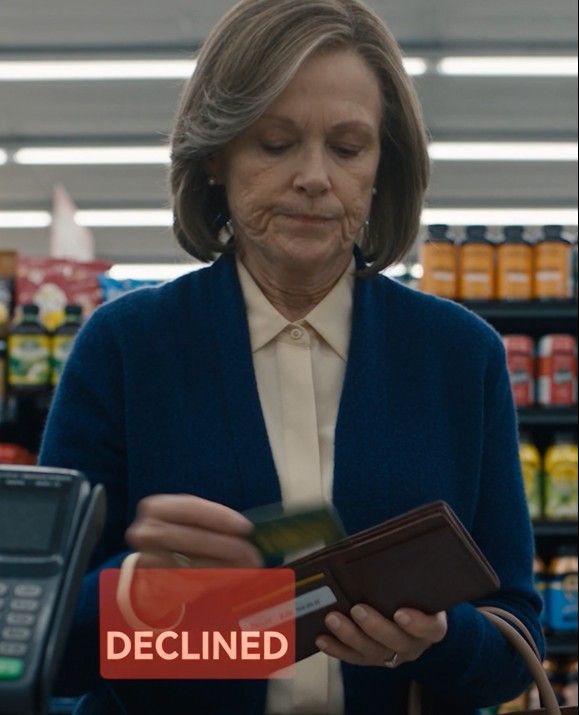
I also went back to the grocery store more than once during those weeks, almost as if repetition could teach my body that the first morning was over. I bought ordinary things: detergent, coffee filters, oranges, a birthday card for a friend. Every approval at the register was boring, which was exactly what I wanted.
One afternoon, the same cashier asked whether I wanted a paper receipt. I almost told her the whole story. Instead I said yes, folded the receipt into my wallet beside Warren’s photograph, and drove home. It became a private piece of evidence no bank or board required: I could move through my own life without permission.
The grocery-store humiliation had been designed, intentionally or not, to make me feel incapable. Ordinary independence became part of how I answered it.
I stopped carrying the emergency American Express card as though it were a talisman. I kept it, but it became just another card in a wallet that belonged entirely to me.
My relationship with Desmond became almost nonexistent for nearly a year.
That was the hardest consequence of all.
I had imagined motherhood as a permanent bridge. I had never understood that sometimes keeping a bridge open allows someone to keep driving heavy machinery across it until it collapses.
So I closed the bridge for repairs.
I saw a therapist who worked with older adults facing financial exploitation inside families. I hated the phrase at first. It sounded as though I had been gullible.
Then she asked me whether I would call Warren gullible for trusting me with access to our accounts.
