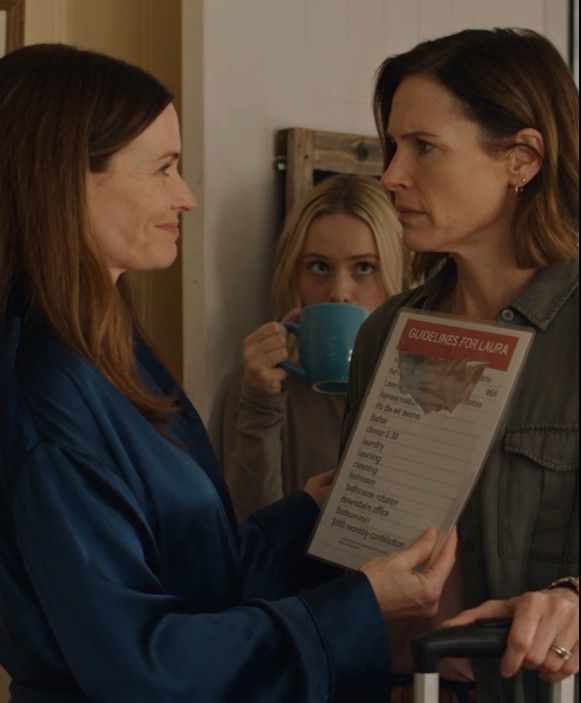
Waiting for Diane to become reasonable.
Waiting for Megan to move out.
Waiting for me to come home and somehow absorb the problem without forcing him to choose.
“I cannot stay married to someone who waits for me to enforce every boundary,” I said.
He nodded.
“I know.”
Then he started changing behavior outside counseling.
He separated his mother from our finances entirely. There had been no stolen account, no secret mortgage, no giant hidden debt—just the household contribution list and several ordinary expenses he had covered for Diane without discussing them with me. We reviewed every shared account and agreed on thresholds that required both of us to approve family support.
He called Diane himself when she tried to pressure me through relatives.
He told them the decision was his too.
That mattered.
Diane’s anger shifted toward him.
For the first time, he did not redirect it back toward me.
Three months after she moved out, she wrote me a letter.
The first page was mostly defense.
I nearly stopped reading.
Then the tone changed.
She admitted that after her surgery she had been terrified of living alone. She liked the feeling of being needed in Ethan’s house. When she realized I was returning, she feared becoming unnecessary again.
So she converted fear into rules.
The $900 contribution, she wrote, was not about money. It was about proving I was joining her household rather than reclaiming mine.
I read that line twice.
It was an ugly truth.
It was also the first honest one she had offered.
She apologized for the bedroom, the robe, the sign, the mug, and the way she treated my deployment as a vacancy she could fill.
I did not invite her back.
I wrote one paragraph in return.
I appreciate the apology. I am not ready for visits. If that changes, Ethan and I will decide together.
She did not answer.
For once, silence was respectful.
Six months after I came home, Ethan asked if I wanted to replace the entry bench.
The original was still there beneath the flowered cushions after all; the cushions had hidden it rather than replaced it. The white wood had a few new scratches.
“No,” I said.
We removed the last stray thread from one corner and put it back against the wall.
Then I carried the Hill Country photograph upstairs.
Ethan followed.
I stopped in the hallway.
“Why did you save it?”
He looked at the frame.
“When Mom said it did not match, I almost let it go. Then I remembered the day we bought it.”
I remembered too.
A weekend trip before we were married. A roadside gallery. Ethan complaining we had nowhere to hang a photograph that wide, then carrying it three blocks because I refused to leave it behind.
“I hid it because I was too weak to tell her it stayed,” he said. “I know that is not noble.”
“No.”
“But I could not throw it away.”
I ran my fingers along the frame.
The photograph did not redeem him.
It did something smaller and more believable.
It proved that even while he was failing me, some part of him still knew the house had a before.
And that before included me.
We rehung it in the foyer where the pink laminated sign had been.
