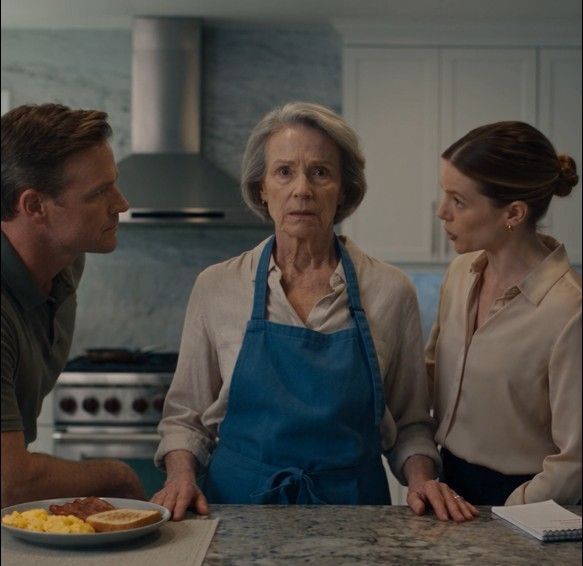
My own son looked at me over the breakfast I had cooked for him and said, “Serve the household, Mom, or leave.” His wife, Rebecca, smiled into her coffee as though he had said something perfectly reasonable. I was sixty-four years old, widowed, retired, and standing in the kitchen of a house my own money had helped them buy when David calmly explained that my bedroom was about to become their home gym. At first, I thought I had misunderstood him. The house had four bedrooms, yet David said I would be moving into the unfinished basement beside storage boxes, paint cans, Christmas decorations, and a treadmill Rebecca had barely used. There was no real bedroom downstairs, no proper heat where they intended to put me, and no nearby bathroom. Rebecca actually smiled. “We can get you one of those divider screens. Make it cozy.” I stared at David. He knew about the arthritis in my knee. He knew stairs were harder at night. He knew I was still grieving his father, Thomas, after nearly forty years of marriage. Most importantly, he knew why he and Rebecca were living in that beautiful suburban house. Two years earlier, after Thomas died, I had sold our small home and given David a substantial portion of the money for his down payment because he begged me not to live alone. He had held my hand and promised, “You’ll never have to worry about housing again, Mom.” I believed him. Now he sat at the granite island telling me I had been “living here rent-free.” My pension paid the electric bill, internet, and most groceries. I cooked five or six nights a week, washed clothes, cleaned bathrooms, handled deliveries, collected prescriptions, returned Rebecca’s packages, and walked Chester every morning. Somehow, all of that became invisible the moment they wanted more. Rebecca pulled out her phone. She had already created a list. Dinner every night. Laundry on schedule. Weekly sheets. Deep cleaning. Pantry organization. Errands. Anything else that made life easier for two healthy adults with full-time jobs. “I retired from one job,” I said. “I am not becoming your maid.” Rebecca looked offended. David called me overly sensitive. Then he repeated the choice more clearly. If I wanted to stay, I needed to “contribute appropriately.” Otherwise, I could leave. Rebecca added that contractors were already coming Monday to convert my bedroom. There had never been a discussion. They had already decided where I would sleep, what work I would perform, and how grateful I was expected to be. Something inside me became very still. I untied the old blue apron Thomas had once given me, folded it carefully, and placed it beside David’s unfinished breakfast. “Okay.” Rebecca’s eyebrows rose. David relaxed. They thought I had surrendered. I walked upstairs, locked my bedroom door, pulled a dark blue suitcase from beneath the bed, and packed clothes, medication, important papers, jewelry, and the photograph of Thomas I kept beside me every night. Then I opened my laptop. Electricity. Internet. Grocery deliveries. Streaming services. Rebecca’s food-delivery account, where my card was still the preferred payment method. For two years, I had paid because I believed we were one household. David had just informed me I was merely a woman living rent-free in his house. So I clicked through the accounts one by one. Remove payment method. Cancel autopay. Confirm. Confirm. Confirm. I did not cancel their services. I simply removed my money from the household that had just removed my dignity. Twenty minutes later, I rolled my suitcase downstairs. Rebecca was discussing where to put the rowing machine and barely noticed until I opened the front door. I walked outside with one suitcase, one purse, and no permanent place to sleep that night. Before I reached the sidewalk, my phone buzzed. Rebecca: “Don’t forget to scrub the master bathroom today.” I read it once, slipped the phone back into my purse, and kept walking. They believed they had given me two choices: serve them or lose my home. As the car I had ordered turned onto the street, neither David nor Rebecca understood that I had quietly chosen something else. 👇
The car slowed at the curb just as the front door opened behind me. For one foolish second, I thought David had come running out to stop me. I turned with my hand on the suitcase handle, my heart beating hard enough to hurt.
It was Rebecca. She stood on the porch with her phone in one hand and the dish towel I had left beside the sink in the other. “Where are you going?” she called, not frightened, not sorry—annoyed, as if I had walked away in the middle of an assigned chore.
I looked at her, then at the window above the garage that belonged to the bedroom they had already taken from me in their minds. “Somewhere I’m not required to earn the right to be treated like family.”
David appeared behind her. His face had changed. He had finally noticed the suitcase. “Mom, don’t be dramatic. Come back inside and we’ll talk tonight.”
The driver got out and lifted my bag into the trunk. I opened the rear door. “You already talked. I listened.”
Then I got in.
For the first three blocks, I could barely see through my tears. I kept one hand around the photograph of Thomas inside my purse as though the frame could steady me through the leather. I had not planned where to go because, until twenty minutes earlier, I had believed that house was my home.
I gave the driver the name of a modest hotel near the library. It was the only place I could think of that felt neutral. Not a friend’s sofa. Not a relative’s guest room. Not another place where I would have to explain why a sixty-four-year-old woman had left a house she had helped her son buy.
My phone began ringing before we reached the hotel.
David called first. Then Rebecca. Then David again.
I turned the sound off.
At the front desk, I paid for three nights. The room was small, clean, and too quiet. There was one chair by the window, a narrow desk, and a bedspread the color of oatmeal. I set Thomas’s photograph on the nightstand and sat on the edge of the bed without taking off my coat.
That was when the shaking started.
Leaving had felt strong while I was moving. Sitting still made room for everything else: humiliation, grief, fear, and the terrible question of whether I had just made myself homeless because I could not swallow one more insult.
I let myself cry until my throat hurt. Then I did what I had done through forty years of marriage, two layoffs, Thomas’s cancer scare, and the long months after his funeral. I made a list.
I wrote down what I had in checking, savings, and my retirement account. I wrote down my pension. I listed my monthly expenses, medications, insurance, and the amount I could safely spend on rent. I wrote down every household bill I had been paying for David and Rebecca.
Seeing the numbers on paper changed something.
I was not helpless. I was hurt.
Those were not the same thing.
The next morning, I called three apartment communities I had once driven past without really seeing. One had no availability. One was too expensive. The third was an older complex near a park, with a small elevator, a laundry room on each floor, and a one-bedroom unit becoming available in two weeks.
I made an appointment to see it.
At 9:14, David sent a text.
Mom, this has gone far enough. Come home.
At 9:22, Rebecca sent another.
The grocery app says your card doesn’t work. Fix it please.
I stared at that message for a long time. There was something almost clarifying about it. Less than a day after I had walked out with nowhere to sleep, her first practical concern was that she could not order groceries with my money.
I did not answer either of them.
The apartment was on the third floor. Its carpet was worn near the entry, the kitchen cabinets were dated, and the view was mostly the tops of maple trees and the brick wall of the building next door. But sunlight came through the living-room window in a broad warm rectangle.
The manager showed me a thermostat I could control myself, a bathroom six steps from the bedroom, and the elevator at the end of the hall.
I signed the application before I could talk myself out of it.
For the next two weeks, I stayed first at the hotel and then with my friend Carol, who had spent twenty-six years teaching second grade and had perfected the art of asking one direct question and waiting through any amount of silence for the truth.
“Did they ask you to come back because they miss you,” she said one evening, “or because they miss what you did?”
I looked down at the tea in my hands.
“I don’t know.”
Carol did not rescue me from the answer. “Then wait until they show you.”
They showed me quickly.
On the third day, David called from his office. I finally answered because I was tired of watching his name light up my screen.
“Mom, the electric account says the automatic payment was removed.”
“Yes.”
A pause. “Why would you do that?”
“Because it is your electric bill.”
“You’ve always paid it.”
“I did.”
“And the internet?”
“Yours.”
“The grocery account?”
“Yours.”
His breathing changed. “So this is punishment.”
“No, David. Punishment would be shutting off services that belong to you. I didn’t do that. I stopped paying for a household you told me I did not belong to unless I served it.”
