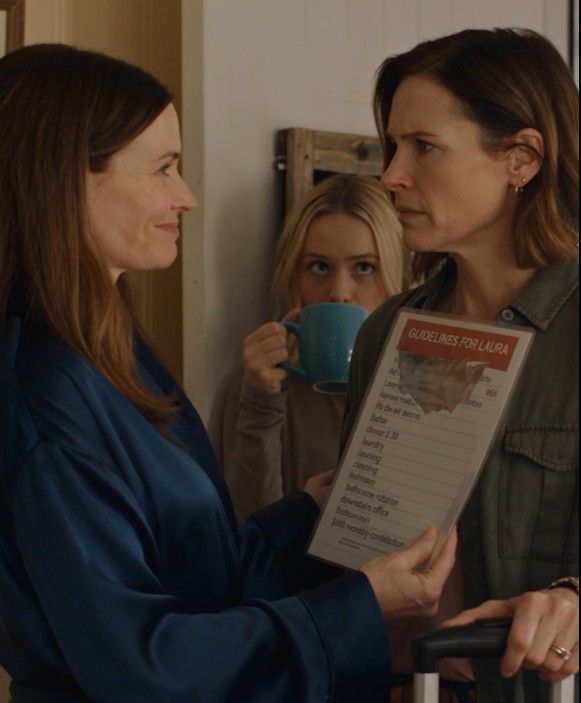
The original was still there beneath the flowered cushions after all; the cushions had hidden it rather than replaced it. The white wood had a few new scratches.
“No,” I said.
We removed the last stray thread from one corner and put it back against the wall.
Then I carried the Hill Country photograph upstairs.
Ethan followed.
I stopped in the hallway.
“Why did you save it?”
He looked at the frame.
“When Mom said it did not match, I almost let it go. Then I remembered the day we bought it.”
I remembered too.
A weekend trip before we were married. A roadside gallery. Ethan complaining we had nowhere to hang a photograph that wide, then carrying it three blocks because I refused to leave it behind.
“I hid it because I was too weak to tell her it stayed,” he said. “I know that is not noble.”
“No.”
“But I could not throw it away.”
I ran my fingers along the frame.
The photograph did not redeem him.
It did something smaller and more believable.
It proved that even while he was failing me, some part of him still knew the house had a before.
And that before included me.
We rehung it in the foyer where the pink laminated sign had been.
Not as a declaration.
Just where it belonged.
Our marriage survived, but not because I forgave quickly.
It survived because Ethan stopped treating remorse as a substitute for action.
He learned to say no before resentment reached me. I learned that returning from deployment did not require me to be infinitely capable at home too. We rebuilt routines together instead of pretending the old ones had waited untouched.
Before Diane came back into the house, Ethan and I made one decision that would have seemed absurdly formal before my deployment. We wrote down our household boundaries. Not laminated. Not posted on a wall. A private agreement between two adults who had learned how dangerous assumptions could become when nobody named them.
Family visits longer than a weekend required both of us to agree. Financial support above a set amount required discussion first. Bedrooms could not be reassigned without both people consenting. Neither of us could volunteer the other person’s time, money, belongings, or privacy to relatives.
The counselor asked whether writing those things down made marriage feel transactional.
“No,” I said. “Pretending we automatically agree is what got us here.”
Ethan nodded.
