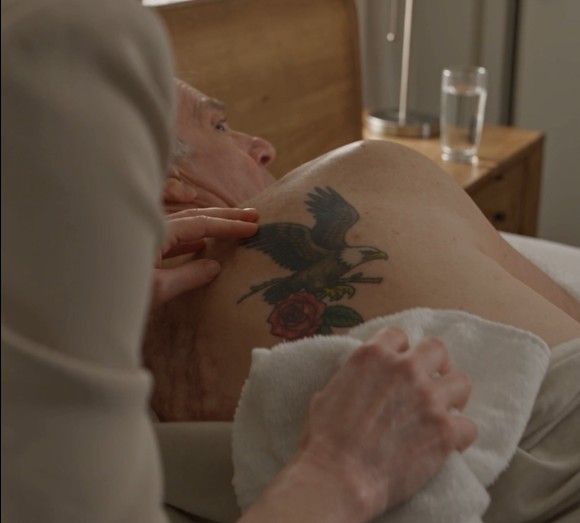
Daniel began counseling because he recognized a pattern larger than the tattoo. When afraid of losing someone, he tried to control information and circumstances around them. The rule about Rafael had been the clearest example, not the only one. Lucia agreed to couples sessions on the condition that therapy would not become another place where Daniel explained his intentions until her experience disappeared. He accepted that condition.
Rafael’s health remained fragile, but the atmosphere around his care changed. People knocked. They asked. He answered with gestures, the tablet, or the expressive lift of one eyebrow that Lucia learned to read with surprising accuracy. On good afternoons they sat in the garden. Rafael showed her how to prune roses without cutting back the new growth. Lucia teased him that a man with a rose tattoo had no right to be so critical of actual roses. His laugh came out rough after the stroke, but it filled the yard.
Months later, Lucia visited the fire station where Rafael had served. She went with him and Daniel, not to stage a ceremony but because Rafael wanted to see the old building. A retired colleague recognized him and found the incident log from the fire. Lucia read her childhood address and the time of the rescue. The record was factual and brief. It could not contain the heat, the fear, or the arm she remembered holding. Still, seeing her name beside Rafael’s made the past feel anchored.
She copied one page and kept it in a drawer rather than displaying it. The rescue was part of her life, not the only story about it. Rafael approved. He had spent years hiding the tattoo because he feared becoming too important in Lucia’s memory. Now both of them understood that truth did not require worship. It required room.
Daniel eventually asked Lucia whether she wished he had told her on their first date. She considered it. No, she said. The story belonged to Rafael too. But before asking me to promise something I could not understand? Yes. Daniel nodded. The distinction hurt, but it also gave him a clear lesson: privacy could be respected without using secrecy to control another person’s behavior.
That evening Daniel stood outside his father’s room and asked before entering. Lucia noticed the small courtesy. It was the opposite of the old rule: not fear enforced from outside, but respect offered at the door.
The change in Daniel was most visible when something went wrong. A caregiver once canceled with less than an hour’s notice, the exact kind of situation that had previously triggered commands and secrecy. Daniel started to tell Lucia what could not happen. Then he stopped. He went to Rafael, explained the problem, and asked what arrangement he preferred. Rafael chose Lucia for part of the routine and asked Daniel to handle the rest. The crisis lasted twenty minutes and ended without anyone feeling trapped.
Lucia noticed how powerful that ordinary success felt. Trust had not removed the need for privacy. Rafael still had boundaries around his body and his history. The difference was that those boundaries now belonged to him. Daniel no longer used mystery to make everyone obey. Lucia no longer interpreted a closed bedroom door as proof that she was outside some essential part of the family.
On the anniversary of the fire, Lucia expected the recovered story to make the date heavier. Instead, she and Rafael spent the afternoon repotting a rose that had outgrown its container. Daniel carried soil from the garage and complained about both of them giving contradictory instructions. Rafael typed that firefighters were trained to ignore bad directions. Lucia laughed so hard she dropped a gardening glove. Nothing ceremonial happened. That was what made the afternoon beautiful. The event that had once linked them through danger could now exist beside a relationship built from ordinary days.
Rafael eventually gave Lucia a small cutting from the rosebush they had tended together. She planted it near a window where morning light reached the leaves. He did not attach a speech to the gift. He simply pointed to the new roots and gave her an approving nod. Lucia understood the gesture without turning it into another debt. The plant had survived being cut away from something older because it had been given enough care to grow on its own. She liked the thought, but she kept it to herself. Some meanings were better lived than announced.
Rafael was already asleep. The eagle and rose remained hidden beneath his shirt, exactly where he wanted them. In the garden below, a new rose moved gently in the night air.
Lucia closed the door softly. The mystery that had followed her since childhood was finally resolved, and nobody had to disappear for the truth to remain safe.
Lucia and Rafael developed a private joke about closed doors. She would knock with an exaggerated rhythm, and he would answer by tapping twice on the bedside table. The ritual made Daniel smile because it turned the old prohibition into something voluntary. Privacy remained, but fear no longer enforced it.
