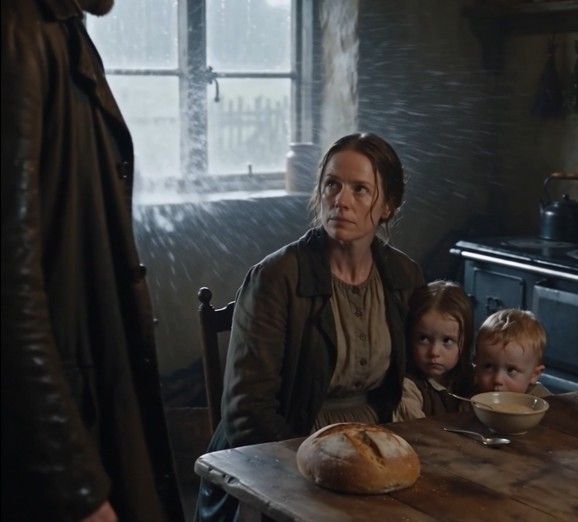
“Are you from the county?” The little girl opened the door only wide enough to show one frightened eye, a thin shoulder, and the toddler balanced on her hip. Rain dripped from Nora Whitaker’s coat onto the Mercer porch while the child tightened her hold on the boy and whispered the question as if the wrong answer might cost her everything.
“No,” Nora said softly. “I heard him crying.” For a moment, the girl just stared.
Then the door opened another inch, and Nora saw what the storm had hidden from the road. Sadie Mercer could not have been more than seven, yet she stood like someone used to guarding a house alone.
The boy in her arms—Jonah—looked sick and exhausted, his cheek pressed against her collarbone. Inside, the farmhouse felt hollow.
The chimney was cold. The kettle was empty.
The cupboards, when Sadie finally let Nora near them, held almost nothing. Nora had not come to pry.
She had only meant to leave food and keep walking. She had walked two days through rain with a loaf of bread tucked under one arm, a worn Bible in her satchel, and a few coins sewn into the hem of her skirt after every job in Mill Haven turned her away.
Widowhood had taught her how easy it was for people to look through a woman and see only trouble. But when she heard a child crying from the road outside the Mercer place, she could not keep going.
Sadie shifted Jonah higher on her hip as if she had been carrying him that way for months. “Pa said if a stranger came, we weren’t supposed to say much.” Nora looked at her more carefully then.
The floor had been swept. Two blankets were folded neatly beside the stove.
A cracked cup had been rinsed and turned upside down to dry. Hunger lived in the house, but so did effort.
Sadie had been trying to hold things together with the small, determined hands of a child. When Nora set the loaf of bread on the table, Jonah reached toward it so quickly it hurt to see.
Then, just as quickly, he pulled back and lowered his eyes, as though wanting food were something to be ashamed of. That troubled her more than the empty cupboards.
She stirred porridge from what little she could find, warmed water, and coaxed Jonah to eat slowly. After the first spoonful, the little boy’s face changed with relief so pure that Nora had to turn away for a second.
Sadie watched in silence, her mouth pressed tight, tears shining but refusing to fall. Then the front door opened.
Thomas Mercer came in soaked from the rain, the smell of wet earth following him. His gaze landed on Nora, then on the bread, then on the children.
His whole face hardened. “What are you doing in my house?” Sadie lowered her eyes immediately.
Nora kept her voice calm. “Feeding your children.” Embarrassment crossed his face, but it passed too fast to become gratitude.
What remained was anger. “You should leave,” he said.
“My family doesn’t need charity.” The children went still. Later, Nora would remember that silence more than the storm outside or the cold inside.
Not the empty cupboards. Not the shaking windmill in the yard.
The way those two children were more frightened of their father’s displeasure than of their own hunger. Thomas spoke of hardship after his wife’s death.
He said work had been scarce. He said neighbors exaggerated.
He said he was managing. But when he stepped into the shed a little later, Nora noticed a torn envelope near the stove.
Inside was a county notice mentioning payments, a farm account, and a signature that did not sit right with anything he had told her. The next morning, she returned with her small notebook, one loaf’s worth of resolve still hardening inside her, and a single question she could no longer ignore: why was a man receiving money meant for his children while those same children were starving?
She was ready to confront Thomas Mercer. She was not ready for the floorboard.
It lifted too easily near the stove, as if someone had been there often. Beneath it lay a sealed folder with a name written across the front—one name, in careful dark ink, that made Nora go completely still.
When Thomas had spent months telling everyone he had nothing, this was what he had not counted on: the person he dismissed finding the one thing he had hidden best. The folder was still sealed when Nora carried it to the kitchen table and laid her hand over the name. 👇
Nora kept her palm on the sealed folder while rain tapped the kitchen window. Thomas had not yet returned from the shed, and Sadie stood beside the cold stove watching Nora with the wary attention of a child who had learned that adult discoveries could become dangerous. Nora did not break the seal. She asked Sadie whose name was written there.
For several seconds, the weight of while rain tapped the kitchen window thomas had not yet stayed in the room. Nora did not try to make the moment cleaner than it was. There were practical questions to answer, but there was also damage that could not be handled like paperwork. Sadie listened, watched, and responded to what was actually happening rather than the version everyone had relied on before. That distinction mattered because trust could no longer be requested as a favor; it had to be rebuilt through visible choices.
