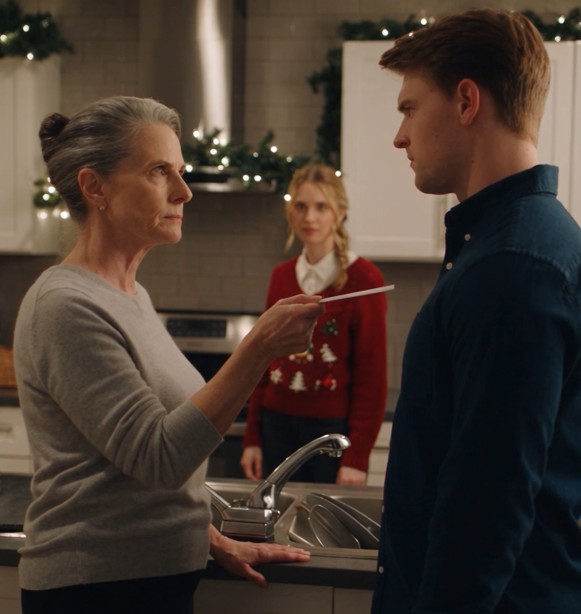
“Come tomorrow,” she said. “Or next week. The room is yours.”
I leaned against the wall beneath the coat hooks. For five years, I had told her Christmas was too busy, that I would visit once things settled down. She had stopped suggesting dates but had never stopped making the invitation.
“I wanted to be there tonight,” I said.
“I know.”
I looked through the open doorway at Emily carrying the untouched Christmas pudding back to the kitchen.
“I should have come sooner.”
Ruth was quiet for a moment. “You can come when you’re ready. You don’t owe me a good explanation.”
I slept badly. In the morning, the house smelled of roast meat and extinguished candles. The tree lights were still on. June had left a note beside the sink telling me which containers were for the neighbors and that she would return for her pie dish whenever I felt like seeing her. Beneath it, Emily had left her own note: I’m staying elsewhere. I’ll give the police everything I have. I won’t let myself into the house.
For the first time in years, no one asked me what was for breakfast.
The weeks that followed were full of work I had never wanted. I changed passwords and spent hours on the telephone. The bank confirmed that the disputed credit line had not been released, though the investigation continued. I checked each account with a stranger on the line and learned how often Daniel had been able to get into them. He had not taken other money. He had, however, tried to make my home guarantee his new one.
The house on Birch Lane went back on the market. Daniel’s deposit could not be returned immediately while the payments were traced. June and several other guests gave statements. Some of the money had already been spent on fees and debts Daniel had kept hidden. I wrote down each guest’s name and what they had paid, even after the officer told me the records were being kept elsewhere. I needed to see the numbers somewhere I could understand them.
Emily came by once to collect her clothes. I stayed in the kitchen while she went upstairs. She had given the investigators the messages Daniel sent her that morning, and a recording she had made when she first asked about the deposit. She told me this without asking for credit.
At the door, she paused with her bag against her leg. “I’m separating from him.”
“I’m sorry,” I said. I was sorry for the life she had thought she was building. I was not sorry she had seen its foundation.
“I should have listened to you when you said you couldn’t host everyone.” She glanced toward the kitchen. “You said it in November. I remember.”
“So do I.”
Her eyes filled. “I can’t undo that.”
“No.”
She nodded and left. We spoke again months later, after she had found a place of her own. We never became close in the easy way people sometimes expect after a shared disaster. But when we talked, she listened to my answer without trying to change it. It was a beginning I could live with.
Daniel pleaded guilty after the bank produced the application records and the guests’ payments had been accounted for. The court ordered restitution as part of his sentence. He lost his job; the money he had paid toward Birch Lane was recovered where possible, and he still owed the rest. The credit line against my house was canceled. I kept the letters confirming it in the drawer beneath the stove, beside the heating bill.
At the sentencing, Daniel turned to look at me. He appeared older than he had on Christmas Day. I had imagined that seeing him held responsible would give me a clean feeling of relief. Instead, I remembered teaching him to write his name at this kitchen table and felt grief so sudden I had to grip the bench.
Outside the courthouse, he asked whether I would ever speak to him again.
“I don’t know,” I said. “I won’t decide because you need an answer today.”
He nodded once. He did not ask me to forgive him. Perhaps his lawyer had told him not to. Perhaps, for the first time, he understood that I could not do it for him.
Spring arrived slowly. The kitchen window stayed open longer each morning. I went to see Ruth for two weeks, then came home because I wanted to, not because a table needed setting. We walked along the river in her town and spoke about our mother, about the years we had spent making ourselves useful when we were lonely. Some afternoons we said very little. I learned how restful that could be beside someone who knew me.
June and I began having supper together on Thursdays. She brought her pie dish back the first time and left it with me again the second. One evening, while I washed it, she asked if I still had the list of guests.
“I do.”
“Would you let me give something back to them?”
“I’ve been trying to work out how.”
We invited them to the community hall, where there were long tables and a kitchen large enough for several people to stand in at once. I brought the records and the money Daniel had repaid so far. Each guest received an accounting of what was owed. Some needed their money back urgently and said so. Others asked to wait until those people had been paid. It was awkward, practical work, and a relief to do it together in the open.
When the meeting ended, June lingered beside the door. Her daughter was stacking chairs. The late sun lay across the floor in bright rectangles.
“There’s something I didn’t tell you at Christmas,” June said.
I felt myself brace.
“Daniel said he was worried you might refuse help. I believed him because you refused mine last year.”
I frowned. “I don’t remember that.”
“After my husband died. You came over with soup, then came back the next week when you knew everyone else had stopped visiting. I offered to pay for the groceries.” June smiled faintly. “You told me you’d already made too much.”
I remembered the soup. I had made it in a pot big enough for an army because I knew June might not ask for company even if she wanted it.
“I told my daughter about that,” June said. “She was the one who wanted to come at Christmas. Several of the others had stories of their own. Daniel used them to make his lie believable.”
I looked across the hall. June’s daughter was laughing with the man who had brought the extra envelope for my heating bill. I knew him now as Peter, who had once knocked on my door during a power cut to ask if I had candles. I had given him three and asked him to stay for tea until the lights came back.
All winter, I had thought of the guests as twenty-five people who had expected me to serve them. Daniel had counted on that feeling. He had counted on my shame when they arrived. But June and her daughter had come carrying a pie, and Peter had come prepared to help pay a bill. They had believed a lie about what I needed, yet their concern had been real.
“Why didn’t you say so that night?” I asked.
June looked toward the windows. “You had enough to carry. And I didn’t want you to think the soup meant you owed me anything.”
I held her gaze for a long moment. Then I reached for the stack of chairs beside her.
By the following Christmas, the last of the guests’ money had been repaid. Daniel was still working through what he owed under the court order. He sent one letter, which I read beside Ruth in her kitchen. He wrote about what he had done without calling it a mistake or asking me to excuse it. I put the letter away. I did not answer yet.
Ruth came to my house for Christmas. So did June and her daughter. Emily stopped by in the afternoon with a small tin of biscuits and stayed when I invited her in. Nobody had been assigned a job, but hands appeared when plates needed carrying. June’s daughter found the stubborn cupboard and lifted its door into place without a word.
There were six places at the table. I had cooked one dish I loved and left the others to the people who offered. Through the window, I could see a light dusting of snow settling along the fence. Ruth leaned her shoulder against mine as we watched it.
“Do you remember my old ticket?” I asked her.
“The one you missed?”
“It’s still in the drawer. I kept thinking I should throw it away.”
Ruth considered that. “You did get here.”
“Eventually.”
“You got home that night, too.”
I looked around the kitchen. June was cutting her pie, Emily was listening while Peter described the repair he had made to June’s back step, and a clean plate waited at my place. The house was quiet enough for me to hear the knife touch the pie dish. For years I had believed I had to keep moving to hold everyone together. Now I stood still, and the room held.
Ruth took my hand. When June called us to the table, I went with her.
