“Garrett is watching from the shore,” he whispered. “If he sees you survive, he’ll try to kill you again.”
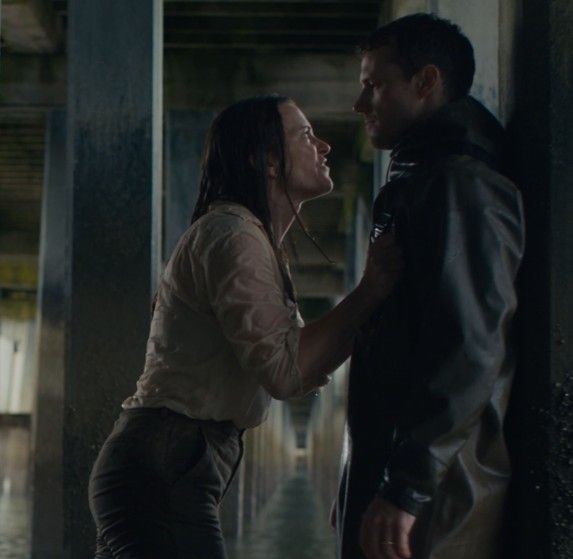
We stayed under and swam beneath an old pier until we reached a narrow gap between two concrete pillars, hidden from the road.
The moment I could breathe again, I shoved him against the wall.
“Fifteen years!” I cried. “You’ve spent fifteen years pretending you couldn’t walk!”
He didn’t argue. He didn’t defend himself.
He just looked me straight in the eyes and said, “Because Mom and Dad’s accident wasn’t an accident either.”
My blood ran cold.
“What are you talking about?”
“Garrett’s family has been trying to take control of the shipyard for fifteen years,” he said. “He never married you because he loved you.”
And then he told me the real reason Garrett tried to kill me today.
It wasn’t just about what I own.
He was finishing the job his father started with our parents.
But that wasn’t even the worst part.
The worst part was what Garrett had been secretly putting into my body every night for the past three years.
What do you think he was giving her? 👇
The water dripping from his hair landed on my cheek and I flinched.
Tobias hadn’t let go of my wrist. His fingers were locked so tight the skin had gone white around my nails, and his chest was heaving in short, sharp bursts that echoed off the concrete.
“Say it,” I whispered. “Say what he was giving me.”
He reached into the inside pocket of his soaked jacket. Not for another tool. For a small, clear plastic bag with three inches of pale liquid left in it, sealed with a pharmacy label that had been peeled off halfway.
He held it under the thin light coming through the slats of the pier.
“Low-dose warfarin,” he said, his voice flat. “And a hormone suppressor. Bromocriptine. Enough to make you tired. Enough to make you forget things. Enough to make your periods stop so you’d think you were just stressed and broken. Enough to make a doctor later say you were unstable. Unfit to run the yard.”
The air left my lungs all at once.
Three years of that glass on my nightstand. Garrett’s hand on my shoulder. “Drink it while it’s warm, love. You push yourself too hard.”
I had thanked him.
I put both hands over my mouth and made a sound that wasn’t a word. Tobias didn’t touch me. He just stood there and let me shake.
“I started testing it eight months ago,” he said. “I swapped your glass twice a week. Sent your hair to a lab in Denton under a fake name. I have the reports on my phone. In a waterproof case. I also kept every bottle he didn’t throw away fast enough.”
I stared at the bag in his hand. The water around our knees was black and lapping softly, carrying the smell of oil and river mud.
“Why didn’t you tell me?” I finally managed.
“Because the first time I tried to tell Mom that Garrett’s father cut the brake line on their truck, no one believed the ten-year-old in the leg braces,” he said. “And because if I told you and you confronted him before we could prove it, he would have just changed the dose. Or changed the plan.”
The sirens started then.
Thin at first, over on the coastal road above us. Then louder. Red and blue light flickered through the cracks of the pier and danced across the water.
Tobias pulled me deeper into the shadow as two police cruisers stopped where the barrier had been broken. Doors slammed. Voices shouted.
And then Garrett’s voice, clear and broken and perfect.
“My wife! My brother-in-law! They were in the car! Oh God, please — someone help them!”
He was sobbing.
I could hear him sobbing from under the pier while Penelope’s softer crying rose beside his.
Tobias lifted his phone. The screen was cracked but lit. On it was a video, paused. He pressed play and turned it toward me.
It was from this morning. A tiny camera he had taped under the dashboard of the SUV, angled up. Garrett’s hands on the wheel. His calm face. His voice speaking on Bluetooth: “Yes, Dad. It’ll look exactly like her parents. No wire will show once the river does its work. And the milk has done its job — the board already thinks she’s losing it.”
My knees gave out. Tobias caught me before I hit the water.
He slid down the concrete with me until we were both sitting in the shallow, his legs stretched out in front of him — strong, real legs that had carried me out of a sinking car. I stared at them.
“Two years after the accident I could walk again,” he said quietly, not looking at me. “Dr. Albright did therapy at night. Mom’s friend paid. But Dad made me promise before he died — if anything happened to them, I had to stay small. Stay underestimated. He said the Ellerys would come back for the yard and they’d never see a crippled boy as a threat.”
“You let me push you for fifteen years,” I whispered.
“You needed someone to need,” he said, and his voice cracked for the first time. “And I needed to stay close enough to keep you alive.”
Above us, a diver splashed into the river. Someone shouted that the SUV was fully submerged.
Tobias gripped my arms. “Rosie, listen to me. We have a choice right now. If we climb out and shout, they pull us up. Garrett says it was a terrible accident, that I must have cut your belt in the panic. There’s no wire left to find — it sinks with the car. The milk is just milk. We lose.”
“So what do we do?” My teeth were chattering so hard I could barely speak.
“We stay dead,” he said. “For one night. Let him file the report. Let him think he’s a widower. Let him go to the shipyard tomorrow morning and try to claim your shares with the paperwork he’s already forged. Mara can hide us. Her brother works the pier cameras. If Garrett moves, we catch him on record doing it.”
Mara. The harbormaster’s daughter who had taught us to tie bowlines when we were kids.
I wanted to say no. I wanted to climb out of this black water and scream until Garrett’s perfect sobbing stopped.
But Tobias pressed the emergency mouthpiece into my palm again and closed my fingers around it.
