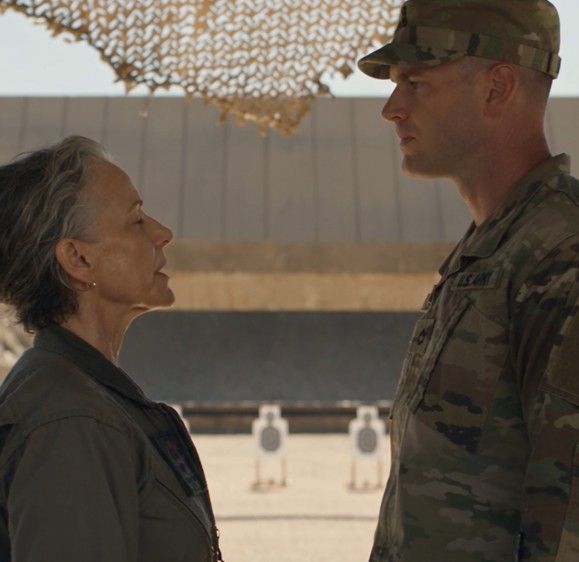
When Blake told her she only carried screwdrivers, the pain on her face came from knowing how much responsibility those tools represented.
Olivia learned that story only after six months.
“Why didn’t you tell him?” she asked.
“Because a warning should not need a tragic story before people respect it.”
That answer stayed with her.
Blake’s path after the investigation was less visible.
He spent months in a staff assignment where his technical decisions were reviewed by people he had once considered support personnel. At first he resented every signature.
Then he began reading the reports attached to them.
He learned how many failures technicians caught before instructors ever saw a weapon. He learned how much documentation existed because someone, somewhere, had once been hurt when a shortcut seemed reasonable.
The manuals stopped looking like obstacles written by people who had never done real work.
They started looking like memory stored on paper.
The procedural changes also exposed a problem Sarah had complained about for years: too much technical knowledge stayed inside the armory while shooters learned only the limits relevant to performance. The result was not that instructors lacked intelligence. It was that many of them had never been shown how a small unauthorized change could interact with wear, heat, and manufacturing tolerance in ways experience on the trigger could not reliably predict.
Sarah proposed a short cross-training block.
No one would learn how to modify a weapon. The opposite. Instructors would learn why certain adjustments required approved parts, documentation, and technical signoff. Armorers would learn enough about training schedules to understand why delays created pressure on the range. Each side would see the constraints the other side carried.
The first session was awkward.
One instructor asked whether the class was punishment for Blake.
Sarah answered, “If the only lesson you learned is not to be Blake, you missed the problem.”
She placed three decommissioned components on a table, each tagged with a different inspection history. They looked nearly identical from several feet away. One had been removed for routine wear. One had a manufacturing defect. One had been damaged after an unauthorized change.
“Confidence cannot tell you which is which,” she said. “Process can.”
The instructors listened.
Olivia sat in the front row and took more notes than anyone.
Later, she asked Sarah whether technical specialists ever became too attached to process.
Sarah smiled. “Constantly.”
“Then how do you know when a rule needs changing?”
“You change it through evidence, testing, approval, and documentation. You do not change it because one person is impatient.”
That distinction became central to Olivia’s training. Rules were not sacred because they were old. They were valuable because people knew how and why to revise them safely. Sarah liked that Olivia challenged the process itself instead of simply memorizing it.
The safety officer from the original incident joined the second session. He stood in front of the class and described his hesitation without protecting himself.
“I knew Ms. Kane had authority over the inspection. I also knew Sergeant Morgan outranked most people on the range. I waited because I hoped somebody else would make the conflict disappear.”
A trainee asked what changed his mind.
“Nothing changed in the weapon. I changed. Too late.”
