“Close your right hand around this.”
He did.
The reading was significantly lower than his left.
“Again.”
The second reading dropped further.
Priya wrote down the number.
“Dr. Carter did not weaken your hand.”
Ryan said nothing.
“And she did not grab her own wrist.”
That was the beginning of the part he could not avoid.
Recovery required him to admit two facts at the same time: he had been injured, and he had behaved badly.
He wanted one fact to cancel the other.
It did not.
Maya learned most of this through the return-to-duty team because Ryan’s case became relevant to the program she had come to review. She kept herself out of his direct medical decisions to avoid a conflict.
Her actual consultation focused on why service members hid treatable problems until they became operational risks.
She had seen the pattern for years.
People feared being labeled weak. They feared losing qualifications, teams, or momentum. Some began protecting the image of readiness instead of readiness itself.
Ryan was an ugly version of a common problem.
Maya proposed changes that made early reporting less punitive when people came forward before an incident. She also insisted that hiding symptoms while performing high-risk duties could not be normalized as toughness.
The command adopted a six-month pilot.
Ryan hated knowing his failure had helped inspire it.
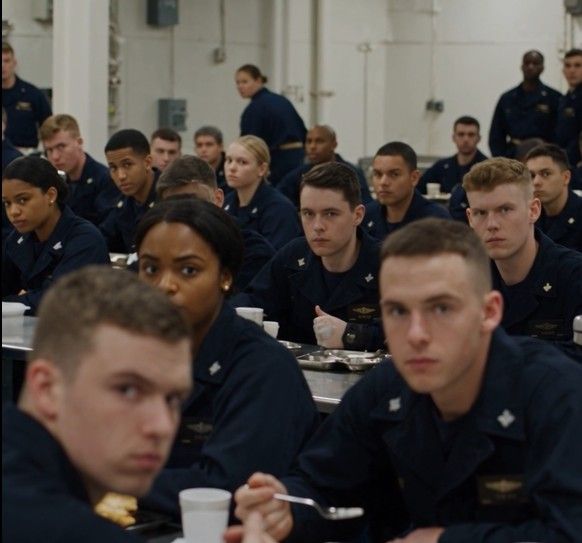
Months later, Priya asked whether he would speak to a small group of junior officers about delayed reporting.
“Absolutely not,” he said.
“Good,” she replied. “Think about it until your answer is based on something other than embarrassment.”
He eventually agreed.
He stood in a classroom without slides and told the group he had confused secrecy with resilience.
He did not mention Maya by name until the end.
“The person who noticed my hand was someone I had just treated like she was beneath me,” he said. “The worst part is that I thought learning her title changed what I had done. It didn’t.”
That sentence reached Maya later through Priya.
She said nothing for a long time.
“Progress?” Priya asked.
“Maybe.”
“You physicians are impossible to impress.”
“Occupational hazard.”
Ryan’s first talk did not repair his reputation. Several junior sailors who attended knew about the cafeteria incident, and one asked the question he feared most.
“Would you have listened if Dr. Carter had told you about your hand before you found out she was a doctor?”
Ryan stood at the front of the room for a long moment.
“No,” he said.
The honesty unsettled the room.
“Why not?” the sailor asked.
Ryan looked down at his right hand.
“Because I had already decided the apron told me how much her opinion was worth.”
Priya, standing near the back, said nothing. She did not rescue him from the silence that followed.
Ryan continued. “I wish I could say the medical problem made me act that way. It made me scared. The rest was something I had practiced before that morning.”
After the talk, three sailors approached medical staff privately about symptoms they had been hiding. One had persistent numbness after a shoulder injury. Another had headaches after a training impact. A third admitted he had stopped taking prescribed recovery time because he thought his team would see him as unreliable.
None of them had dramatic diagnoses.
That was the point.
Early attention meant smaller problems stayed smaller.
Maya reviewed the anonymous program data months later and found herself staring at the change in reporting patterns. More people were asking for evaluation before performance deteriorated. Fewer were arriving only after an incident forced them to admit something was wrong.
The pilot also tracked leadership response. That part mattered to her even more. A sailor who reported pain and was mocked by a supervisor would hide the next problem. A sailor who was evaluated, treated, and returned when safe learned that reporting was part of readiness rather than evidence against it.
