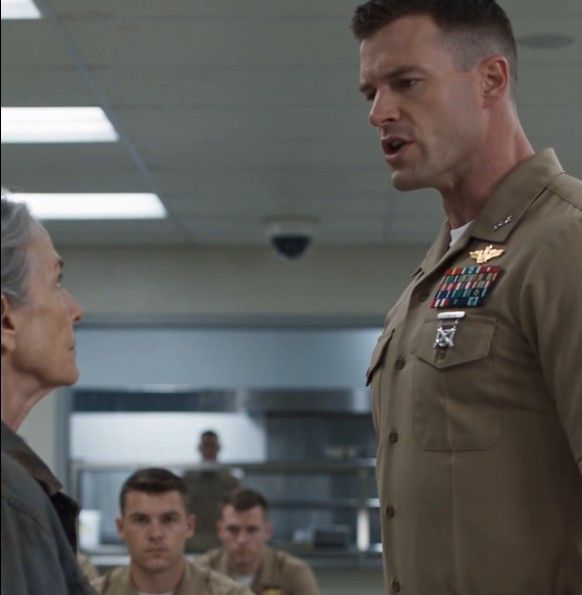
Andrew smiled sadly.
“That is when it counts.”
The months between those letters and the memorial were not easy for Andrew either. He had spent years telling the story of David’s courage as if a good story could guarantee what a child learned from it. Watching Blake fail so badly forced him to confront a quieter truth about fatherhood. Lessons could be offered. They could not be installed.
Andrew met with Blake every other Sunday. At first the visits were stiff. They repaired a fence, changed oil in an old truck, and argued about baseball because practical work felt safer than the cafeteria.
Eventually Andrew brought up the photograph.
“Do you remember the first time I showed you the cropped copy?”
Blake nodded. “I was fourteen.”
“What did you think the story was about?”
Blake considered it.
“Being tough enough to get somebody home.”
Andrew looked disappointed, but not at his son alone.
“That is probably how I told it. David was tough. But the part I needed you to understand was that he was exhausted and scared and still made room for my weakness without using it against me later.”
Blake stared at the truck engine.
“I used weakness against people all the time.”
“Yes.”
The answer was painful because Andrew did not soften it.
“Did you know I was like that?” Blake asked.
Andrew took longer to answer.
“I knew you liked control. I knew you hated looking wrong. I told myself that was confidence because I was proud of you.”
Now the shame belonged to both of them in different ways.
Blake shook his head. “This is not your fault.”
“No. But being your father means I get to examine my part without stealing yours.”
That sentence stayed with Blake.
He began using the same distinction in counseling. Responsibility did not have to be exclusive. Another person’s influence could matter without erasing his choice. His injury-free record, his training success, his father’s stories, the culture around him, and the fear of appearing weak had all shaped him. None of them had forced his hand onto Victoria’s bag.
Meanwhile, Victoria resumed ordinary life. She volunteered at a maritime museum twice a month, argued with her neighbor about a hedge, and finally repaired the loose hinge on a kitchen cabinet David had promised to fix before he became ill.
The dive watch sat on her dresser for weeks.
One morning, she took it to a watchmaker.
“Do you want it restored?” he asked.
Victoria looked at the frozen hands.
“Can you make it run without replacing everything that makes it his?”
The watchmaker smiled. “I can try.”
He cleaned the movement, replaced only what had failed, and left the scratches on the case exactly where they were.
When Victoria picked it up, the second hand was moving again.
She cried in the parking lot.
The watch had not become new. It had become alive while remaining worn.
That mattered to her more than she could explain.
She sent Andrew a photograph of it running.
He replied: David would complain you spent money on it.
Victoria wrote back: David complained professionally.
Their friendship returned through small messages like that. Not through the operation. Not through grief. Through ordinary jokes, appointments, weather, and the kinds of details people share when the past no longer has to carry every conversation.
Miller occasionally checked on her too. He had been the sailor recording beneath the table. During the investigation, he admitted he wished he had stood openly instead of hiding the phone.
Victoria told him the recording mattered, but the lesson was not that everyone needed to become fearless.
“Next time, find one person beside you and make it less lonely to speak,” she said.
Miller did. He and another sailor began a simple peer practice in their section: when one person raised a concern during training, a second person repeated the concern clearly before the group moved on. It was not a formal program. It simply prevented a useful warning from disappearing because one junior voice sounded uncertain.
Andrew loved the idea.
“David used to do that,” he said. “If somebody quiet spoke in a brief, he would repeat the point so the room had to hear it.”
Victoria smiled.
Another piece of her husband had returned without anyone trying to turn him into a legend.
A year after the cafeteria incident, Victoria returned to the base for a memorial gathering of former operators and families.
She carried the same leather bag.
