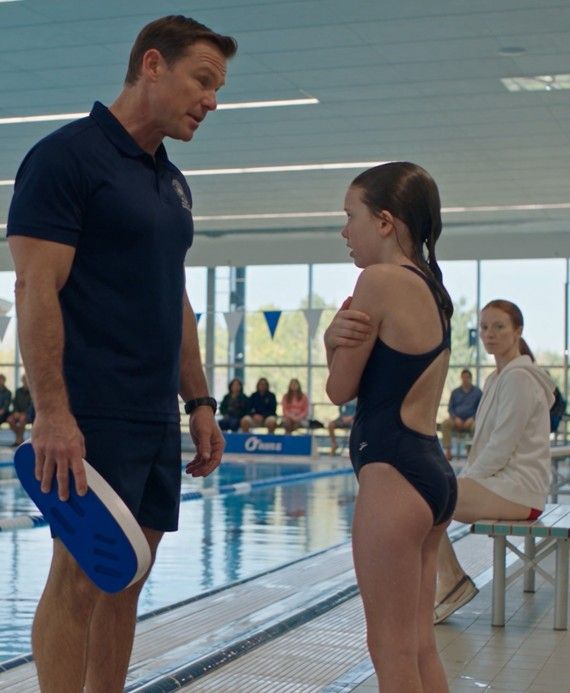
“Good. Nervous. Breathing fine.”
“Perfectly acceptable combination.”
Ellie smiled.
She dove at the signal.
Halfway through her leg, she felt strong—not because she had defeated her body, but because she was working with it. She touched the wall, climbed out, and watched the next swimmer launch. The relay finished second.
Nobody acted as if second were a tragedy.
After the meet, the team took a group photo. Tasha happened to walk behind them. Ellie called her over.
“You are not on the team,” Noah complained jokingly.
“She is in this picture,” Ellie said.
Tasha stood at the edge.
Months later, when the facility replaced one of its old cameras, Ellie saw the maintenance worker on a ladder and remembered the day Tasha pointed toward the ceiling. For a long time she had thought the cameras saved them.
They had not.
Cameras recorded. People still had to notice, preserve, compare, and act. Tasha had done that. Noah had spoken. Other swimmers had nodded. Their parents had listened.
Ellie’s own body had spoken first.
That was the beautiful thing she finally understood. The tightness in her chest had never been proof that she was weak. It had been information. Her fear had not betrayed the team. It had helped reveal a system that asked children to ignore themselves for an adult’s approval.
Before the new season, the team invited swimmers to write one thing they wanted adults to remember. The answers were anonymous. Some were funny—more snack breaks, warmer pool water, fewer early mornings. Others were painfully specific. Believe us before you call us dramatic. Don’t punish everyone because one parent complains. Tell us why a lineup changes. Let us finish a sentence.
Ms. Ramirez posted the list in the equipment room, not as a promise that children would always get what they wanted, but as a reminder of how authority felt from the other side. Ellie noticed her own sentence among them: Stopping is not the same as giving up.
No one knew she wrote it. She liked that. The sentence belonged to the whole team now.
When the first new swimmer became upset after missing a turn, Ellie almost slipped into the old culture and told her to toughen up. She caught herself. Instead she said, “Take a second. Then decide if you want another try.”
The girl took the second and tried again.
Ellie realized culture changed through moments that small. Bryan had built fear through repeated ordinary comments, not one grand speech. The team would build something safer the same way: one honored stop, one honest question, one parent told the truth, one coach willing to explain rather than threaten.
At the first practice of the next season, Ms. Ramirez reviewed safety signals with a group of new swimmers. She asked one of the returning athletes to demonstrate the stop signal.
Ellie raised her hand.
The gesture that once would have felt like quitting now meant something entirely different.
It meant: I am still here. I am paying attention. I get to stop long enough to stay safe.
Then she lowered her hand, adjusted her goggles, and waited for the whistle she no longer feared.
Ellie never thanked Coach Bryan for making her stronger. She rejected that story completely. Whatever strength she gained came from the people who listened, from learning her own body, and from choosing to return to swimming on safer terms. Harm did not deserve credit for the healing that followed it. The pool was hers again because adults finally respected the line she had tried to draw at the edge. Every clean breath after that felt less like victory over weakness and more like permission to trust herself without asking first. Again.
