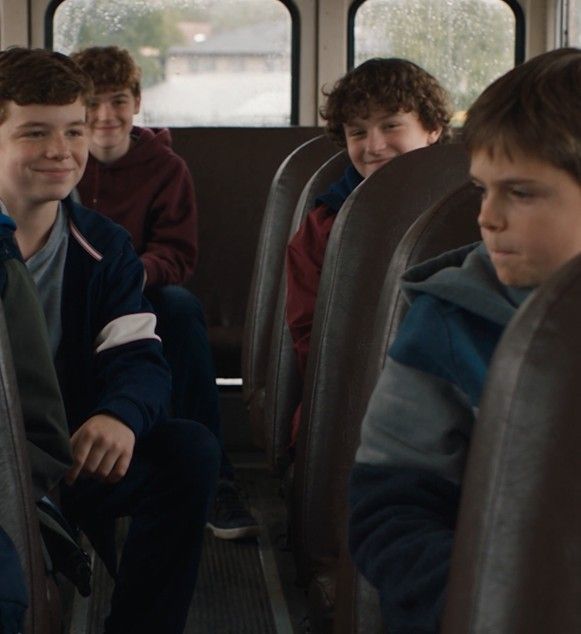
Carter looked smaller without the bus seat, the laughter, and the boys behind him. He apologized for moving the hearing aid and telling Ellis to hide it. The words sounded practiced.
Ben listened.
Then Carter said, “I didn’t know it was that serious.”
Ben looked at him.
“You knew I needed it back.”
Carter did not answer.
“That was enough.”
The counselor did not ask Ben to accept the apology.
He didn’t.
He said thank you for saying it and left.
Outside the office, June was waiting with two vending-machine hot chocolates.
“How’d it go?”
Ben took one cup.
“He talked.”
“And?”
“I talked too.”
June smiled. “Terrifying for him, I’m sure.”
Ben laughed so suddenly he spilled chocolate on his sleeve.
The laughter surprised him.
For months the bus had trained his body to treat laughter behind him as danger. Now the sound coming from his own mouth felt like taking something back.
Winter arrived. The baseball fields beside the route turned white at the edges. Carter remained on a different bus through the end of the semester. The boys who had joined him stopped mimicking Ben. One of them apologized privately and then, more importantly, stopped expecting Ben to reassure him that everything was fine.
Ellis sometimes sat across the aisle.
Their friendship did not become instant or simple. Ben was still angry that Ellis had closed his fist around the hearing aid even after seeing him search. Ellis was ashamed of it. They learned to let both facts exist.
One afternoon Ellis asked, “Do you hate me?”
Ben considered the question.
“No.”
“Are you mad at me?”
“Sometimes.”
Ellis nodded. “Okay.”
That honest answer did more for them than a forced forgiveness would have.
By spring, Ben returned to his old middle rows by choice. The front was louder near the door and the heater clicked constantly. He preferred the view halfway back.
The driver asked if he was sure.
“Yes.”
She did not ask again.
The repaired hearing aid worked perfectly, but Ben had changed one small habit. Each afternoon when he boarded, he touched the device lightly with one finger before sitting down. Not because he expected someone to steal it. Because he liked knowing it was there and that he had stopped treating the things he needed as something embarrassing to protect in secret.
June still met him at the library stop when debate ended early.
One rainy afternoon, nearly six months after the incident, Ben saw the red umbrella before the bus turned the corner.
Rain drummed hard against the roof.
Through both hearing aids, the sound was full and layered: water on metal, the hiss of tires, a backpack zipper, someone whispering about homework.
A boy behind Ben laughed.
For one instant, Ben’s shoulders tightened.
Then he listened again.
The boy was laughing at a video with his friend.
Nothing to do with Ben.
The realization passed through him quietly.
At the library stop, the driver set the brake and looked into the mirror.
“Ben, your stop.”
He lifted two fingers.
Not because he needed help.
Just to show he had heard.
