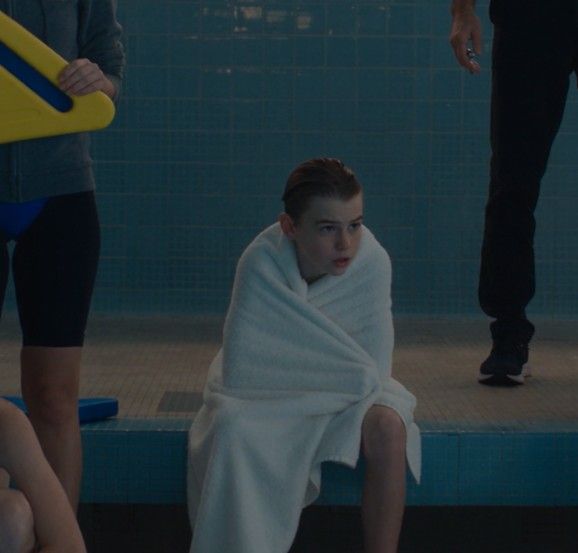
“What if I don’t anymore?”
“Then you don’t.”
Aaron looked at him. “You won’t be disappointed?”
His father took longer to answer than Aaron expected.
“I’ll be sad if something you loved got ruined for you,” he said. “That is different from being disappointed in you.”
Aaron looked down.
That answer helped because it was not perfect optimism.
It made room for loss.
They went to the pool on Saturday when no team practice was scheduled. Mara had arranged for one lane to be open, but she stayed in the office unless Aaron called her.
His father sat on the bench instead of upstairs behind the observation glass.
Aaron changed slowly.
He stood at the edge of lane six.
The water looked exactly the same.
For several minutes he did not get in.
His father did not ask when he would.
Finally Aaron sat on the edge and lowered his feet into the water.
Then his legs.
Then he slipped in.
He pushed off once.
No stopwatch.
No whistle.
At the far wall, he stopped and looked back.
His father raised one hand.
Aaron swam another length.
Then another.
He left after twelve minutes.
It was enough.
The next week he returned for twenty.
When team practices resumed under Mara, Aaron watched from the observation deck before deciding whether to rejoin. He saw something that would have looked unremarkable months earlier: a boy missed a turn, and Mara stopped the lane to explain it. Nobody had to perform extra laps while teammates waited. Nobody laughed because the coach did not laugh first.
Aaron came down.
