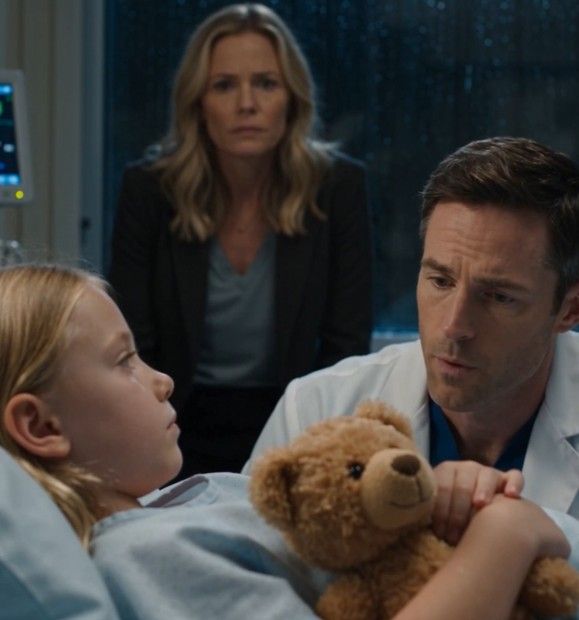
There was one more conversation Claire insisted on having before she allowed herself to call the chapter closed. She asked Daniel to meet her without Emma in the room. They sat in the small family lounge where she had spent too many nights drinking bad coffee beneath fluorescent lights.
“If the old sample had never surfaced,” she asked, “how long would you have kept treating the first diagnosis?”
Daniel did not answer quickly.
“I don’t know,” he said at last. “We were already becoming uncomfortable with the pattern. I hope we would have reopened the diagnosis soon. But hope is not an audit trail.”
Claire appreciated the sentence because it refused to make him look better.
“What changes because of this?”
“For Emma, her treatment. For me, how I handle discordant results. I’ve asked the department to require a formal review whenever a significant marker remains unexplained across two treatment cycles. Not a note in the chart. A real review with a second physician.”
“You’re changing policy because of her?”
“Because the system made it too easy for everyone, including me, to call one clue noise.”
Claire looked through the glass wall toward the hallway. “She is going to remember this place for the rest of her life.”
“I know.”
“I don’t want what she remembers to be that adults guessed until they got lucky.”
Daniel nodded. “Then I’ll make sure what I remember is that we owe children more than certainty. We owe them the discipline to question ourselves.”
Claire carried that conversation home with her. It did not erase the anger. It gave the anger somewhere useful to go. When the hospital invited her to participate in a patient-safety review, she agreed on one condition: Emma would never be turned into an inspirational anecdote. They could discuss the failed routing code, the archived sample, the diagnostic assumptions, and the repair. They could not reduce her daughter to a story about resilience.
Emma had already been called brave enough. Claire wanted her to be allowed to be ordinary.
That became the real measure of recovery. Not dramatic milestones. Ordinary complaints. Homework she did not want to finish. Socks abandoned in the hallway. An argument about screen time. The first morning Claire realized she had gone almost twenty minutes without checking Emma’s temperature, she stood in the kitchen and cried over a bowl of pancake batter.
Emma walked in, saw her, and sighed. “Are these happy tears or hospital tears?”
“Happy.”
“Good. Hospital tears make the pancakes weird.”
Claire laughed so hard she had to sit down.
Three months later, Emma returned to Room 714 only once.
Not as a patient.
Dr. Morris had arranged for her to meet the laboratory team during a hospital science day for children. Emma wore a sweatshirt covered in whales and carried Arthur under one arm.
Daniel found her studying a microscope slide.
“Still planning to be a marine biologist?” he asked.
“Obviously.”
“No interest in immunology?”
Emma considered him with great seriousness.
“Fish are less dramatic.”
Claire laughed.
