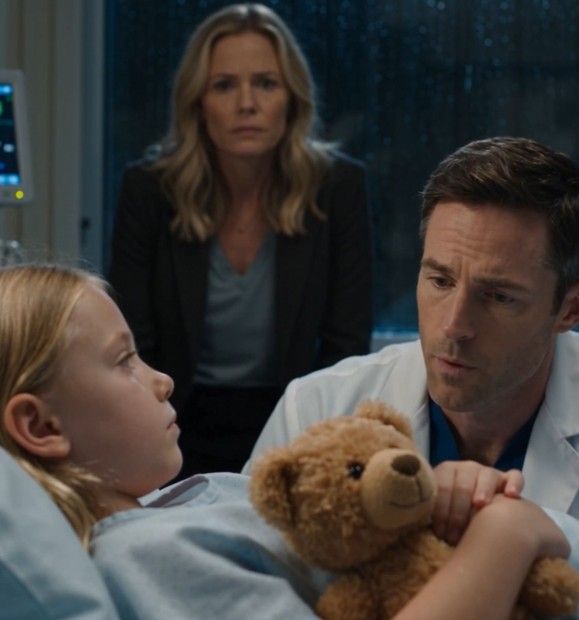
“That can’t be right.” Claire Bennett stared at the date on the laboratory report, then read it again. Seven years earlier. Her daughter Emma would have been three. “She wasn’t treated here when she was three.” Dr. Daniel Carter’s expression did not change. “I know.” Claire looked through the glass panel in Room 714, where ten-year-old Emma slept with a battered brown teddy bear tucked beneath her chin. “She had never even been inside this hospital.” “I know.” “Then why does St. Catherine have my daughter’s blood?” Daniel had been asking himself the same question for twenty minutes. Only an hour earlier, the night had almost felt hopeful. Rain blurred the lights of downtown Chicago outside the seventh-floor windows while Emma sat beneath a pale blue blanket, blonde hair falling loose around her face. Daniel had read her laboratory report three times before realizing his hands were trembling. For six months, Emma had endured recurring inflammatory episodes, abnormal blood markers, tests, hospital stays, and treatment based on what doctors believed was causing them. One result had never fit. Tonight, the laboratory reran a specialized panel. Twice. Both results were identical. Daniel pulled a chair toward Emma’s bed and knelt beside her. “We found something unexpected.” Emma hugged her teddy bear, Arthur, tighter. “Is something wrong?” “No. Not the way we thought.” Claire stared at him. “This could actually be good news,” Daniel said. Claire had heard hope before. Promising approach. Encouraging response. Words that sounded beautiful until they disappeared. “What does good news mean?” “One of Emma’s results doesn’t behave the way we expected.” Emma frowned. “That sounds like bad news.” Despite himself, Daniel smiled. “You’d make a good doctor.” “I want to be a marine biologist.” “Then you’d make a terrifying marine biologist.” Emma almost smiled. Claire didn’t. “Daniel.” He became serious. “The result suggests we may not be looking at the condition we thought we were.” “What are we looking at?” “I don’t know yet.” Claire’s face fell. “But if this is what I think it might be,” Daniel continued, “the treatment options could be very different.” “Better?” “Potentially much better.” Emma looked at him. “Like I could go home?” The question broke something in Claire. Emma did not ask whether she would be cured. She wanted her bedroom. Her aquarium. Saturday pancakes. Her bicycle. “When?” Emma asked. Daniel hesitated. “You always say soon.” “You’re right.” “So don’t say soon.” “I won’t.” He explained that another test needed confirmation in the morning. Emma considered that. “That’s more honest.” Later, after Emma fell asleep, Claire followed Daniel into the hallway. “You didn’t tell her everything.” “No.” “Tell me.” Daniel showed her the report. “The pattern suggests a specific immune response that can mimic what we’ve been treating.” Claire’s relief collided with anger. “You’ve treated my daughter for six months.” “I know.” “What if you were wrong?” Daniel did not defend himself. “Sometimes five clues point one way,” he said quietly, “while the sixth looks meaningless. Then something changes, and you realize the sixth clue was telling the truth.” “What’s the sixth clue?” “A protein marker that shouldn’t be there.” “And that means?” “Possibly something treatable.” Claire studied his face. “What aren’t you telling me?” Daniel hesitated. That was enough. “The lab compared tonight’s sample with an archived sample.” “From when?” He handed her the second page. Claire looked down. Seven years earlier. Emma, age three. A blood sample stored inside a hospital she had never visited. Then Claire noticed the physician listed beside it. She stopped breathing. She knew the name. And according to everything Claire had ever been told, that doctor had retired before Emma was even born. 👇
Claire kept staring at the physician’s name until the letters blurred.
Dr. Helen Rowe.
She had seen that name on framed newspaper clippings in her mother’s old house, on charity brochures, and once on a faded photograph from a hospital fundraiser. Rowe had been a celebrated pediatric immunologist at St. Catherine. She had also, according to every biography Claire had ever read, retired twelve years earlier.
Emma was ten.
Claire lifted the page toward Daniel. “Explain this.”
“I can’t yet.”
“That’s not an answer.”
“No. It isn’t.” Daniel took the report back and pointed to a string of numbers near the bottom. “This is the accession code. It tells us where the archived sample came from. I’ve asked the lab to freeze every linked record until we know the provenance.”
“Freeze it?”
“So nothing can be overwritten or merged while we’re looking.”
Claire’s voice dropped. “Are you telling me somebody changed my daughter’s chart?”
“I’m telling you I don’t know why a seven-year-old sample is attached to Emma’s record. Those are not the same thing.”
She hated the calmness in his answer because she needed somebody to be certain.
Inside Room 714, Emma shifted beneath the blanket. Arthur, the battered teddy bear, rolled against her shoulder. Claire looked through the glass and felt anger give way to fear so quickly it made her dizzy.
“What if it isn’t her blood?”
“Then we disregard it and start over.”
“And if it is?”
Daniel’s eyes moved to the report.
“Then it may be the most important result we’ve found.”
The lab director arrived twenty minutes later. Dr. Priya Shah wore a navy sweater over scrubs and carried a laptop under one arm. She apologized for the hour, pulled two chairs into a consultation room, and opened a screen full of accession histories.
“This sample was not collected at St. Catherine,” she said.
Claire’s head snapped up.
“Then why is it here?”
“Because St. Catherine inherited the biobank that stored it.”
Daniel leaned forward. “Which biobank?”
Dr. Shah enlarged a scanned label.
ROWAN COMMUNITY IMMUNE PROJECT.
The name meant nothing to Claire.
Dr. Shah continued. “It was a mobile screening program affiliated with Dr. Rowe’s research foundation. Blood was collected at pediatric clinics, schools, church health fairs, and community centers. Dr. Rowe’s name remained attached as principal investigator even after she stopped seeing patients. The foundation continued operating under her protocol for several years.”
Claire stared at her. “So Emma could have been tested somewhere else.”
“Yes.”
“She was three. I would remember someone taking her blood.”
Dr. Shah’s expression became careful. “There should be a consent form in the archived packet.”
“Should be?”
“The paper records were scanned during a merger. Some indexing is incomplete.”
Claire laughed once, sharply. “Of course it is.”
Daniel did not tell her to calm down.
Dr. Shah clicked through another screen. “The specimen identifier matches the old tube label. It has been in storage continuously. There’s no sign the sample was swapped or relabeled after accession.”
“That still doesn’t prove it’s Emma’s.”
“No. The confirmation panel in the morning can compare stable genetic markers from the archived sample with her current specimen. That will tell us whether both samples came from the same person.”
Claire folded her arms so tightly her fingers hurt.
“And the physician name?”
“Administrative attribution. Not proof Dr. Rowe ever met Emma.”
For the first time in twenty minutes, the impossible thing became merely unexplained.
Claire did not feel better.
She returned to Emma’s room and sat beside the bed until dawn.
At 5:12, Emma opened one eye.
“Are you mad?”
Claire looked down. “Why would I be mad at you?”
