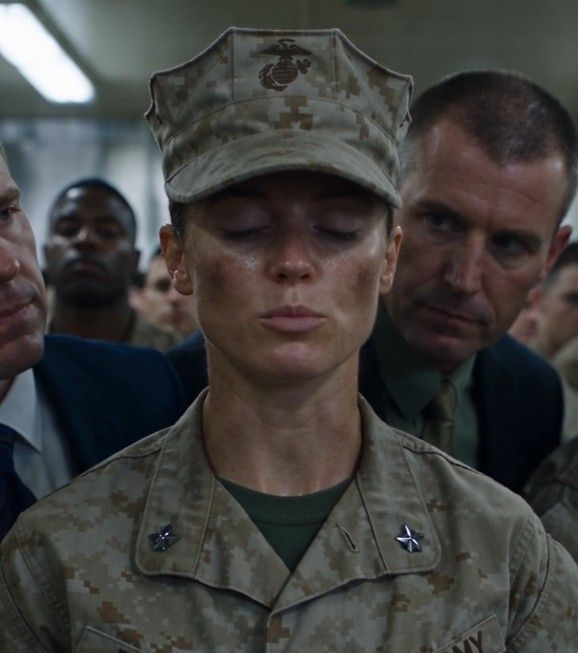
The pressure had been more ordinary.
A captain was dead. A young corporal had a memory she could not prove. Senior people wanted clean timelines. Everyone was tired. Sarah had doubted herself until silence felt safer than insisting.
“Hale told me something before he left,” she said.
I waited.
“He said if the inspections were good, the paperwork would prove him wrong and he’d be happy about it. He wasn’t trying to catch somebody. He was trying to keep people alive.”
Her eyes filled.
“I should have said that six months ago.”
“Say it now.”
“It might be too late.”
“Then let the investigators decide what the evidence can still show. Your job is the truth.”
She looked at me.
“You sound like him.”
“I’ll take that as a compliment.”
The next morning, Sarah corrected her original statement in full.
That decision became the turning point.
The reopened mishap review did not move like a movie. There were no midnight raids, no instant confessions, no one-page document that solved everything. There were maintenance logs, work orders, inspection signatures, parts histories, interviews, emails, training schedules, and hours of people comparing what should have happened with what had actually happened.
The recovered folder was important because Captain Hale had annotated several discrepancies before the accident. More important, those notes pointed investigators toward records that could be independently checked.
They found inconsistencies.
Some inspections had been certified at times when the technicians listed on the forms were documented elsewhere. Several corrective actions had been closed without the supporting measurements normally attached. None of that alone proved what caused the crash.
Then investigators examined the contractor’s internal messages.
The man who slapped Sarah was not a random employee.
He was a regional compliance manager visiting the installation because the company had been told the old mishap file was being reviewed again.
He had seen Sarah’s name in a preliminary witness list earlier that afternoon.
That fact did not prove he entered the chow hall intending to hurt her.
The video suggested something uglier and simpler.
He was already angry. He recognized her after hearing someone use her name in line. She asked him to step back. He lost control and hit her.
His own action turned a quiet administrative review into a much larger question about intimidation, judgment, and credibility.
He denied recognizing Sarah until investigators showed him the meeting notes listing her name.
Then he changed his story.
That change cost him more than the slap alone ever could.
His employer removed him from the installation immediately. The contract office suspended his access pending the investigation. Later, after the company’s internal review found he had approved compliance responses he could not adequately support, he lost his position.
Nobody in our unit celebrated.
Sarah least of all.
“I wanted him to be a monster,” she told me one evening.
We were sitting outside the barracks with paper cups of coffee, watching the sun go down behind the motor pool.
“Why?”
“Because then Hale’s death would make sense.”
I understood.
People prefer evil that announces itself. It is easier than accepting that catastrophic harm can grow from small dishonest choices, pressure to meet schedules, people signing what they did not verify, and other people deciding not to ask another question.
The final mishap findings came months later.
The review could not reduce Captain Hale’s death to a single cause. Weather mattered. Fatigue mattered. The road conditions mattered. But the mechanical history mattered too. A braking problem he had identified had not been documented and corrected with the rigor the records claimed.
The conclusion did not say one person killed him.
It said the system had failed to treat uncertainty as a reason to stop.
For Sarah, that was worse and better at the same time.
Worse because there was no single villain to carry all the blame.
Better because the truth did not require inventing one.
The company lost part of its maintenance role after the review. New verification rules required independent sign-off on certain safety-critical work. Units were instructed to preserve duplicate discrepancy reports outside local chains. None of those changes brought Hale back.
They were not supposed to.
They were supposed to make his warning matter.
The chow hall assault followed its own process alongside the mishap review. Sarah was offered the chance to make a written statement about how the contact affected her, and for a long time she left the page blank.
