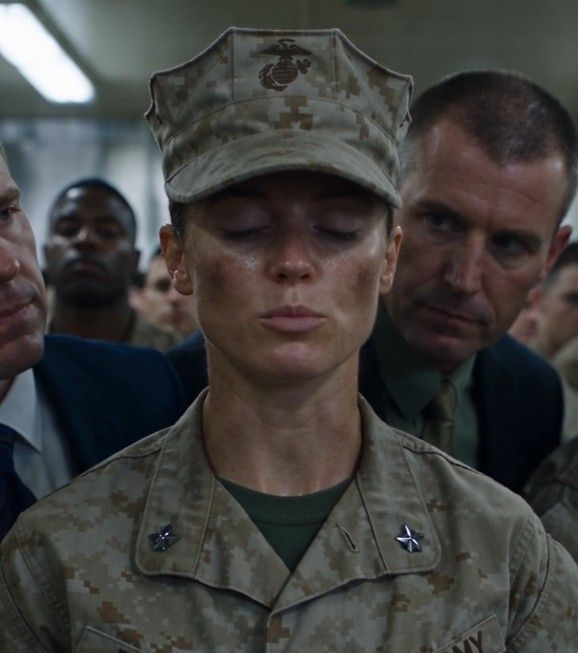
Not dramatically. That was not her way.
Her shoulders lowered half an inch. Her mouth opened, then closed. One hand rose toward the cheek the contractor had struck, but she stopped herself before touching it.
I knew the name.
Everyone in our company did.
Captain Hale had died six months earlier during a night training movement when a tactical vehicle left a mountain road. Officially, the accident had been blamed on weather, fatigue, and a mechanical failure nobody could fully reconstruct after the wreck burned.
Sarah had never talked about that night.
The officer continued.
“Corporal Sarah Miller was the last person to see Captain Hale before he departed the staging area. She was also the last person he documented speaking with regarding a safety concern tied to contractor-maintained equipment.”
A sound came from the civilian behind her.
Not a word.
A breath.
Sharp enough that I heard it.
The officer did too.
He looked up.
“Sir, what’s your name?”
The contractor’s confidence had disappeared completely. “This has nothing to do with me.”
“I asked your name.”
He glanced toward the exit.
Sixty Marines were still standing.
Nobody blocked him.
Nobody had to.
He gave his name and company affiliation in a voice much smaller than the one he had used when he called Sarah sweetheart.
The officer’s eyes narrowed.
The company name matched the one printed several times inside the folder.
Sarah looked at the contractor as if she were seeing him for the first time.
“You knew who I was.”
He shook his head immediately. “No.”
“You knew my name.”
“I heard someone call you Miller. That’s all.”
The officer closed the folder.
“Nobody is deciding anything in this chow hall.”
His voice cut through the tension before it could become something dangerous.
He looked at the Marines around us.
“Step back. Give them room.”
We did.
That mattered.
What had begun as instinctive solidarity could have become a mob if somebody had wanted spectacle more than truth. The officer refused to let that happen. He told two staff NCOs to keep the contractor where he was without touching him unless necessary. He asked another Marine to call military police and medical. Then he turned to Sarah.
“Corporal, sit down.”
“I’m fine, sir.”
Blood had begun to color the inside of her lip.
“That wasn’t a medical assessment. Sit down.”
She obeyed.
I carried her tray to a table and sat across from her while a corpsman checked her face. The contractor remained near the wall with his arms folded, trying to look insulted by the inconvenience.
He no longer looked important.
He looked trapped by his own choices.
Sarah stared at the sealed folder, now resting on the officer’s table.
“I thought that report was gone,” she said.
The officer heard her.
“What report?”
She looked at him for a long moment.
