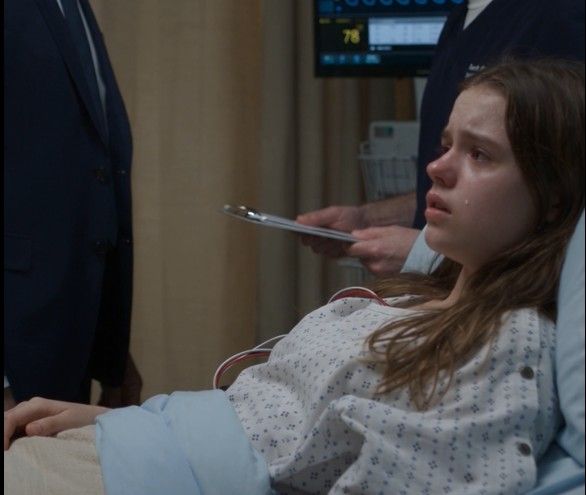
“Don’t treat her.” My father said it while standing beside my emergency-room bed in a perfect navy suit, his eyes on the doctor instead of on me. I was sixteen, wires covered my chest, my heartbeat was unstable, and a surgical team was waiting because delaying the procedure could put my life at risk.
The doctor stared at him. “Mr.
Carter, waiting could be dangerous.” “I understand.” “Then you understand why we need to proceed.” My father checked his watch. “Don’t treat her.” Until that moment, I had expected fear from him.
I had collapsed on a volleyball court less than an hour earlier. One second I was serving; the next, my vision blurred, my chest tightened, and my heartbeat felt like it was fighting against me.
My coach caught me before I hit the floor. The hospital called Mark Carter because he was my emergency contact.
I thought he would rush to me. Instead, he walked in, looked at the monitor, and asked what would happen if the doctors waited.
“Dad,” I whispered. He did not look at me.
“I know what I’m doing.” That sentence had shaped my childhood. My father chose my friends, my classes, my clothes, even which ambitions were acceptable.
He called it protection. Other people saw a successful, disciplined man who always seemed certain.
Lying there struggling to breathe, I watched that certainty become something else. The doctor explained the risks again.
My father repeated his refusal. Then the curtain opened.
A cardiothoracic surgeon stepped inside and took my chart. “Dr.
Nathan Bell,” he said quickly before scanning the pages. Then he looked at me.
His expression changed. He did not look like a surgeon studying a patient anymore.
He looked as though he recognized something he had never expected to see again. Slowly, he turned toward my father.
“What was your wife’s maiden name?” My father stiffened. “That has nothing to do with this.” “Was it Claire Bennett?” My mother’s name had barely existed inside our house.
She died when I was young, and my father almost never spoke about her. I knew photographs, fragments, a few carefully chosen facts.
But when Dr. Bell said her maiden name, fear crossed my father’s face.
“Pull the sealed Carter file from sixteen years ago,” Dr. Bell told the nurse.
My father stepped forward. “You don’t have permission.” The nurse moved between them.
“Please move back.” Minutes later, the old file appeared on a screen. Dr.
Bell read silently. Then he looked at me.
“Your mother knew this could happen.” He explained that Claire Bennett Carter had documented my heart condition when I was a baby. She had requested regular monitoring and left instructions for what should happen if someone tried to deny me treatment.
My father said nothing. He did not ask what the file contained.
That frightened me more than anything. He already knew.
Dr. Bell opened another scanned page.
At the bottom was my father’s signature. Above it was a handwritten note from my mother: “If Mark refuses care for Emma, call Rebecca Bennett immediately.
Do not let him decide alone.” Rebecca Bennett. I had never heard the name.
Yet my mother had trusted this person enough to leave instructions protecting me from my own father. I looked at him.
For the first time, I understood that his refusal was not only about the surgery. He had been keeping something from me for years.
