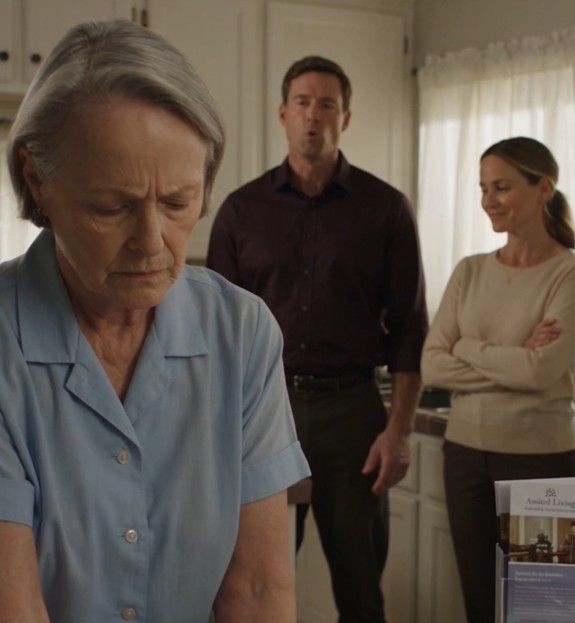
David stood beside the conference table while an investigator closed the door behind him. “Mom,” he said, his voice barely steady. “What have you done?”
The night before, I had heard him order me out of the home my savings helped build. I had washed dishes while cold water ran over the tile I had paid to install.
“If you won’t move into assisted living,” David had said, “pack your things and get out of my house.” Emily, his wife, smiled just enough to tell me the decision had already been made.
After Albert died, David begged me not to live alone in Queens. I sold our apartment and gave him nearly all my savings from thirty-two years of sewing wedding gowns. He called it a family investment.
My money rebuilt the kitchen, replaced the windows, added the porch, and paid for the staircase runner Emily showed visitors. I received a narrow bedroom at the back of the second floor and told myself being near my son and grandchildren was enough.
Then pieces of my jewelry began disappearing: my grandmother Clarice’s pearl brooch, an amber necklace, a silver bracelet, an amethyst ring. David barely looked up when I told him. “Maybe you misplaced them.” Emily smiled sympathetically and said memory slips happened at my age.
Six months later, I saw Emily’s vacation photographs from Cancún. My grandmother’s silver bracelet was around her wrist. I said nothing. One evening, I heard her on the phone saying she only needed a few more months before I was in assisted living and she could turn my room into a walk-in closet. “She still thinks David is a good son,” she laughed.
When David finally gave me the choice of assisted living or the street, I turned off the water, dried my hands, and smiled. “All right. I’ll pack.” He had expected tears. Instead, I placed a few dresses, medication, documents, and photographs into my old leather suitcase.
The doorbell rang. Henry Montgomery, Albert’s former business partner and closest friend, stepped from a limousine and came directly to me. “Catherine, are you ready?” I took my suitcase. “Yes.”
The next morning, Henry and I met attorney Oliver Samson at a Midtown law firm. A blue folder held Albert’s will, company-share records, trust papers, and transfer forms carrying an almost perfect imitation of my signature. The documents appeared to move financial authority and investments I had never agreed to sell.
Henry said Albert had created protections. Oliver explained I controlled a substantial share of the company through a trust. The papers appeared to have been filed during the past eighteen months, and one attempted to transfer my interest in the house to David.
I recognized the date. I had been visiting my sister in Boston. Oliver had train records, hotel receipts, security footage, and a notarized document I signed there that afternoon. “So the transfer is not merely invalid,” Henry said. “It’s evidence,” Oliver replied.
Then the door opened. David and Emily entered with two corporate attorneys. A uniformed investigator closed it behind them. David stared at the folder and asked what I had done. I laid my hand over the forged signature bearing my name. “No, David,” I said. “What did you do?”
David did not answer. His eyes stayed fixed on the paper beneath my hand, as if the ink might rearrange itself into something he could explain. Emily stood beside him, jaw set, while the investigator introduced herself as Detective Alvarez and asked everyone to remain seated.
Oliver spoke first. “This is a scheduled meeting about documents submitted in Catherine’s name. No one is under arrest. We are here to establish what each person knows and to preserve the records.”
The plainness of that statement changed the room. There would be no dramatic confession forced by a badge, no instant verdict. There would be questions, copies, dates, and a process that might take months.
David glanced at the corporate attorneys. One leaned close and whispered something. Emily did not sit. “This is a family matter,” she said. “There has been a misunderstanding about paperwork.”
“Then we can clarify it,” Detective Alvarez replied. “Who prepared the forms?”
No one spoke. Oliver placed three copies on the table. He showed the date beside each signature, the notary stamp, and the filing receipt. One transfer was never recorded; it had been rejected for a missing attachment. Another had been submitted to a financial institution, which had paused action after its verification team noticed a mismatch in Catherine’s identity records. The house document had been filed with a county office but challenged before any change was entered in the public record.
I asked whether the house could be taken from me. Oliver said the deed currently remained as it had been recorded: in David’s name. His words were careful. The money I had contributed and the circumstances of the transfer might support a civil claim, but no one could simply announce that the house belonged to me and make it true. We would need evidence, proper filings, and possibly a court decision.
The deed was in David’s name. I had trusted him enough to put my money into a home we said was ours. The paperwork would have to catch up to what happened.
Detective Alvarez turned to David. “Did you ask your mother to sign these documents?”
“No.”
“Did you sign or submit any of them?”
“I didn’t sign her name.”
“That wasn’t my question.”
He looked at Emily. She had finally taken the chair beside him but sat rigidly, hands clasped. “I sent documents to the adviser,” he said. “Emily said Mom had signed them.”
Emily stared at him. “You knew what they were.”
“I knew we were changing the beneficiary information. I thought you had her authorization.”
“Then why did you tell me to keep the signature page out of the family folder?”
