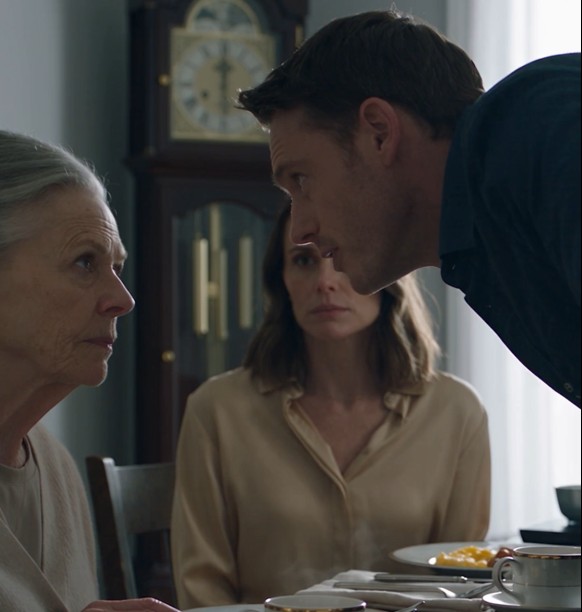
Julian slapped his mother so hard she stumbled into the bookcase.
“Sign over the bakery.”
For a moment, she stayed where she had landed, one hand against the shelves. Julian stood in front of her, waiting for an answer as though what he had done were part of an ordinary conversation.
His wife smiled.
Julian’s mother looked past them, toward the antique clock. Her husband had hidden a camera there. If it was still working, it had caught everything.
She said nothing about it.
The next morning, she set the breakfast table for four.
One place for herself. One for Julian. One for his wife.
And one more.
Julian noticed it as soon as he came in. His eyes moved across the plates, then back to his mother. She had poured herself coffee, but she hadn’t taken a sip.
He laughed.
“Expecting someone to save you?”
His mother kept her hand around the cup. She could still feel the shock of hitting the bookcase, but she held his gaze.
“The police. I sent them the recording.”
Julian’s wife stopped smiling.
It was a small change. She didn’t move away from the table or turn toward Julian. She just looked at his mother, suddenly alert.
“Just last night’s?” she asked.
The question seemed to hang between the four place settings.
Julian’s mother slowly lowered her coffee. She had expected anger from her son. She had expected him to ask how she had recorded him, or to deny what he had done.
She had not expected his wife to ask that.
“What else would I send?”
Julian turned toward his wife.
She ignored him.
For the first time that morning, his mother looked at her longer than she looked at Julian. The woman who had smiled while he demanded the bakery was watching the antique clock now.
“That camera wasn’t working when his father died,” Julian’s wife said.
Julian’s mother stared at her.
Her husband was gone. His camera had been hidden. Yet Julian’s wife had spoken as if she knew exactly when it had stopped working.
Julian was still turned toward his wife, waiting. His mother could see that he wanted an explanation too. Neither of them got one.
The coffee sat untouched beside her hand. Across the table, the fourth place remained empty.
She thought about the recording she had sent to the police. She thought about the camera inside the clock, and about the certainty in his wife’s voice.
Then she asked the only question that mattered.
“How would you know?”
Julian’s wife looked at her.
Her chair scraped backward. One hand went toward the clock, and Julian’s mother stood so abruptly that coffee spilled across her saucer.
“Leave it.”
For a second, nobody moved. Then three firm knocks sounded at the front door.
Julian stepped into his mother’s path. He was close enough for her to smell the peppermint toothpaste she had bought for the upstairs bathroom. That ordinary detail nearly undid her.
“Mum. Listen to me.”
She looked at his hand hovering near her elbow.
“Move.”
He did, but only when the knocking came again.
Two officers stood on the doorstep. Eleanor had given the dispatcher her name before dawn, whispering in the locked bathroom, but hearing it spoken kindly made her throat close. The younger officer saw her cheek and stopped asking whether this was a convenient time. Within minutes, Julian was standing beside the kitchen counter, his hands visible, while the other officer placed herself between Eleanor and the dining room.
“My daughter-in-law knows something about my husband’s death,” Eleanor said. “She just told us the camera wasn’t working that day.”
Mara folded her arms.
“I said I didn’t think it was working.”
“No,” Eleanor said. “You didn’t.”
The officer asked them to speak separately. Mara reached for her handbag.
“Leave that on the table for now, please.”
Julian stared at his wife. His face had changed, though Eleanor could not yet tell whether it was fear for his father or fear for himself.
When they arrested him for the assault, he began to cry.
“Mum, tell them. We were arguing. You know how things have been.”
Eleanor remembered him at seven, holding a broken bird in both hands and demanding that she make it breathe. She remembered last night with equal clarity: the brief adjustment of his feet before he struck her, the way he had waited afterward for her signature.
Both memories belonged to her son.
“Yes,” she said. “I know.”
The officer took him through the doorway. Eleanor did not follow.
Mara left separately after giving her details, her departure watched from the porch. There was not yet enough to hold her. Before stepping outside, she glanced at the flour tin beside the stove.
“You’ll have to run the place yourself now.”
Eleanor’s mouth tasted of blood where the inside of her cheek had split.
“I always did.”
Only after the door closed did her knees weaken. The officer caught her chair before it tipped and helped her sit. The fourth plate was still empty. Eleanor put her palm over its cold center and finally began to shake.
