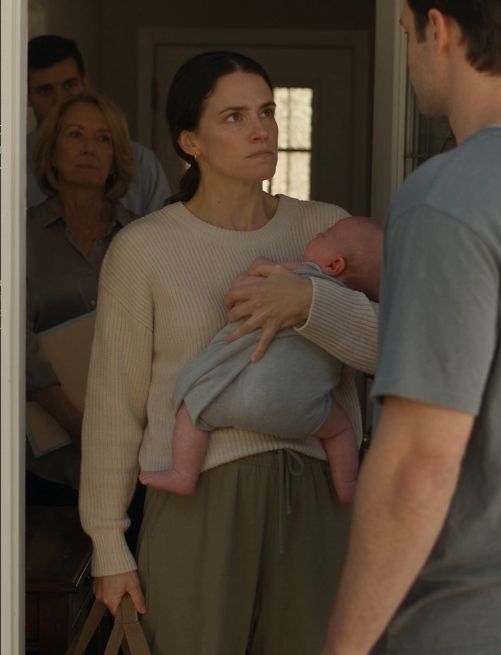
On Monday, Frank filed everything at 8 a.m., an hour before Brenda’s petition was supposed to be slipped to Judge Harrell. The judge’s clerk called Frank by 10 a.m. to say the Miller filing had been withdrawn. By noon, the bank had frozen Derek’s access and flagged the eighty-six thousand for return. By evening, the Tacoma was back in Gaby’s driveway, vacuumed and with a full tank, Mason having driven it over with his head down and an apology mumbled to the pavement that Gaby accepted with a nod but not a hug.
It should have felt like victory. And it did, in the way that finally breathing after holding your breath feels like victory. But that night, after Leo was asleep in the motel, Gaby sat on the bed with her hands in her lap and said something that changed everything I thought I understood.
“I need to tell you something,” she said, not looking at me. The lamp was low again. Outside, the same ice machine hummed. “About Grand Avenue. About you finding me.”
I sat down across from her. “What about it?”
Her fingers picked at a loose thread on the bedspread. Her voice was so quiet I had to lean in.
“I stood there on purpose,” she whispered. “On Grand Avenue. I knew you drive Grand every Thursday to check the shops. You always have. Since I was little. You take 19th Avenue to Grand, past the AutoZone, at four o’clock. I remembered.”
My breath caught.
“I was at the shelter for two weeks,” she went on, tears running silently now. “I didn’t know what to do. Brenda said if I called you, you’d think I was crazy too. But one of the women at the shelter, Elena, she said, ‘Your dad owns those shops, right? He still drives that route?’ And I thought… maybe if I just stood where you would see me… maybe you would stop. I stood there three days, Dad. Three days from two to five. With that cup. Leo was so hot. I felt so ashamed. But I didn’t know how else to make you see me without Derek seeing me first.”
The photo on her phone. The video Brenda made. All of it, I had thought it was their trap. That they had put her there to be seen, to be judged. And they had, in a way. But Gaby had taken the very street they used to humiliate her and turned it into a signal flare.
“You were begging,” I said, my voice breaking, “because they made you. But you chose where to beg so I would find you.”
She nodded, finally looking at me, her face wet and open and terrified that I would be angry.
“I was so scared you would just drive by,” she sobbed. “When you said my name… I wanted to run. I thought you’d be ashamed of me.”
I didn’t answer with words. I couldn’t. I slid off the chair onto my knees again and pulled her into me, and we both shook. Leo slept through it, his little chest rising and falling in the bassinet. I held my daughter and felt the full weight of what she had done, how much courage it had taken to stand in traffic with her baby and hold a plastic cup and hope that her old father would still take the same road at the same time, that he would still look.
“You were so brave,” I whispered into her hair, the way I had when she was four and fell off her bike. “You were so, so brave, my girl. I’m so sorry it took me three days to find you.”
She cried harder then, but it was a different kind of crying, the kind that lets go.
We moved her back into the townhouse on a Tuesday. I brought my crew from the shops, not to work on cars but to carry boxes, to fix the lock on the back door that Brenda had broken, to repaint the nursery a soft green that Gaby chose. Marisol came with a bag of baby clothes donated from the shelter and stayed for coffee. Frank brought the final papers that said the trust was secure and the protective order was granted. Carlos stopped by with his sister, who hugged Gaby for a long time and said, “You did it.”
Gaby didn’t frame the quitclaim deed or the photos. She shredded them in the office shredder Frank lent us, Leo watching the paper disappear with wide eyes, and then she vacuumed up the shreds herself.
A week later, I found her in the kitchen at the townhouse on a Sunday morning. The light was coming in through the window over the sink, warm and gold, catching dust motes and the steam from the coffee. Leo was in his high chair, banging a soft spoon against the tray, giggling every time it made a noise. Gaby was barefoot, in a clean shirt that was finally her own, her hair still damp from a shower she could take as long as she wanted.
She was making pancakes. The radio was on low, an old song her mother used to hum while she did the same thing.
I stood in the doorway and watched them. My daughter, safe in her own kitchen. My grandson, fed and warm and laughing. The house quiet except for the spoon and the radio and the soft sound of Gaby singing under her breath, off-key and unashamed.
She saw me and smiled. Not the ashamed smile from the traffic island. A real one, tired and whole.
“Dad, you want the first one?” she asked, holding up a slightly lopsided pancake. “It’s ugly but it’s good.”
I walked into that sunlight and took the plate from her hands. Leo reached for me with both arms, and I picked him up, his weight solid and warm against my chest, his little hand patting my cheek.
We ate together at the small table that was hers again, the three of us, with the windows open to the desert air, and for the first time since my wife died, the house didn’t feel empty at all.
