On the second ring, Diane picked up.
“Eleanor?” Her voice was crisp and warm at once, the way it had been in her office when she slid the folder back across the desk to me. “Are you at the property?”
“I am,” I said, and my voice did not shake. “I’m standing in my living room. And Megan is here. Early. With guests. Just like you said might happen.”
Megan’s brow furrowed.
“Who is that?” she whispered, her smile thinning into a hard line. “Mom, who is she talking to?”
Her mother stepped forward, arms crossed over her bright beach cover-up, perfume heavy and sweet. “Hang up the phone, Eleanor. You’re making everyone uncomfortable. This is a private family gathering.”
Diane’s voice came through clearly now, because I had pressed speaker without asking permission. “Eleanor, do you want me to put this on record? Are you safe to stay on speaker?”
“Yes,” I said, looking straight at Megan. “Please say it so everyone can hear.”
A small gasp came from the woman sitting on my quilt. One of the children stopped mid-stride, a broken rose stem still in his fist.
Megan’s eyes darted to my purse, to the phone, to the front door as if calculating how fast she could make this stop.
Diane didn’t raise her voice. She didn’t need to.
“As of eleven days ago, the beach house at 14 Pelican Way is held in the Eleanor Hayes Irrevocable Living Trust, with a reserved life estate for Eleanor Hayes. That means Eleanor owns the right to live in and control that home for the rest of her life. No one may occupy, rent, lend, list, or alter the property without her express written permission. Any person present without that permission is trespassing. The trust was recorded with the county on the 18th. Notices were mailed to all interested parties, including your son, Robert Hayes.”
The air in the room shifted.
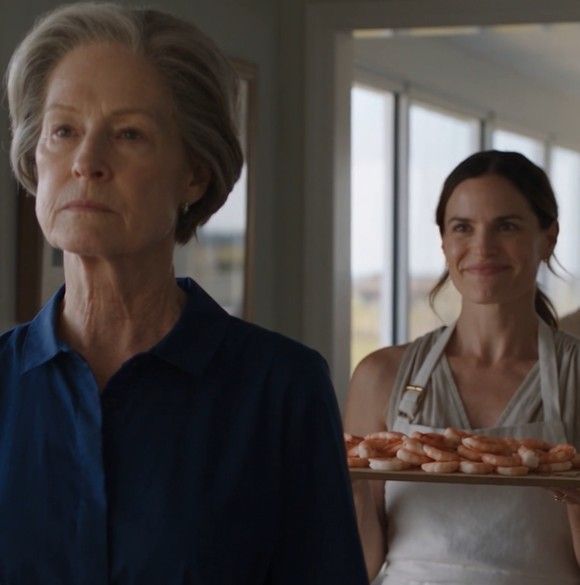
Megan’s tray tipped a fraction. Shrimp juice pooled at the edge.
“That’s not — that’s ridiculous,” she said quickly, too loudly. “Robert is the son. This is his family’s house. You can’t just — my husband said —”
Her mother cut in, sharp. “Robert gave us permission. He said his mother wouldn’t be here until tomorrow. He gave us the key. We have a right to be here.”
I felt the old boards under my shoes, the ones Henry and I had sanded ourselves the summer Robert was ten. My hand found the edge of the kitchen counter to steady myself, not from weakness but from the weight of finally being heard.
“Robert doesn’t have a key to give,” I said quietly. “Not anymore. I changed the locks on Tuesday. The only key he had was the one I left under the blue flowerpot for emergencies. Did he tell you where it was, Megan?”
Megan’s mouth opened. No sound came out at first. Then, “You changed the locks on your own son?”
“I protected my home,” I said.
From the hallway, the front screen door slammed.
Robert stood there with a grocery bag in each hand, his shirt damp with sweat, his hair windblown. He froze when he saw me. The bags slipped an inch in his grip.
“Mom?” he said, his voice cracking. “You — you said tomorrow.”
“And you told your wife tomorrow,” I answered. “So she could fill my house before I got here.”
He set the bags down slowly on the floor. A carton of eggs wobbled inside. His eyes moved from me to Megan to the crowd of strangers holding drinks in my kitchen, to his mother-in-law with her arms still crossed.
“Megan,” he said, low. “What did you do?”
Megan turned on him instantly, her voice turning sweet and wounded. “What did I do? I planned a nice weekend like we talked about. You said she wouldn’t mind sharing for once. You said she never even uses the place in May. Your mother is trying to make me look like a criminal on speakerphone in front of my family.”
“Sharing?” I repeated. The word tasted like salt. “Is that what you call listing my house online for strangers, Megan?”
Her face went white.
Robert stared at her. “Listing?”
