Hannah’s lips parted.
“He did it because my father told him to.”
“Your father is dead too.”
“Yes. He died knowing he had destroyed the only good thing I ever built. He did it deliberately. Because a Blackthorne child born out of wedlock to a nurse from Milwaukee would have disrupted the trust structure. It was purely financial. He traded my daughter’s existence for a tax advantage.”
The cruelty of it hung in the air like smoke.
Maya had stopped eating. She was watching her mother’s face with the careful attention of a child who has learned to read weather.
“Mommy,” she said softly. “Are you okay?”
Hannah wiped her face with the back of her hand. “I’m okay, baby. I’m okay.”
“You’re crying.”
“I know. Sometimes grown-ups cry when they’re happy.”
“Are you happy?”
Hannah looked at Julian. He was still holding her hand. His thumb moved once across her knuckles. A gesture so small it could have been accidental, except nothing about Julian Blackthorne was accidental.
“I don’t know yet,” she said. “But I think I might be.”
—
They didn’t leave Belladonna’s that night.
Sloane handled the bomb threat—two patrol cars, a sweep, nothing found, a crank call traced to a burner phone that had already been destroyed. She handled the restaurant, negotiating a private extension of their reservation until midnight. She handled the staff, quietly, firmly, the way she handled everything.
And then she sat at table nine alone, drinking a glass of Barolo that she would later describe as the best wine she’d ever had, though she could not remember a single note of its flavor because her hands were shaking and had been since the moment Maya said, “Are you my daddy?”
At table seven, Julian and Hannah talked.
Not about the past. Not at first. They talked about Maya. Her school—P.S. 118 in Queens, a good teacher named Mrs. Okafor, a best friend named Lily who had a hamster named General Butterbean. Her favorite books—anything with animals, especially the ones with pictures of baby elephants. Her allergies—peanuts, which meant every birthday party required a separate cupcake brought from home in a little container that Hannah washed and reused every time.
Julian listened to all of it.
He listened the way a man listens to a language he almost spoke fluently but missed by one word for seven years.
And Hannah, despite everything—despite the forged documents, despite Richard Hale, despite the letter, despite seven years of raising a child alone in apartments that got smaller every time the rent increased—Hannah began to tell him things.
The first time Maya walked. A Tuesday. Hannah had been boiling pasta and turned around and Maya was standing at the coffee table holding on with one hand, grinning like she had invented locomotion.
The first word. “More.” Not “mama.” Not “dada.” “More.” Because she wanted more crackers.
The night Maya asked why she didn’t have a daddy and Hannah said, “He loves you very much but he lives far away,” and Maya said, “How far?” and Hannah said, “Very far,” and Maya said, “Farther than Grandma’s house?” and Hannah said, “Yes,” and Maya said, “Then I’ll write him a letter.”
“Did she?” Julian asked.
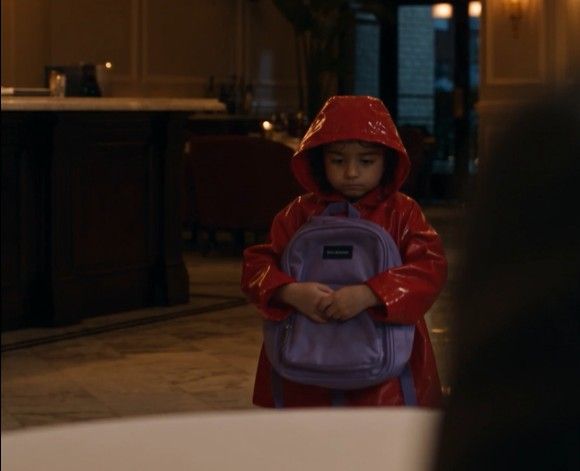
Hannah reached into the purple backpack. Maya was asleep now, curled in the chair with her head on her mother’s coat, the red raincoat draped over her like a blanket. Hannah pulled out a folded piece of construction paper, creased and soft from being handled many times.
Julian took it.
The handwriting was large and uneven, the letters in crayon:
DEAR DADDY I HAVENT MET YOU YET BUT I LIKE DINOSAURS AND MY BEST FRIEND IS LILY AND HER HAMSTER IS FUNNY DO YOU LIKE HAMSTERS PLEASE WRITE BACK LOVE MAYA
