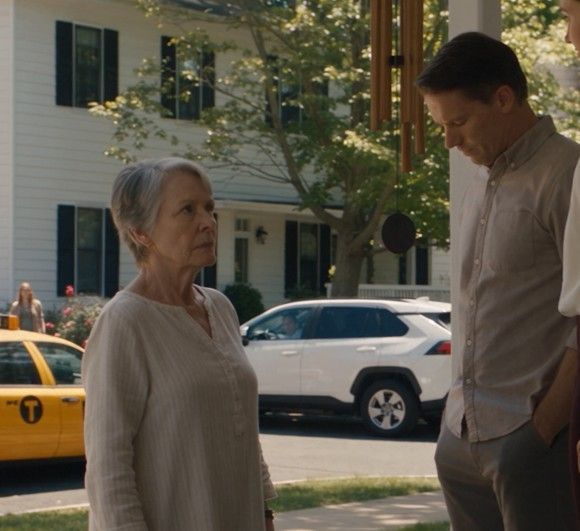
“Your belongings are staying right there.” Catherine shoved Linda’s last suitcase down the front steps, and the wheels struck the sidewalk hard enough to make two neighbors stop walking. The suitcase tipped sideways beside three overstuffed trash bags. A gray sweater slipped from one open bag. Linda stood at the curb without moving. The afternoon sun made everything painfully visible. Across the street, Mrs. Nolan stopped watering her roses. Two teenagers on bicycles slowed near the corner. The taxi Catherine had ordered waited with its engine running. Linda looked at the suitcase. Then she looked past Catherine. Her son Michael stood beside the porch railing with both hands buried in his pockets. His shoulders were rigid. His eyes remained fixed on the concrete. “Michael.” He did not answer. Linda swallowed. “Do you agree with this?” Michael lifted his head. For less than a second, their eyes met. Then he looked away. Catherine folded her arms. Michael rubbed the back of his neck. “It’s only temporary, Mom.” Linda stared at him. The sentence felt far too small for what was happening. Catherine laughed once. There was no humor in it. She stepped between them and nudged one trash bag toward the street with the toe of her shoe. “There’s nothing temporary about it.” Michael’s jaw tightened. Still, he said nothing. Catherine checked her watch. “You have thirty minutes before the driver leaves.” Linda turned toward the house. The white two-story home stood behind them with clean shutters and a freshly painted porch. She had planted the maple beside the driveway nineteen years earlier. Michael had helped dig the hole when he was seventeen. He refused gardening gloves and laughed about the blisters afterward. Now that same tree shaded Catherine’s SUV. A wind chime moved softly above the front door. Linda bent and picked up the fallen sweater. Her hands trembled. She folded it carefully. Catherine watched with obvious impatience. “You don’t need to organize everything here.” “I know.” “You can do that wherever you’re staying.” “I heard you.” Catherine’s lips tightened. Linda looked at the bags again. Her clothes had been pushed into them without care. Sleeves hung over plastic edges. One zipper had not been fully closed. Her life inside that house had been reduced to whatever could be dragged onto the sidewalk. She turned back toward Michael. He had not moved. “Did you pack these?” His face changed. Not much. Enough. Linda understood. Catherine answered before he could. “Does it matter?” “Yes.” “Why?” “Because I asked my son.” Michael closed his eyes briefly. That hurt more than an argument would have. Linda waited. Finally, he spoke. “I helped.” The words landed quietly. She nodded once. Mrs. Nolan lowered the garden hose across the street. The two teenagers had stopped pretending they weren’t watching. Linda became aware of the taxi driver looking toward them through the windshield. Catherine noticed too. Instead of lowering her voice, she stepped closer. “This is exactly why we needed to do this.” Linda looked at her. “Do what?” “End the situation.” Michael shifted beside the railing. Linda kept her eyes on Catherine. “What situation?” Catherine gestured toward the bags. “You living here like nothing has changed.” Linda’s expression stayed calm, but her fingers tightened around the folded sweater. Then she looked at Michael. His silence now felt different. Less like hesitation. More like surrender. “Changed when?” Linda asked. Michael finally raised his eyes. Catherine turned toward him before he could answer. That movement was quick. Automatic. Linda saw it. And for the first time since the suitcase hit the sidewalk, she wondered whether being thrown out was only the final part of a decision her son had made long before she knew there was one.👇
Linda refused to enter the taxi until Michael answered her question. “Changed when, Michael?” she asked. He admitted Catherine had been pressing him for months to make Linda leave. At turn 1 of the confrontation, Linda noticed how different the moment felt once nobody could hide behind the speed of the argument. The details mattered now because this particular turn in the conflict could not be separated from what had just been said and done. Instead of reaching for the easiest explanation after beat 1, Linda stayed with the uncomfortable facts created by that choice. That restraint changed the balance at this point more effectively than another burst of shouting could have done.
For Linda, this was not about winning scene 1 of an argument. It was about refusing to let another person define reality by speaking first or loudest. Michael had to decide what responsibility looked like when apology alone was no longer enough, while Catherine had to face a consequence that could not be dismissed as oversensitivity. The next choice grew directly from that pressure, and the old pattern became harder to repeat without being seen for what it was.
Catherine tried to end the conversation by telling the driver to take the bags. Linda stopped the driver politely and said she would decide where her belongings went. At turn 2 of the confrontation, Linda noticed how different the moment felt once nobody could hide behind the speed of the argument. The details mattered now because this particular turn in the conflict could not be separated from what had just been said and done. Instead of reaching for the easiest explanation after beat 2, Linda stayed with the uncomfortable facts created by that choice. That restraint changed the balance at this point more effectively than another burst of shouting could have done.
For Linda, this was not about winning scene 2 of an argument. It was about refusing to let another person define reality by speaking first or loudest. Michael had to decide what responsibility looked like when apology alone was no longer enough, while Catherine had to face a consequence that could not be dismissed as oversensitivity. The next choice grew directly from that pressure, and the old pattern became harder to repeat without being seen for what it was.
Michael finally confessed that he and Catherine had discussed converting Linda’s room into an office and guest suite. He also admitted he had kept postponing the conversation because he knew how much the house and the maple tree meant to her. At turn 3 of the confrontation, Linda noticed how different the moment felt once nobody could hide behind the speed of the argument. The details mattered now because this particular turn in the conflict could not be separated from what had just been said and done. Instead of reaching for the easiest explanation after beat 3, Linda stayed with the uncomfortable facts created by that choice. That restraint changed the balance at this point more effectively than another burst of shouting could have done.
For Linda, this was not about winning scene 3 of an argument. It was about refusing to let another person define reality by speaking first or loudest. Michael had to decide what responsibility looked like when apology alone was no longer enough, while Catherine had to face a consequence that could not be dismissed as oversensitivity. The next choice grew directly from that pressure, and the old pattern became harder to repeat without being seen for what it was.
Linda asked a simpler question: whether Michael actually wanted her gone. His inability to answer immediately told her more than Catherine’s anger had. At turn 4 of the confrontation, Linda noticed how different the moment felt once nobody could hide behind the speed of the argument. The details mattered now because this particular turn in the conflict could not be separated from what had just been said and done. Instead of reaching for the easiest explanation after beat 4, Linda stayed with the uncomfortable facts created by that choice. That restraint changed the balance at this point more effectively than another burst of shouting could have done.
For Linda, this was not about winning scene 4 of an argument. It was about refusing to let another person define reality by speaking first or loudest. Michael had to decide what responsibility looked like when apology alone was no longer enough, while Catherine had to face a consequence that could not be dismissed as oversensitivity. The next choice grew directly from that pressure, and the old pattern became harder to repeat without being seen for what it was.
Mrs. Nolan crossed the street with a glass of water and quietly offered Linda a place to sit. The small kindness stripped the spectacle of some of its power and gave Linda room to think. At turn 5 of the confrontation, Linda noticed how different the moment felt once nobody could hide behind the speed of the argument. The details mattered now because this particular turn in the conflict could not be separated from what had just been said and done. Instead of reaching for the easiest explanation after beat 5, Linda stayed with the uncomfortable facts created by that choice. That restraint changed the balance at this point more effectively than another burst of shouting could have done.
For Linda, this was not about winning scene 5 of an argument. It was about refusing to let another person define reality by speaking first or loudest. Michael had to decide what responsibility looked like when apology alone was no longer enough, while Catherine had to face a consequence that could not be dismissed as oversensitivity. The next choice grew directly from that pressure, and the old pattern became harder to repeat without being seen for what it was.
Linda remembered that she had moved in after Michael asked for help during a difficult year, not because she had forced herself into their home. She had contributed groceries, utilities, childcare, and months of unpaid work while Catherine rebuilt her schedule. At turn 6 of the confrontation, Linda noticed how different the moment felt once nobody could hide behind the speed of the argument. The details mattered now because this particular turn in the conflict could not be separated from what had just been said and done. Instead of reaching for the easiest explanation after beat 6, Linda stayed with the uncomfortable facts created by that choice. That restraint changed the balance at this point more effectively than another burst of shouting could have done.
For Linda, this was not about winning scene 6 of an argument. It was about refusing to let another person define reality by speaking first or loudest. Michael had to decide what responsibility looked like when apology alone was no longer enough, while Catherine had to face a consequence that could not be dismissed as oversensitivity. The next choice grew directly from that pressure, and the old pattern became harder to repeat without being seen for what it was.
Michael acknowledged those facts in front of Catherine. Catherine called them irrelevant because, in her words, the arrangement had lasted too long. At turn 7 of the confrontation, Linda noticed how different the moment felt once nobody could hide behind the speed of the argument. The details mattered now because this particular turn in the conflict could not be separated from what had just been said and done. Instead of reaching for the easiest explanation after beat 7, Linda stayed with the uncomfortable facts created by that choice. That restraint changed the balance at this point more effectively than another burst of shouting could have done.
For Linda, this was not about winning scene 7 of an argument. It was about refusing to let another person define reality by speaking first or loudest. Michael had to decide what responsibility looked like when apology alone was no longer enough, while Catherine had to face a consequence that could not be dismissed as oversensitivity. The next choice grew directly from that pressure, and the old pattern became harder to repeat without being seen for what it was.
Linda chose not to argue about gratitude. Instead, she asked Michael to bring out the folder from the desk drawer that contained the written household agreement they had made when she moved in. At turn 8 of the confrontation, Linda noticed how different the moment felt once nobody could hide behind the speed of the argument. The details mattered now because this particular turn in the conflict could not be separated from what had just been said and done. Instead of reaching for the easiest explanation after beat 8, Linda stayed with the uncomfortable facts created by that choice. That restraint changed the balance at this point more effectively than another burst of shouting could have done.
For Linda, this was not about winning scene 8 of an argument. It was about refusing to let another person define reality by speaking first or loudest. Michael had to decide what responsibility looked like when apology alone was no longer enough, while Catherine had to face a consequence that could not be dismissed as oversensitivity. The next choice grew directly from that pressure, and the old pattern became harder to repeat without being seen for what it was.
Michael returned with the folder and found the page stating that Linda would receive sixty days’ notice before any move. Catherine had known about the agreement, but had decided that a sudden removal would prevent another discussion. At turn 9 of the confrontation, Linda noticed how different the moment felt once nobody could hide behind the speed of the argument. The details mattered now because this particular turn in the conflict could not be separated from what had just been said and done. Instead of reaching for the easiest explanation after beat 9, Linda stayed with the uncomfortable facts created by that choice. That restraint changed the balance at this point more effectively than another burst of shouting could have done.
For Linda, this was not about winning scene 9 of an argument. It was about refusing to let another person define reality by speaking first or loudest. Michael had to decide what responsibility looked like when apology alone was no longer enough, while Catherine had to face a consequence that could not be dismissed as oversensitivity. The next choice grew directly from that pressure, and the old pattern became harder to repeat without being seen for what it was.
For the first time Michael told Catherine no without lowering his voice. He carried the bags back from the curb and told the taxi driver they would not need the ride. At turn 10 of the confrontation, Linda noticed how different the moment felt once nobody could hide behind the speed of the argument. The details mattered now because this particular turn in the conflict could not be separated from what had just been said and done. Instead of reaching for the easiest explanation after beat 10, Linda stayed with the uncomfortable facts created by that choice. That restraint changed the balance at this point more effectively than another burst of shouting could have done.
For Linda, this was not about winning scene 10 of an argument. It was about refusing to let another person define reality by speaking first or loudest. Michael had to decide what responsibility looked like when apology alone was no longer enough, while Catherine had to face a consequence that could not be dismissed as oversensitivity. The next choice grew directly from that pressure, and the old pattern became harder to repeat without being seen for what it was.
Linda stopped him from taking the suitcase inside. She said a written promise could protect her belongings, but it could not restore the feeling of being welcome. At turn 11 of the confrontation, Linda noticed how different the moment felt once nobody could hide behind the speed of the argument. The details mattered now because this particular turn in the conflict could not be separated from what had just been said and done. Instead of reaching for the easiest explanation after beat 11, Linda stayed with the uncomfortable facts created by that choice. That restraint changed the balance at this point more effectively than another burst of shouting could have done.
For Linda, this was not about winning scene 11 of an argument. It was about refusing to let another person define reality by speaking first or loudest. Michael had to decide what responsibility looked like when apology alone was no longer enough, while Catherine had to face a consequence that could not be dismissed as oversensitivity. The next choice grew directly from that pressure, and the old pattern became harder to repeat without being seen for what it was.
She arranged to spend several nights with Mrs. Nolan while she considered her options. Michael looked ashamed when he realized his mother preferred a neighbor’s spare room to his house. At turn 12 of the confrontation, Linda noticed how different the moment felt once nobody could hide behind the speed of the argument. The details mattered now because this particular turn in the conflict could not be separated from what had just been said and done. Instead of reaching for the easiest explanation after beat 12, Linda stayed with the uncomfortable facts created by that choice. That restraint changed the balance at this point more effectively than another burst of shouting could have done.
For Linda, this was not about winning scene 12 of an argument. It was about refusing to let another person define reality by speaking first or loudest. Michael had to decide what responsibility looked like when apology alone was no longer enough, while Catherine had to face a consequence that could not be dismissed as oversensitivity. The next choice grew directly from that pressure, and the old pattern became harder to repeat without being seen for what it was.
Over the next week Michael apologized without excuses and helped Linda search for an apartment nearby. Catherine remained angry, but the argument shifted because Michael would no longer let her speak for him. At turn 13 of the confrontation, Linda noticed how different the moment felt once nobody could hide behind the speed of the argument. The details mattered now because this particular turn in the conflict could not be separated from what had just been said and done. Instead of reaching for the easiest explanation after beat 13, Linda stayed with the uncomfortable facts created by that choice. That restraint changed the balance at this point more effectively than another burst of shouting could have done.
For Linda, this was not about winning scene 13 of an argument. It was about refusing to let another person define reality by speaking first or loudest. Michael had to decide what responsibility looked like when apology alone was no longer enough, while Catherine had to face a consequence that could not be dismissed as oversensitivity. The next choice grew directly from that pressure, and the old pattern became harder to repeat without being seen for what it was.
Linda signed a lease on a small sunny apartment with a balcony large enough for herbs and two chairs. She paid for it herself and kept the key in the same pocket where she once carried Michael’s childhood house key. At turn 14 of the confrontation, Linda noticed how different the moment felt once nobody could hide behind the speed of the argument. The details mattered now because this particular turn in the conflict could not be separated from what had just been said and done. Instead of reaching for the easiest explanation after beat 14, Linda stayed with the uncomfortable facts created by that choice. That restraint changed the balance at this point more effectively than another burst of shouting could have done.
For Linda, this was not about winning scene 14 of an argument. It was about refusing to let another person define reality by speaking first or loudest. Michael had to decide what responsibility looked like when apology alone was no longer enough, while Catherine had to face a consequence that could not be dismissed as oversensitivity. The next choice grew directly from that pressure, and the old pattern became harder to repeat without being seen for what it was.
Michael and Catherine entered counseling after Michael said their marriage could not continue on the pattern of private decisions followed by public pressure. Catherine eventually admitted that resentment had grown because she had never voiced boundaries directly. At turn 15 of the confrontation, Linda noticed how different the moment felt once nobody could hide behind the speed of the argument. The details mattered now because this particular turn in the conflict could not be separated from what had just been said and done. Instead of reaching for the easiest explanation after beat 15, Linda stayed with the uncomfortable facts created by that choice. That restraint changed the balance at this point more effectively than another burst of shouting could have done.
For Linda, this was not about winning scene 15 of an argument. It was about refusing to let another person define reality by speaking first or loudest. Michael had to decide what responsibility looked like when apology alone was no longer enough, while Catherine had to face a consequence that could not be dismissed as oversensitivity. The next choice grew directly from that pressure, and the old pattern became harder to repeat without being seen for what it was.
Linda did not rush to forgive the sidewalk humiliation. She accepted Catherine’s apology only after Catherine named what she had done without blaming stress, space, or Linda. At turn 16 of the confrontation, Linda noticed how different the moment felt once nobody could hide behind the speed of the argument. The details mattered now because this particular turn in the conflict could not be separated from what had just been said and done. Instead of reaching for the easiest explanation after beat 16, Linda stayed with the uncomfortable facts created by that choice. That restraint changed the balance at this point more effectively than another burst of shouting could have done.
For Linda, this was not about winning scene 16 of an argument. It was about refusing to let another person define reality by speaking first or loudest. Michael had to decide what responsibility looked like when apology alone was no longer enough, while Catherine had to face a consequence that could not be dismissed as oversensitivity. The next choice grew directly from that pressure, and the old pattern became harder to repeat without being seen for what it was.
Months later Michael brought a young maple sapling to Linda’s apartment complex after receiving permission to plant it in the courtyard. He said he could not undo the afternoon at the curb, but he wanted to help create something that would outlive it. At turn 17 of the confrontation, Linda noticed how different the moment felt once nobody could hide behind the speed of the argument. The details mattered now because this particular turn in the conflict could not be separated from what had just been said and done. Instead of reaching for the easiest explanation after beat 17, Linda stayed with the uncomfortable facts created by that choice. That restraint changed the balance at this point more effectively than another burst of shouting could have done.
For Linda, this was not about winning scene 17 of an argument. It was about refusing to let another person define reality by speaking first or loudest. Michael had to decide what responsibility looked like when apology alone was no longer enough, while Catherine had to face a consequence that could not be dismissed as oversensitivity. The next choice grew directly from that pressure, and the old pattern became harder to repeat without being seen for what it was.
